


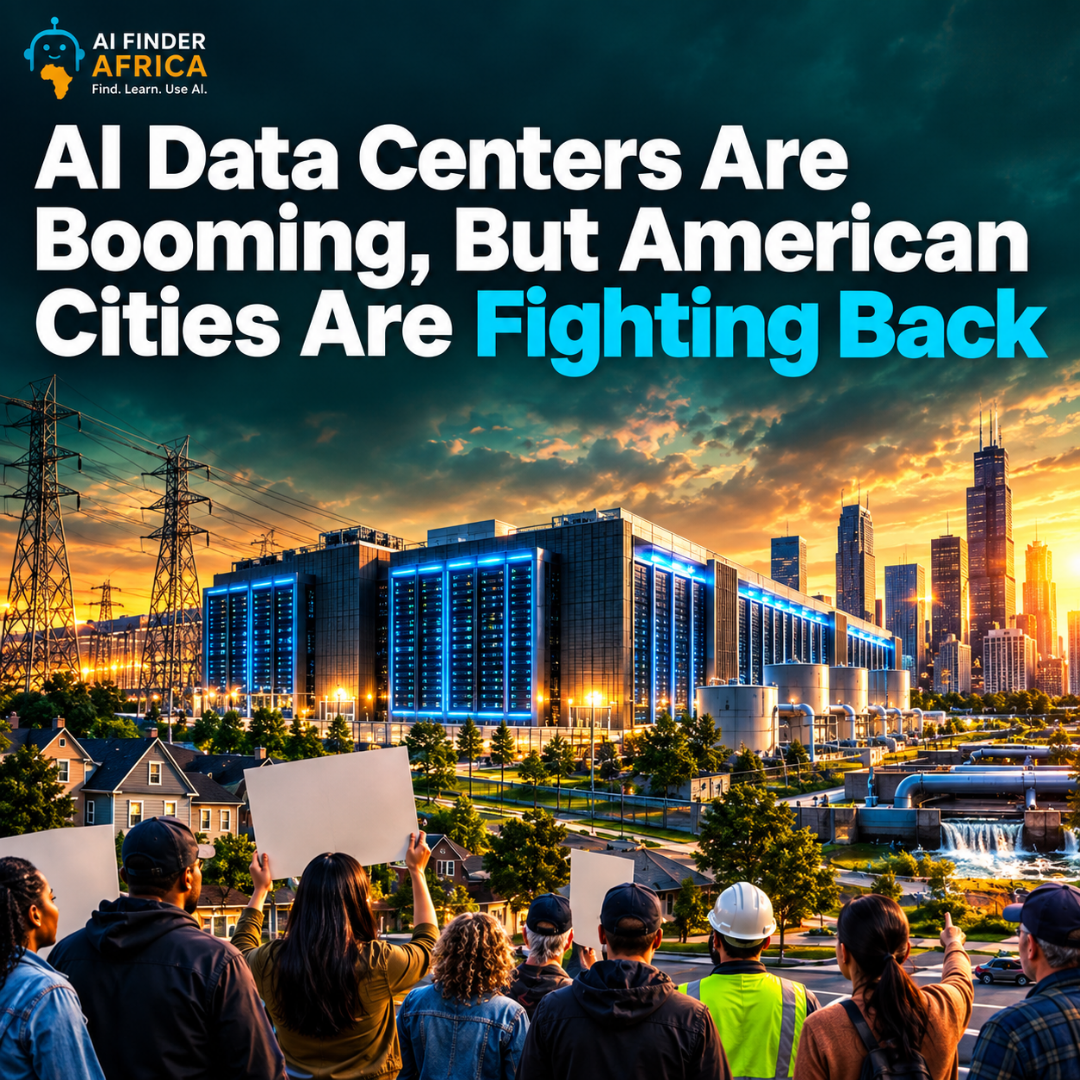
AI Data Centers Are Booming, But American Cities Are Fighting Back
AI Data Centers Are Booming, But American Cities Are Fighting Back
Artificial intelligence may live in the cloud.
But the machines powering it need very real things:
Land. Electricity. Water. Cooling. And enormous buildings.
And increasingly, those buildings are becoming a problem.
Across the United States, the race to build AI data centers is colliding with communities that have already spent decades dealing with pollution, industrial development, and strained infrastructure.
Philadelphia is becoming one of the latest battlegrounds.
The AI Boom Has Arrived at America’s Doorstep
For years, the AI conversation was mostly about chatbots, image generators, and increasingly powerful models.
Now there is another part of the story:
Where do all these AI systems actually live?
The answer is inside data centers, massive facilities filled with computing equipment that can consume huge amounts of electricity and require substantial water for cooling. And the demand is growing quickly.
Gallup reported in May that 70% of Americans opposed building an AI data center in their local area, including 48% who were strongly opposed. Concerns included environmental effects, electricity demand, and the potential impact on local utility bills. That means the AI infrastructure boom is running into something technology companies cannot simply solve with more GPUs:
local resistance.
Philadelphia Has a Complicated History With Big Industry
Consider Grays Ferry in Southwest Philadelphia.
For years, residents lived beside what was once the East Coast's largest oil refinery. The Philadelphia Energy Solutions refinery processed up to 335,000 barrels of crude oil a day before an explosion in 2019 led to its closure.
Now, years later, the neighborhood is once again at the center of an industrial debate. City officials have identified two potential locations for future data centers, including one in Grays Ferry and another in Northeast Philadelphia.
There is currently no formal data-center development proposal for those sites. But residents are not waiting around. More than 100 people gathered outside Philadelphia City Hall on September 14 to launch the No Data Centers in Philly campaign, calling for a three-year moratorium on new data-center construction.
For people who have already experienced the effects of heavy industry, the promise of a new wave of development brings an obvious question: What happens this time?
The Jobs Argument Is Not Winning Everyone Over
Data center developers and technology companies point to economic benefits. Construction creates work. New facilities require workers. Local governments can receive tax revenue. And the broader AI economy is generating enormous investment.
But critics argue that the long-term number of permanent jobs created by data centers may be relatively small compared with the amount of land, electricity, and infrastructure they require. That tension is becoming increasingly visible.
In Philadelphia, activists say they do not want another industrial project that provides economic benefits while leaving local residents to deal with the environmental and infrastructure costs.
City officials, meanwhile, are still discussing what role data centers should have in the city's future. Philadelphia City Council President Kenyatta Johnson has not committed to a moratorium.
So, this is not simply a fight between people who love technology and people who hate it. It is a much more practical question:
Who pays for the infrastructure needed to power the AI boom?
And Then There Is Electricity
Here is where the story gets even bigger. AI data centers do not just need computers. They need power and lots of it.
A new report analysis citing BloombergNEF projections says U.S. data centers could consume more natural gas by 2035 than Germany and Japan combined, reflecting the enormous amount of electricity expected to be needed as AI infrastructure expands. That does not mean every data center will literally run on natural gas.
Instead, the projection highlights a larger problem: where will all the electricity come from?
Utilities are already dealing with growing demand, while communities are worried about what additional infrastructure could mean for energy prices, water supplies and local environments. And the debate is no longer confined to Philadelphia.
New York Has Already Hit Pause
New York took a major step in July.
Governor Kathy Hochul signed an executive order creating a temporary moratorium on new hyperscale data centers while the state develops new standards for their construction and creates a framework for community benefits.
The state's stated goal is to make sure new projects do not simply shift infrastructure costs onto residents. That is becoming a recurring theme across America.
Several cities have also introduced or approved temporary pauses on data-center development as officials try to understand the potential impact before approving more projects. The idea is not necessarily to stop AI forever.
In many cases, the pause is about giving governments time to answer basic questions:
How much electricity will this facility use?
Who pays for new power infrastructure?
How much water will it consume?
What happens to nearby communities?
How many jobs will actually remain after construction ends?
The AI Race Has a Physical Cost
This is the part of the AI boom that is easy to forget. When someone asks ChatGPT a question, generates an image, or runs an AI agent, the experience feels almost weightless.
You type. The answer appears.
But behind that simple interaction are warehouses of computers running around the clock. As AI models grow more powerful, companies are building increasingly large facilities to provide the computing capacity they need. That creates a strange contradiction.
The technology is marketed as digital and almost invisible. Its infrastructure is anything but.
You can see the buildings. You can hear the cooling systems. You can measure the electricity.
And communities can feel the effects when infrastructure demand rises.
The Pushback Is Getting Harder to Ignore
Philadelphia is only one example. Across the US, residents and local governments are increasingly questioning whether the benefits of data centers justify their potential costs.
A recent New York Times/Siena poll reported by The Verge found that 61% of likely voters opposed constructing AI data centers, with environmental impact and effects on local communities among the concerns cited.
Meanwhile, data-center developers continue to push ahead because AI companies need more computing power.
That creates a fascinating collision:
Silicon Valley wants more capacity. Communities want more answers.
And governments are being forced to figure out how those two things can exist together.
AI Is Not Just a Software Story Anymore
That may be the biggest takeaway. The next chapter of AI will not be written entirely by engineers building smarter models. Energy companies, city planners, environmental regulators, local residents, and governments will also shape it by deciding where and under what conditions these giant computing facilities can be built.
The AI revolution may have started with software. But it is quickly becoming an infrastructure story. And for communities that have already experienced the consequences of large-scale industrial development, the question is not whether AI is exciting.
They want to know something much simpler:
What will it mean for the place they call home?
That question is becoming harder for the AI industry to ignore.




 Explore