


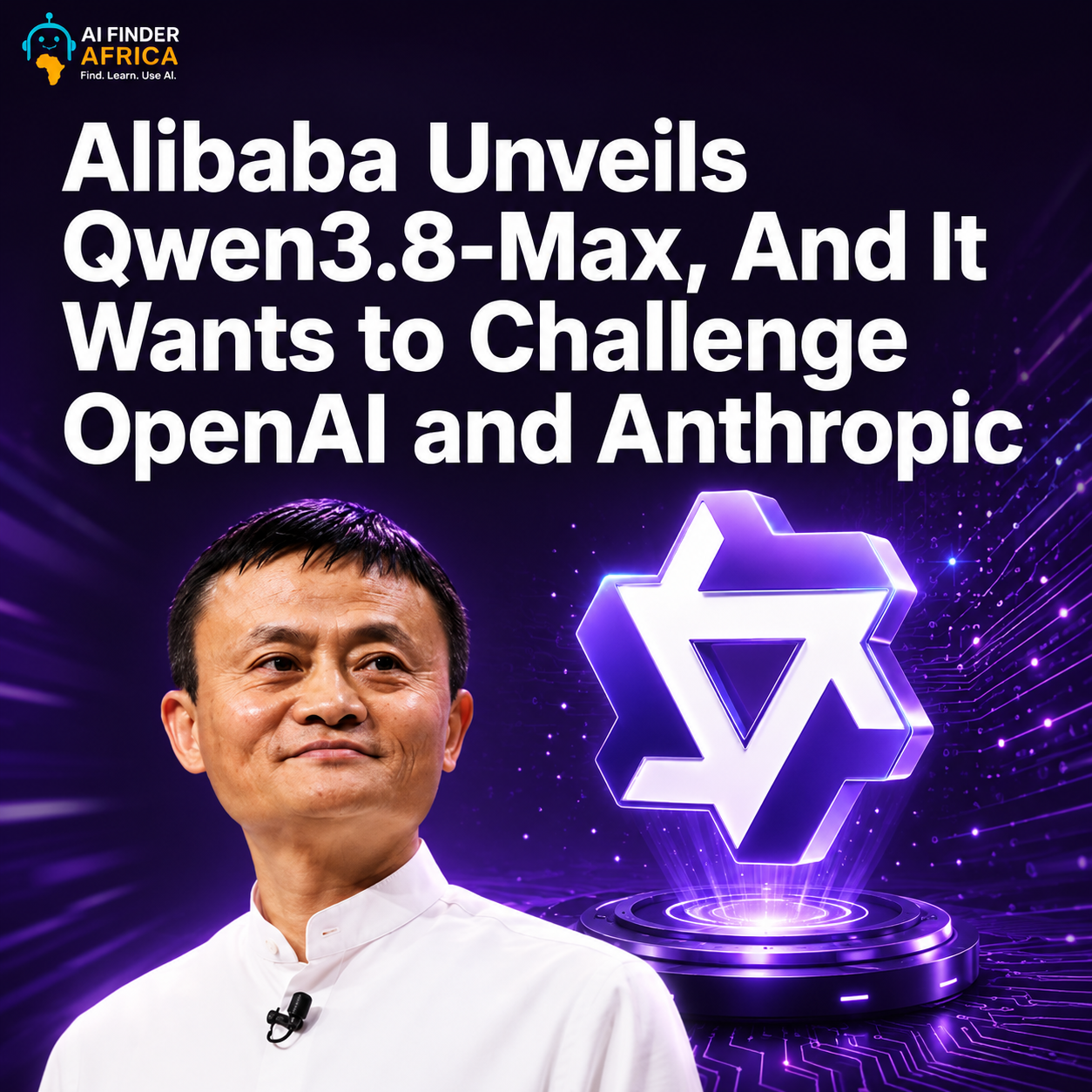
Alibaba Unveils Qwen3.8-Max, And It Wants to Challenge OpenAI and Anthropic
Alibaba Unveils Qwen3.8-Max, And It Wants to Challenge OpenAI and Anthropic
For years, the AI race has mostly been a battle between American companies.
OpenAI.
Anthropic.
Google.
Meta.
But that story is changing and fast.
Chinese tech giant Alibaba has just unveiled Qwen3.8-Max, its biggest and most powerful AI model yet, openly declaring that it is built to compete with the world's leading AI systems from OpenAI and Anthropic.
The announcement is not just another product launch. It is another sign that the global AI race is no longer a one-country competition.
China Is Closing the Gap
Not long ago, Chinese AI models were often viewed as being a generation behind their American rivals.
Today? That gap is shrinking.
Alibaba says Qwen3.8-Max delivers strong performance in advanced reasoning, coding, research, multimodal understanding, and long-context tasks areas traditionally dominated by models like GPT and Claude.
While independent testing will ultimately determine exactly where it ranks, the message from Alibaba is clear: China intends to compete at the highest level.
This Model Is Huge
One reason everyone is paying attention is its sheer size.
Qwen3.8-Max reportedly contains 2.4 trillion parameters, making it one of the largest AI models ever publicly announced. That is second only to a handful of frontier-scale systems and places it among the biggest models in the world today. But size alone does not guarantee intelligence.
Modern AI increasingly relies on architectures that activate only the parts of the model needed for each task, allowing these enormous systems to remain efficient despite their scale.
More Than Just a Chatbot
Alibaba says Qwen3.8-Max is designed for much more than answering questions.
The company claims it can:
Write and debug complex code, Perform deep research, Understand images and documents, Handle long, multi-step tasks, Support autonomous AI agents
It also supports an extremely large context window up to 1 million tokens, allowing it to process massive documents, books, or codebases in a single session.
For businesses building AI applications, that could unlock entirely new workflows.
Alibaba Is Choosing an Open-Weight Strategy
Perhaps the biggest surprise is not the model itself. It is how Alibaba plans to release it.
Unlike OpenAI and Anthropic, which keep their most advanced models closed, Alibaba says it will make Qwen3.8-Max available as an open-weight model, allowing developers to customize and fine-tune it for their own projects. That decision reflects a growing trend among Chinese AI companies to embrace open-weight AI, making advanced models more accessible to researchers and businesses around the world.
Why This Matters
The AI race is no longer only about who builds the smartest chatbot. It is becoming a battle over:
Open vs. closed AI
Cost vs. premium performance
Accessibility vs. proprietary control
Chinese companies are betting that making powerful models widely available will accelerate adoption and attract developers.
American companies, meanwhile, continue emphasizing safety, controlled deployment, and commercial APIs.
The result is two very different visions for the future of AI.
Investors Are Paying Attention
The announcement did not go unnoticed on Wall Street.
Alibaba's shares climbed after the launch as investors welcomed the company's latest push into frontier AI and its efforts to strengthen its position in one of the fastest-growing technology markets. AI has become one of Alibaba's biggest strategic priorities alongside its cloud business.
Can It Really Beat OpenAI?
That is the billion-dollar question.
Alibaba says Qwen3.8-Max performs competitively against leading American models on several internal benchmarks. Independent observers note that it appears to be among the strongest models developed in China, though public benchmark claims should always be interpreted cautiously until verified by broader testing.
In AI, today's leaderboard can change overnight.
The Bigger Picture
Just two years ago, most conversations about advanced AI revolved around Silicon Valley.
Today, the competition spans continents.
OpenAI is releasing increasingly capable GPT models.
Anthropic continues pushing Claude forward.
Google keeps improving Gemini.
Meanwhile, Chinese companies like Alibaba, Moonshot AI, DeepSeek, MiniMax, and ByteDance are rapidly narrowing the performance gap.
Whether Qwen3.8-Max ultimately proves to be the equal of OpenAI's best models remains to be seen. But one thing is already obvious. The next chapter of artificial intelligence will not be written by one country alone. It will be shaped by a global race where innovation is happening faster than ever before.



 Explore