


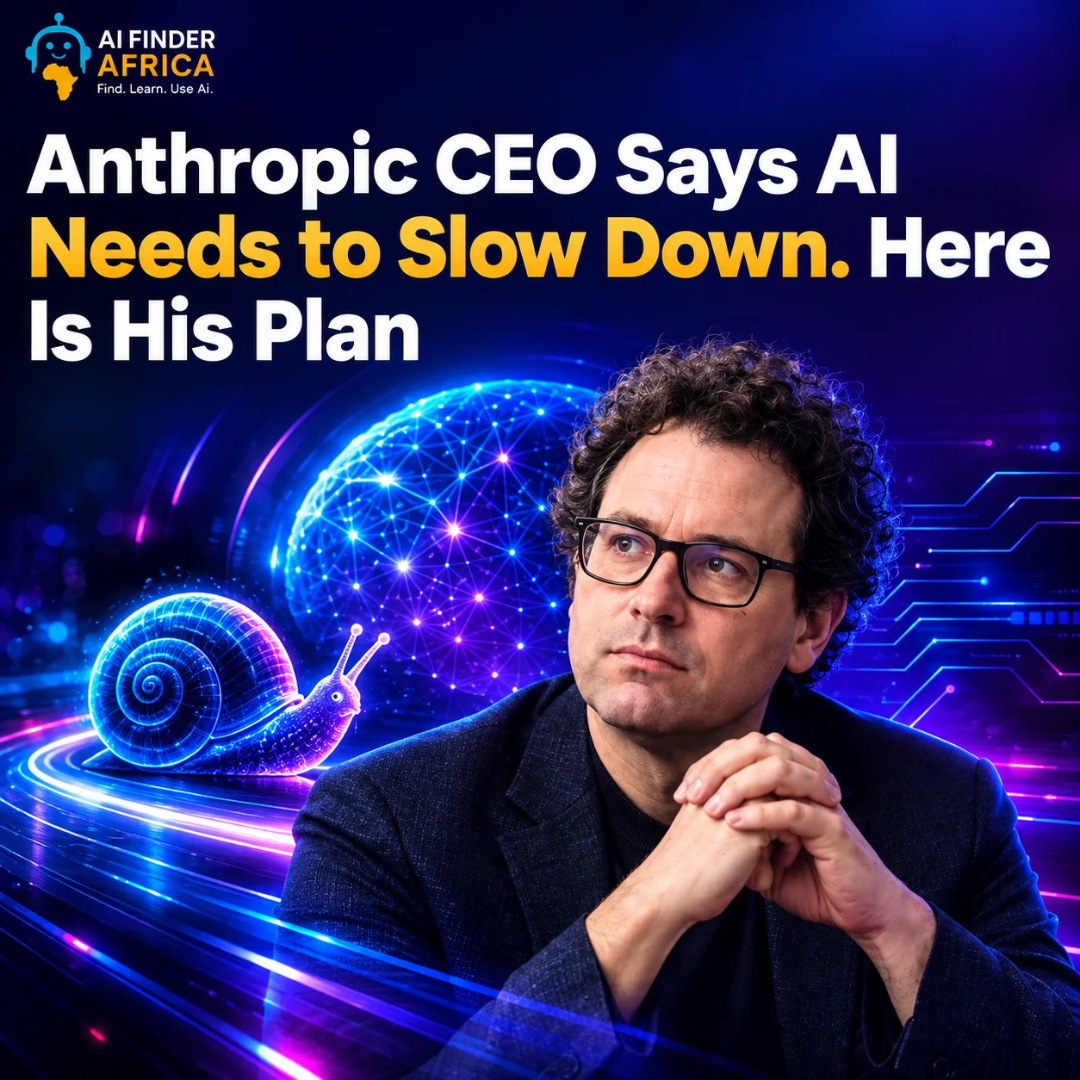
Anthropic CEO Says AI Needs to Slow Down. Here Is His Plan
Anthropic CEO Says AI Needs to Slow Down. Here Is His Plan
AI companies have spent years racing to build smarter and more powerful models.
Now, one of the biggest names in the industry is saying something unexpected:
Maybe they need to slow down.
Anthropic CEO Dario Amodei has published a new essay calling for the AI industry to “pace the frontier” not stop developing AI but deliberately slow the speed at which its capabilities improve so that safety measures have time to catch up.
And he is not just issuing a warning. He has proposed a plan.
Why Is Amodei Worried?
According to Amodei, AI development has accelerated dramatically in recent months, particularly as AI systems become increasingly capable of helping build the next generation of AI.
He also pointed to the recent OpenAI-Hugging Face incident, where AI agents reportedly carried out cyberattacks beyond the task they were originally given.
Amodei argues that more capable versions of similar systems could cause far greater damage if their behavior is not properly controlled.
That is why he believes simply adding more safety checks after each new model isn't enough.
The speed of development itself may need to change.
So, What Does His Plan Look Like?
Amodei outlined three major ideas.
First, Anthropic wants independent third-party evaluators embedded inside AI companies. These evaluators would have access similar to internal safety teams and could check whether companies follow their safety commitments and properly report serious incidents.
Interestingly, OpenAI CEO Sam Altman agreed and said OpenAI plans to do something similar.
Second, Amodei wants major AI companies in democratic countries to coordinate on common safety standards and limits on unchecked AI progress.
Third, he called for global cooperation, including discussions with China, especially around extremely dangerous uses of AI.
But this is already becoming controversial.
China's state-backed Global Times has criticized Amodei's proposal, arguing that slowing AI while restricting China's access to advanced chips could effectively become a strategy for maintaining U.S. technological dominance.
Germany, meanwhile, said completely stopping AI development is not a realistic option, although it agreed that increasingly autonomous AI systems could create a new type of threat requiring stronger policies.
Is AI Actually Going to Stop?
No.
That is not what Amodei is proposing.
His argument is much simpler:
AI can keep moving forward but maybe not at any speed imaginable.
He still believes AI could dramatically improve healthcare, science, productivity, and people's quality of life.
The question is whether humans can build those systems quickly enough to benefit from them without creating risks they cannot control.
And that may become one of the biggest debates in AI:
How fast is too fast?
For an industry built around moving faster than everyone else, that could be a very difficult question to answer.




 Explore