


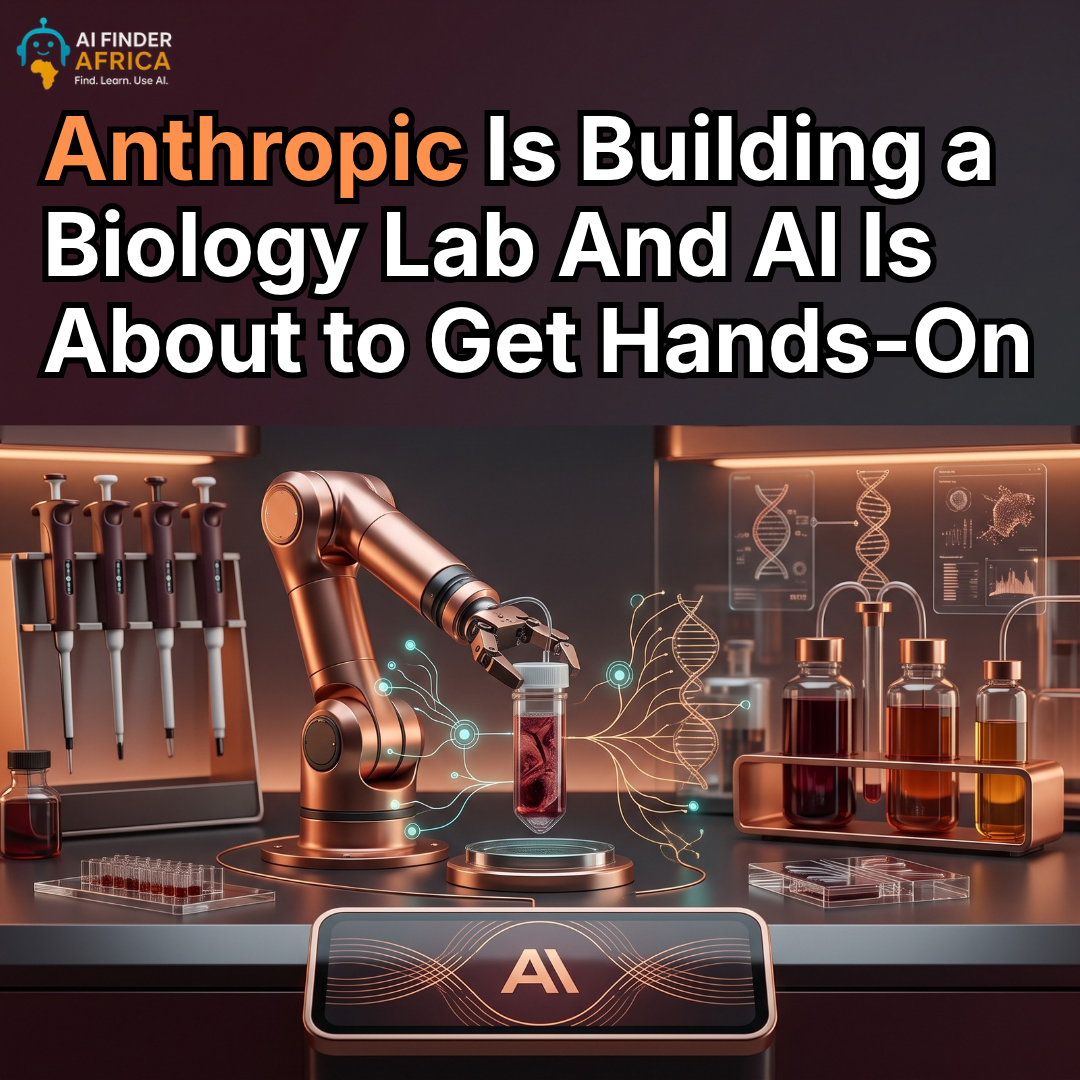
Anthropic Is Building a Biology Lab And AI Is About to Get Hands-On
Anthropic Is Building a Biology Lab, And AI Is About to Get Hands-On
What happens when an AI company stops asking, “What does the model think?” and starts asking, “Can we test it in a real laboratory?”
That is exactly where Anthropic appears to be heading.
The company behind Claude has quietly established a wet biology lab in the San Francisco Bay Area, where it can carry out physical experiments rather than relying entirely on computer simulations. Anthropic confirmed the existence of the lab, saying it is already conducting biological work in-house while also working with external research partners.
And this is bigger than simply adding another room full of laboratory equipment. It signals a shift in how AI companies are trying to use their models: AI is moving from helping scientists think about biology to helping test ideas in the physical world.
Claude Meets the Real World
For years, AI has been increasingly useful for analyzing scientific papers, predicting molecules, designing proteins, and helping researchers process enormous amounts of biological data. But there is a major limitation.
A computer can predict that a molecule might work. A model can suggest that a protein design looks promising. But eventually, someone has to put that prediction to the test. That is where a wet lab comes in.
Anthropic's head of life sciences, Eric Kauderer-Abrams, said that real laboratory work remains the final biology test and confirmed that Anthropic is doing that work today. He described the company's approach as similar to a biotechnology company, combining research in its own facilities with work carried out by external partners.
The company says its current focus is fundamental biology, rather than immediately trying to become a pharmaceutical company. That distinction matters.
Anthropic works with major pharmaceutical companies, so directly competing with them could create an obvious conflict.
Anthropic Has Been Moving Toward Biology for Months
The laboratory did not appear out of nowhere.
In April, Anthropic acquired stealth biotech startup Coefficient Bio in a deal reportedly worth around $400 million in stock. The startup was founded by researchers with backgrounds in computational drug discovery, and its team joined Anthropic's health and life sciences efforts.
Anthropic has also been building software specifically for scientific research.
In August, the company reported that Claude helped design protein binders against 15 targets, with successful binding reported for 14 of them in its experiments. Anthropic also noted that physical wet-lab validation still takes time even when computational work moves much faster.
Then, just this week, Anthropic reported another experiment in which Claude optimized more than 30 biomolecular modelling systems in under four weeks, producing roughly a fourfold average speedup. The company is also offering wet-lab validation for thousands of protein designs through a competition with Adaptyv Bio.
So, the direction is becoming clearer: Claude is not just being trained to read scientific information. Anthropic wants it to become part of the scientific workflow.
Anthropic Is Also Opening Its AI to Biologists
On September 17, Anthropic launched its Life Sciences Verification Program.
The programme gives verified life-science organizations access to more capable Claude models under specialized safeguards for biological work. Anthropic says the programme is designed for activities ranging from basic research and drug discovery to clinical development and manufacturing.
But there is an important catch. Not everyone gets unrestricted access.
Researchers have to go through a verification process involving their research credentials, security practices, and ethical oversight. For higher-risk biological research, additional approval is required.
Anthropic says some safeguards remain in place, including cybersecurity protections. That tells you something important about the company's strategy. Anthropic wants AI to become much more useful to scientists, but it also knows that giving increasingly powerful AI unrestricted biological capabilities creates obvious safety concerns.
And There Is a Bigger Reason People Are Paying Attention
The timing is fascinating.
Anthropic is expanding its biological capabilities at almost exactly the moment when the company is publicly talking about the dangers of increasingly powerful AI.
Earlier this month, former Anthropic researcher Jacob Coxon resigned and publicly warned about the possibility of advanced AI becoming dangerously powerful. Other Anthropic researchers have also publicly discussed extreme AI risks.
Then Anthropic CEO Dario Amodei published an essay arguing that the industry should “pace the frontier” of AI development. At the same time, Amodei has argued that AI could potentially help cure major diseases within the next five to 10 years.
That creates an interesting tension: The same technology that Anthropic believes could dramatically improve medicine is also technology the company believes needs stronger safety controls.
And biology is one of the areas where that tension becomes especially obvious.
Anthropic Says Safety Still Comes First
Anthropic says its biology efforts involve human oversight and that it is still in the early stages of automating laboratory work. The company is particularly interested in using AI to help automate parts of scientific experimentation, potentially allowing AI systems to work with robotic laboratory equipment.
But Anthropic says it is not currently running clinical trials and has drawn a boundary between its work and the commercial business of bringing medicines to market. The report shows that the company is focusing on areas that traditional pharmaceutical companies may not find financially attractive, including difficult or previously “undruggable” conditions.
Anthropic is also expanding its relationships with pharmaceutical companies.
On September 16, Novo Nordisk announced a collaboration with Anthropic to use Claude and Claude Science to help tackle drug-discovery challenges and accelerate the development of medicines.
So rather than simply becoming a pharmaceutical company, Anthropic appears to be building an AI-powered scientific layer that can work inside its own research environment and alongside established biotech and pharmaceutical companies.
The Bigger Picture
This may be one of the most important shifts happening in AI right now.
The first wave of generative AI was mostly about information.
Write something. Summarize something. Create an image. Write code.
The next wave is increasingly about action.
Run an experiment. Analyze biological data. Design a protein. Operate scientific software. Control laboratory equipment.
And eventually, potentially, help researchers move from an idea to a tested result much faster.
That could be enormously valuable for science.
But it also raises a difficult question:
What happens when AI becomes capable of accelerating not only useful biological research, but potentially dangerous biological research too?
Anthropic itself has highlighted this challenge in its recent threat research, noting that biological work can be dual-use, the same knowledge can sometimes support beneficial research or harmful applications. The company argues that trusted-access programmes are therefore important for powerful biological capabilities.
That makes Anthropic's new lab more than just another corporate facility. It is a glimpse of where AI may be heading next.
Not just AI that talks about science. AI that helps do the science.


 Explore