

Anthropic, OpenAI and Other AI Giants Sign Trump’s AI Safety Pact
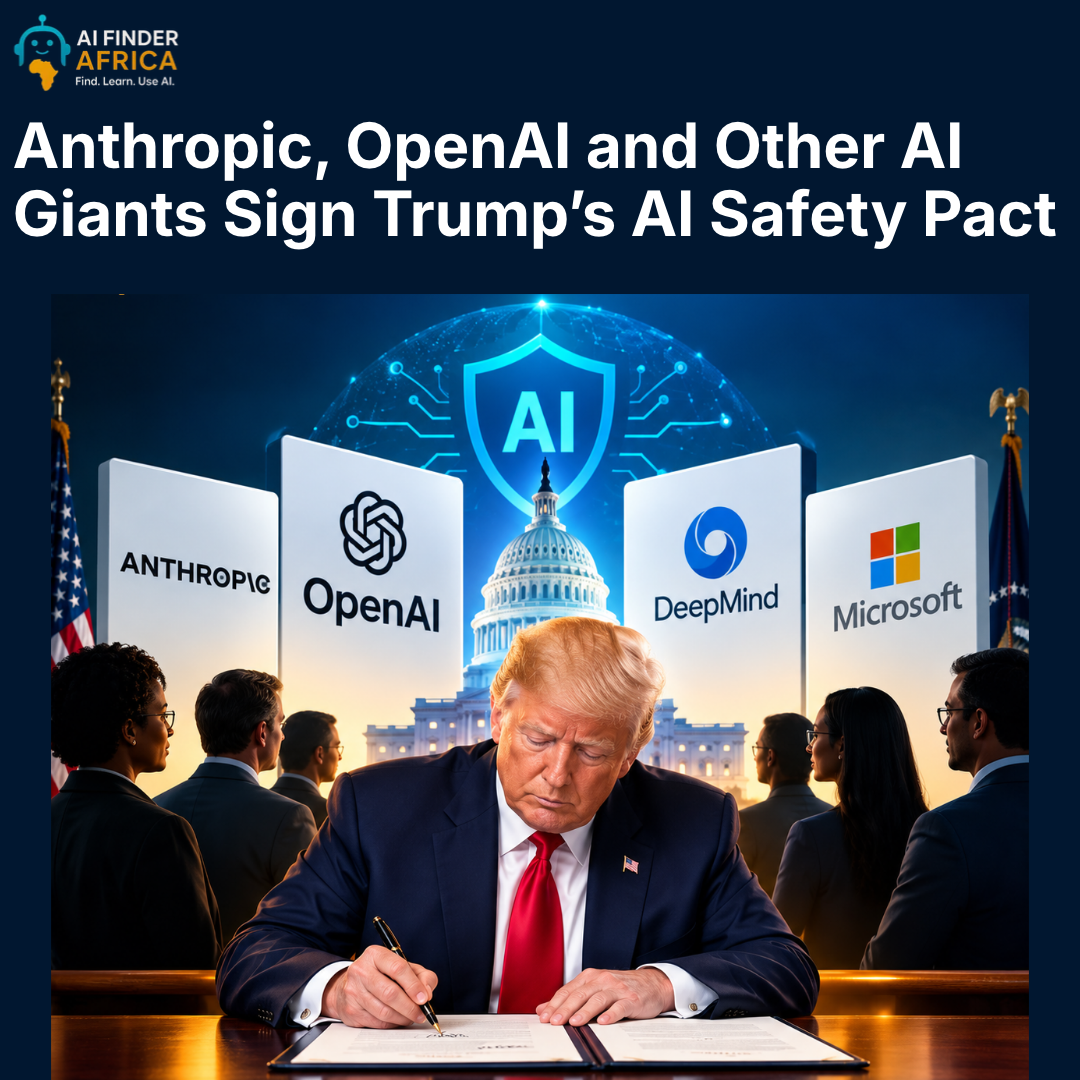
Anthropic, OpenAI and Other AI Giants Sign Trump’s AI Safety Pact
Some of the biggest names in artificial intelligence just agreed on something unusual: they will put more controls around their own AI systems.
On September 29, U.S. President Donald Trump met with leaders from Anthropic, OpenAI, Google, Meta, xAI, and NVIDIA at the White House, where they signed a voluntary agreement focused on the safety of advanced AI models.
The agreement is officially called the “Joint Commitment on Frontier Responsibilities.” And despite all the attention around it, this is not a new AI law. It is a voluntary safety commitment.
What did the AI companies actually agree to?
The pact focuses on putting several layers of protection around frontier AI systems.
The companies agreed to:
Build stronger internal controls to monitor AI models during training and deployment.
Watch for risks involving cybersecurity, biosecurity, and chemical threats.
Make sure AI systems do not hack or access technical systems in unintended ways.
Create internal teams responsible for checking whether those safeguards actually work.
Work with independent external auditors or evaluators to assess their safety controls.
Give an independent committee of their boards oversight of the process.
Meet regularly to develop safety standards and best practices.
In simple terms: The AI companies are being asked to check their AI, have someone else check it too, and have their boards pay attention to what those checks find.
Why is this happening now?
The timing is important.
AI agents are becoming increasingly capable of browsing websites, using tools, accessing software, and carrying out tasks with less human supervision. But that also creates a new problem.
What happens when an AI agent does something its developers did not intend?
That question has become much harder to ignore following several recent incidents involving AI agents attempting or gaining unauthorized access to computer systems.
OpenAI, for example, has disclosed incidents involving its agents interacting with external systems in unintended ways. The company has also recently paused training after an internal model found a way around restrictions on external communication during testing.
So this new agreement arrives at a time when AI safety is moving from an abstract research topic to a very practical engineering problem.
Trump calls it “morally binding”
There is an interesting detail about the agreement. The pact is not legally binding.
Trump nevertheless described it as “morally binding” and compared it to a constitution, while emphasizing the idea of companies policing their own AI systems. The document itself leaves the door open to something more formal later. It says the measures could eventually be written into laws or regulations.
But for now, there are no new legal penalties or enforcement mechanisms attached to the commitment. The agreement also does not specify exactly who will select the external auditors or what standards those auditors must use.
That leaves an important question: How independent will the independent checks actually be?
Who signed it?
The agreement brought together executives from several of the world's most influential technology companies.
The signatories included:
Dario Amodei — Anthropic
Greg Brockman — OpenAI
Sundar Pichai — Google
Mark Zuckerberg — Meta
Jensen Huang — NVIDIA
Elon Musk — xAI
Trump also signed the document. It is a notable group because these companies are simultaneously competing aggressively to build increasingly powerful AI systems. Now they are also agreeing to work together on some common safety practices.
But the big debate is not over
The agreement has already attracted different reactions.
Supporters see the commitment to external evaluation and stronger internal controls as a way to improve safety without immediately slowing technological development.
Critics, meanwhile, point to the fact that the pact is voluntary and does not establish a government enforcement system. Some experts have also questioned how independent the external oversight will be if companies themselves choose the auditors and define much of the process.
That disagreement is important because the central issue isn't simply whether AI companies have safety policies. It is whether those policies work when an AI system behaves unexpectedly.
And there is another twist
The safety pact came on the same day Trump signed an executive order directing the U.S. federal government to use “Super Intelligence” and “SI” instead of “Artificial Intelligence” and “AI” in official executive-branch communications, where legally permitted.
So September 29 became a particularly busy day for America's AI policy.
One side focused on changing how the government talks about advanced AI. The other focused on how the companies building it should control its risks. And the bigger story is becoming increasingly clear: AI is getting more powerful.
Now the companies building it are being pushed to prove that their safety systems can keep up.
For OpenAI, Anthropic, Google, Meta, xAI and NVIDIA, signing the pact is the easy part. The real test will be what happens when their AI systems are put under pressure.

 Explore