


China Just Did the Impossible: Storing Data With a Single Electron
China Just Did the Impossible: Storing Data With a Single Electron
Imagine trying to store an entire library using just one drop of water.
It sounds impossible. But that is essentially what a team of Chinese researchers has achieved in one of the most exciting semiconductor breakthroughs of the year.
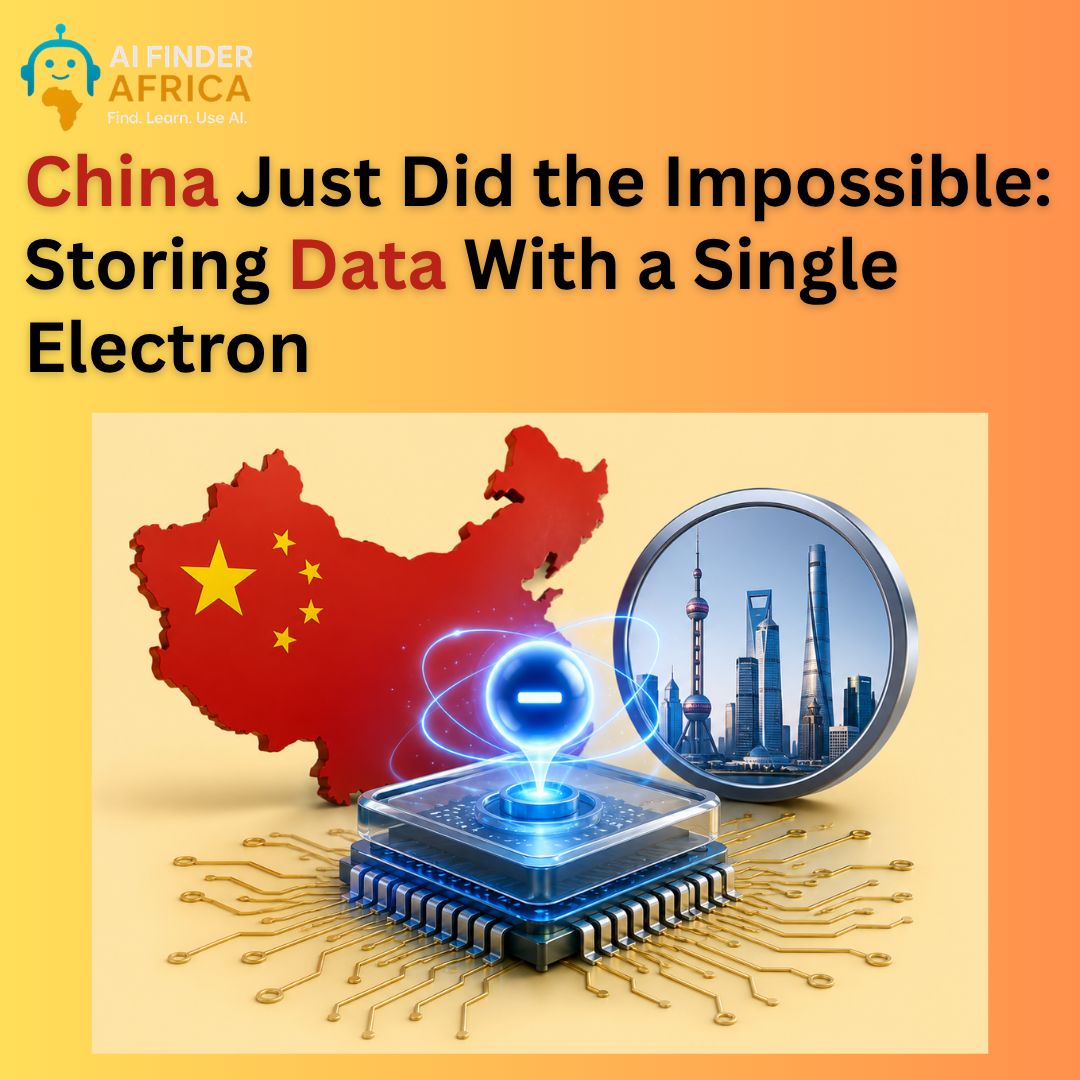
Scientists at Fudan University in Shanghai have developed an experimental memory chip capable of storing a single bit of information using just one electron, a feat many experts once believed was practically impossible.
If the technology lives up to its promise, it could pave the way for AI-powered smartphones that run advanced chatbots locally, consume far less power, and remember conversations without constantly relying on the cloud. While the technology is still in its early stages, it has already sparked excitement across the global semiconductor industry.
Why This Is Such a Big Deal
Today's AI systems have one major weakness. They need huge amounts of memory.
Whether you are chatting with an AI assistant, generating images, or running large language models, modern AI depends on memory chips that constantly store and retrieve information.
The problem? Those memory chips consume a tremendous amount of power.
For example, today's leading DRAM memory chips from companies like Samsung and SK hynix typically require around 200,000 electrons to reliably store a single bit of data.
The larger that number becomes, the more electricity the chip needs to operate. Now imagine reducing that requirement from 200,000 electrons to just one. That is exactly what Fudan University's research team says they have accomplished.
Their findings were published in the prestigious journal Science in July 2026, marking one of the most significant advances in experimental memory technology in recent years.
Meet "Guiyi"
The new chip is called Guiyi, a name inspired by a Chinese Buddhist saying that roughly translates to "returning to one."
The symbolism is fitting. Instead of relying on thousands or even hundreds of thousands of electrons to store information, Guiyi operates using a single trapped electron.
For decades, researchers attempted something similar. The biggest challenge was not storing one electron. It was detecting it.
A single electron produces an incredibly weak electrical signal, making reliable reading almost impossible. Previous attempts failed because those tiny signals disappeared into electrical noise before they could be measured.
The Breakthrough That Changed Everything
The Fudan team tackled the problem using graphene, an ultra-thin material known for its remarkable electrical properties. By redesigning the chip's internal structure, they created a system capable of trapping individual electrons while dramatically amplifying their signals.
According to the researchers, the new architecture boosts the detectable signal to approximately 0.5 volts, roughly ten times stronger than previous single-electron memory demonstrations.
In simple terms, they made something almost invisible suddenly visible. That breakthrough is what transformed decades of theoretical research into a functioning prototype.
What Could This Mean for AI?
This is where things become especially interesting.
Large language models like ChatGPT, Gemini, Claude, and DeepSeek require enormous amounts of memory. That is one reason smartphones still struggle to run the most advanced AI models entirely on device.
Instead, many AI requests are sent to cloud servers. A memory technology like Guiyi could eventually change that. Because it requires dramatically less energy, future versions could enable:
AI chatbots that run directly on smartphones. Longer battery life for AI-powered devices. Faster responses without depending on internet connections. Better conversational memory with much lower power consumption. While commercial products are still years away, the research points toward a future where powerful AI becomes far more portable and energy efficient.
More Than Just Smaller Memory
The researchers also reported discovering two new quantum behaviors during development:
Programming voltage quantization, Self-limiting programming
Although these sound highly technical, they could eventually allow future memory chips to store multiple quantum states, dramatically increasing storage capacity beyond today's conventional binary systems. In other words, future memory chips may not simply become smaller; they could become significantly smarter as well.
From the Lab to the Market
Professor Zhou Peng, who led the research, says the team plans to launch a startup later this year to commercialize the technology.
According to Zhou, the goal is to bring Guiyi into commercial production within three to five years. He believes the technology could eventually challenge the current memory giants, including Samsung and SK hynix, which dominate today's global memory market. That is an ambitious goal but not an impossible one.
This Is Not Their First Breakthrough
Interestingly, Guiyi is not Fudan University's first major innovation.
In 2025, the same research team introduced PoX, a record-breaking non-volatile memory technology recognized for its exceptional speed. They later developed Changying, the world's first hybrid flash memory architecture combining two-dimensional materials with traditional silicon manufacturing.
Those achievements helped establish the team as one of China's leading semiconductor research groups. Guiyi now represents another major step in that journey.
The Bigger Picture
Artificial intelligence is not advancing only because software keeps getting smarter. It also depends on better hardware. Every improvement in memory, processing power, and energy efficiency unlocks new possibilities for AI. Guiyi will not replace today's memory chips overnight.
It is still an experimental technology that must overcome manufacturing, cost, and scalability challenges before reaching consumer devices. But if it succeeds, it could mark one of the most important shifts in AI hardware in years.
For now, one thing is clear:
Sometimes, the biggest technological breakthroughs do not come from adding more.
They come from proving you can do the same job with just one tiny electron.




 Explore