


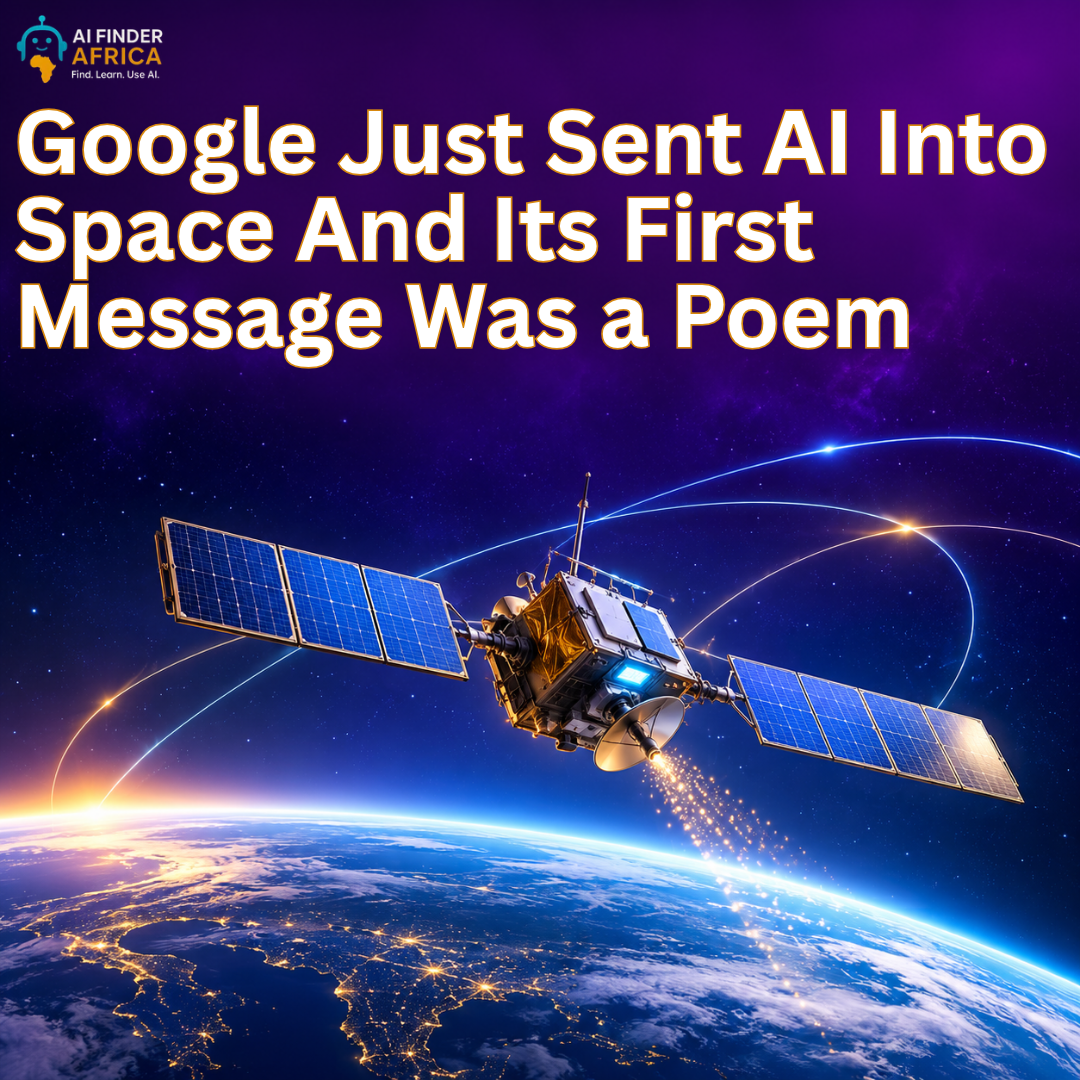
Google Just Sent AI Into Space And Its First Message Was a Poem
Google Just Sent AI Into Space And Its First Message Was a Poem
Google has taken artificial intelligence somewhere it has never operated quite like this before: space.
And its first successful message from orbit was not a technical report or a complicated calculation. It was a short poem about Earth.
On October 30, 2026, Google announced that its experimental Project Suncatcher satellite had successfully run an AI model in orbit and transmitted its first response back to Earth. The prompt came from engineers on the ground, who asked the satellite's onboard Gemma 4 model to write a haiku about being in space.
Its response was:
Blue marble below
Data streams in silent grace
Starlight feeds my core.
It might sound like a simple experiment, but the achievement represents an important step towards Google's bigger ambition: building AI computing infrastructure in space.
What Exactly Is Google's Project Suncatcher?
Project Suncatcher is Google's long-term research project exploring whether AI data centers could eventually operate in orbit around Earth. The idea is straightforward but ambitious.
AI systems require enormous computing power, and that means data centers need large amounts of electricity, cooling equipment, and physical infrastructure. Google is exploring whether satellites equipped with solar panels and powerful AI chips could provide an alternative.
In space, satellites can receive sunlight for much longer periods than solar installations on Earth, potentially generating significantly more solar energy over time.
Google's long-term vision involves networks of smaller satellites working together to handle AI computing tasks. Instead of relying entirely on massive buildings filled with servers, some AI processing could eventually happen hundreds of kilometres above the planet.
However, this is still an experimental project. Google is not operating a commercial space data center yet. Its current mission is focused on finding out whether the technology can survive and function reliably in orbit.
The Satellite Has Four AI Chips, But There Is a Catch
The prototype satellite launched on October 1, 2026, aboard a SpaceX Falcon 9 rocket as part of the Transporter-18 rideshare mission.
Google developed the AI computing technology in partnership with Planet, a satellite company.
Onboard are four of Google's Tensor Processing Units (TPUs), specialized chips designed to handle demanding AI workloads. The satellite can generate up to approximately one kilowatt of electrical power.
However, one important limitation remains: the satellite cannot run all four TPUs simultaneously. Its available power means it can operate only one at a time, and only for short periods of roughly 20 minutes. That makes this mission very different from a traditional data center, where thousands of processors can work continuously.
For now, the satellite is essentially a small experimental laboratory in orbit, helping Google understand what it would take to operate much larger AI systems in space.
Why Running AI in Space Is So Difficult
Getting AI chips into orbit is one challenge. Keeping them working properly once they get there is another.
On Earth, data centers rely on sophisticated cooling systems to prevent processors from overheating. In space, there is no ordinary airflow to carry heat away. Google is therefore testing specialized heat pipes and radiators designed to move heat away from the processors and release it into space.
Radiation is another major concern.
Space exposes electronic equipment to particles that can interfere with computer memory and calculations. These disturbances can cause what engineers call bit flips, where stored digital values change unexpectedly. That may sound like a minor technical issue, but even a small error could affect an AI system's output or interrupt a computing task.
Google has already conducted radiation tests on Earth, but operating the chips in actual space conditions will provide more reliable evidence of how they perform. The current satellite will help researchers study these challenges, including temperature changes, radiation exposure, and the reliability of AI processing in orbit.
What Is Next for Google's Space AI Project?
The successful poem is only the beginning.
Google plans to launch two additional satellites in 2027. Unlike the current prototype, these spacecraft will help test how multiple satellites can communicate and work together.
One of the most important technologies being explored is optical communication, which uses lasers to transmit information between satellites. This matters because Google's ultimate goal is not simply to put individual AI chips in space. It wants to create interconnected satellite networks capable of sharing computing workloads.
If successful, these networks could eventually support much larger AI operations in orbit.
However, building such infrastructure will require major advances in satellite technology, cooling systems, communication networks, and launch costs. Google is looking towards the 2030s for the potential economic viability of space-based AI infrastructure, not an immediate commercial rollout.
Is Space the Future of AI Data Centres?
Google's experiment comes at a time when the demand for AI computing power is increasing rapidly.
Technology companies are investing heavily in data centers, advanced processors and energy infrastructure to support increasingly powerful AI systems.
Space-based computing offers an interesting possibility: using solar energy in orbit to support some of the world's future computing needs.
But there are still serious questions about cost, maintenance, radiation protection, cooling, and how to transport enough equipment into orbit.
For now, Google's achievement is proof of an important concept, not proof that space data centers are ready to replace those on Earth.
Still, the fact that an AI model has successfully processed a prompt aboard a satellite and sent its response back to Earth is a remarkable milestone. And perhaps the most interesting part is that the first message from Google's experimental space computer was not a complicated technical answer.
It was a poem.
The future of AI infrastructure may be much bigger than the buildings we currently call data centers. It may eventually extend beyond Earth itself.




 Explore