


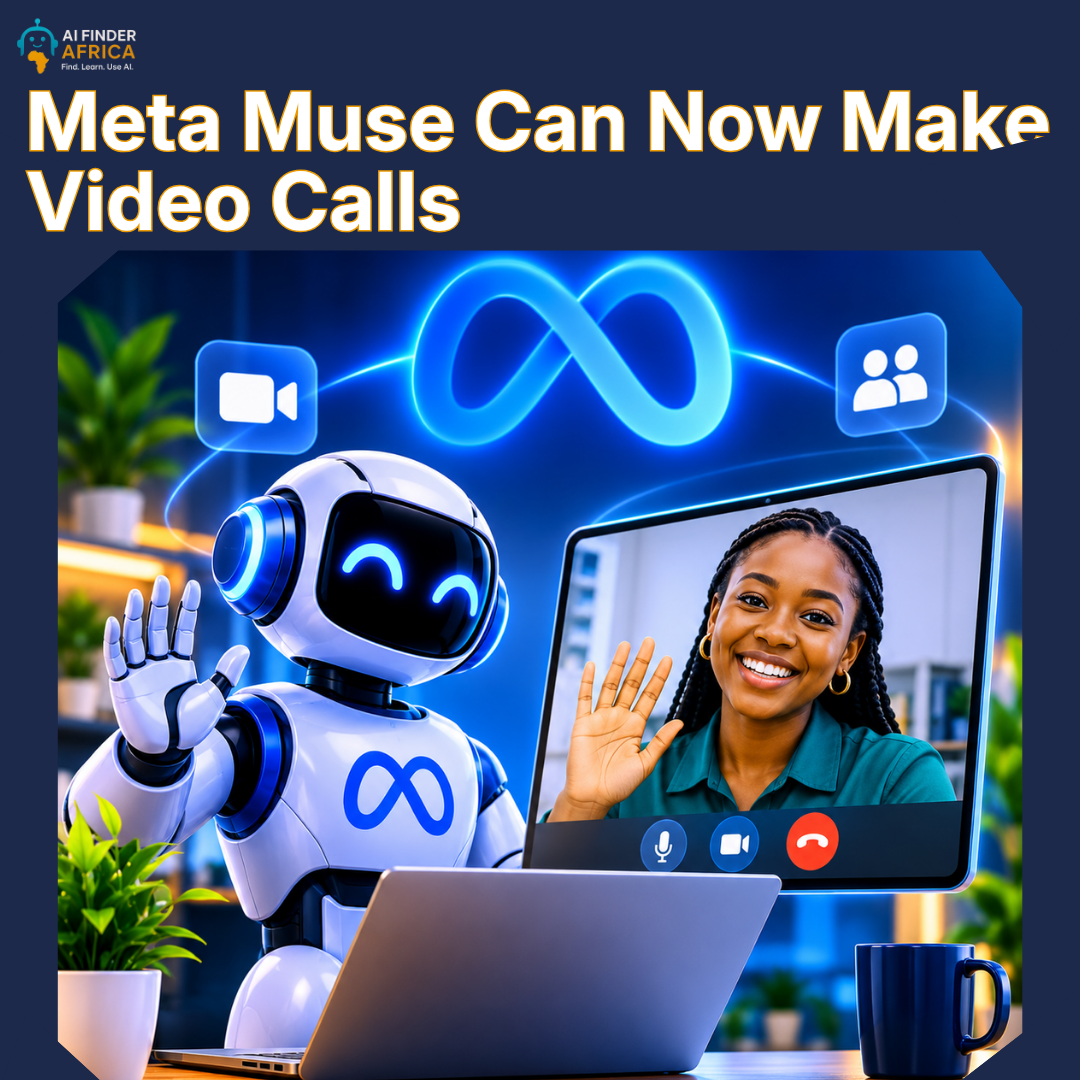
Meta Muse Can Now Make Video Calls
Meta Muse Can Now Make Video Calls
Imagine picking up your phone, tapping a button, and having a video conversation with an AI assistant that actually talks back, moves its face, and reacts to what you are saying.
Not a recorded video. Not a pre-programmed character. A live conversation where you can ask questions, interrupt the AI, and receive responses almost instantly.
Sounds unusual, right?
Well, Meta is bringing that experience to its personal AI assistant, Muse.
On November 5, 2026, Meta announced that users in the United States can now make real-time voice and video-style calls with their Muse AI assistants. But there is something that makes this different from the usual AI voice assistants: Muse does not just talk. It has a face, expressions, and a personality you can customize.
And this could change how people interact with AI assistants.
Meet Muse: Meta's AI Assistant Is Getting a Face
Muse is Meta's personal AI agent designed to do more than answer questions.
Introduced in September 2026, it was built to help people handle everyday tasks, organize their activities, work on projects, and achieve personal goals.
Now, Meta is giving it another interesting ability: real-time conversations through animated digital avatars. The technology behind this experience combines two AI systems: Muse Realtime Voice and Muse Realtime Avatar.
Muse Realtime Voice handles the conversation, allowing the assistant to listen and respond naturally. Meanwhile, Muse Realtime Avatar brings the character to life with facial expressions, movements, and gestures that match the conversation.
So, when Muse speaks, its avatar can smile, move, and react to the tone of the discussion. It makes interacting with AI feel a little more like talking to another person.
You Can Choose What Your AI Assistant Looks Like
Here is where things get even more interesting.
Meta is not forcing everyone to use the same AI character.
Users can customize their Muse avatar to look like different people, animals or even other creative characters. You can also choose from hundreds of voice options and adjust the personality and sound of your assistant.
For example, you could have a friendly, animated dog as your AI companion, a human-like character or something completely different.
Meta's Chief AI Officer, Alexandr Wang, demonstrated the feature using a fluffy white dog as his personal Muse avatar. The character responded to his comments with expressions and suggestions, showing how the technology can make conversations feel more engaging.
Essentially, you are not just choosing an AI assistant. You are also choosing how you want that assistant to appear and sound.
You Can Interrupt It While It Is Talking
One of the biggest improvements is how naturally the conversations flow.
With traditional AI voice interactions, you sometimes have to wait for the assistant to finish speaking before asking another question.
Muse is designed to make that experience more flexible.
You can interrupt it while it is responding, change the direction of the conversation, and ask follow-up questions without restarting everything.
For instance, imagine you are preparing for a job interview.
You can ask Muse to act as an interviewer, ask you questions, and respond to your answers. If you want to change something or ask for clarification, you can jump into the conversation immediately. You can also use it to brainstorm business ideas, practice presentations, plan trips, or talk through a difficult decision.
And because Muse can continue working on tasks while you talk, the idea is to make AI assistance feel less like sending prompts and more like having an ongoing conversation.
You Do Not Have to See the Avatar All the Time
Meta understands that not everyone wants an animated character occupying their screen during every conversation. That is why Muse offers three different ways to interact.
Voice only: Have a normal spoken conversation without displaying the avatar.
Avatar alongside chat: Keep the animated character visible beside your conversation.
Full-screen experience: Display the avatar across the screen for a more face-to-face interaction.
The feature is available through the Muse app on mobile, the web, and Mac. To start a conversation, users simply tap the phone icon in the top-right corner of the Muse interface.
One important clarification: this is not a conventional video call where Muse watches your face through your phone camera. The avatar responds to your voice and the conversation, rather than visually seeing you.
Is Meta Muse Available to Everyone?
Not yet.
Meta announced the rollout for users in the United States, with availability across mobile, web, and Mac. The company has also confirmed plans to bring real-time voice conversations to its AI glasses and its upcoming Muse Charm device.
This means people could eventually interact with their AI assistant without constantly holding their phones. Imagine walking around, asking your AI assistant questions and receiving spoken responses directly through a wearable device. That is the direction Meta is exploring.
However, users outside the United States, including Nigeria, will have to wait for wider availability.
Why This Update Matters for the Future of AI
For a long time, interacting with AI meant typing a question, waiting for an answer, and then typing another prompt.
Voice assistants changed some of that experience, but Meta is taking things further by introducing animated characters that can participate in real-time conversations. And this is about more than making AI look attractive.
The bigger idea is to make AI assistants easier and more natural to use in everyday situations.
Instead of thinking about the perfect prompt, you can simply talk through an idea, ask questions as they come to mind, and allow your assistant to follow the conversation.
It also shows where the competition among AI companies is heading. Companies are no longer competing only on how intelligent their AI models are. They are also competing on how people interact with them and how useful those interactions become.
Meta wants Muse to become an AI assistant people can communicate with throughout their day, whether through a smartphone, computer, or wearable device. And with real-time avatars now entering the picture, that experience is becoming increasingly personal.
The interesting question is no longer whether AI can talk to us. It is how naturally we will be able to interact with it.




 Explore