


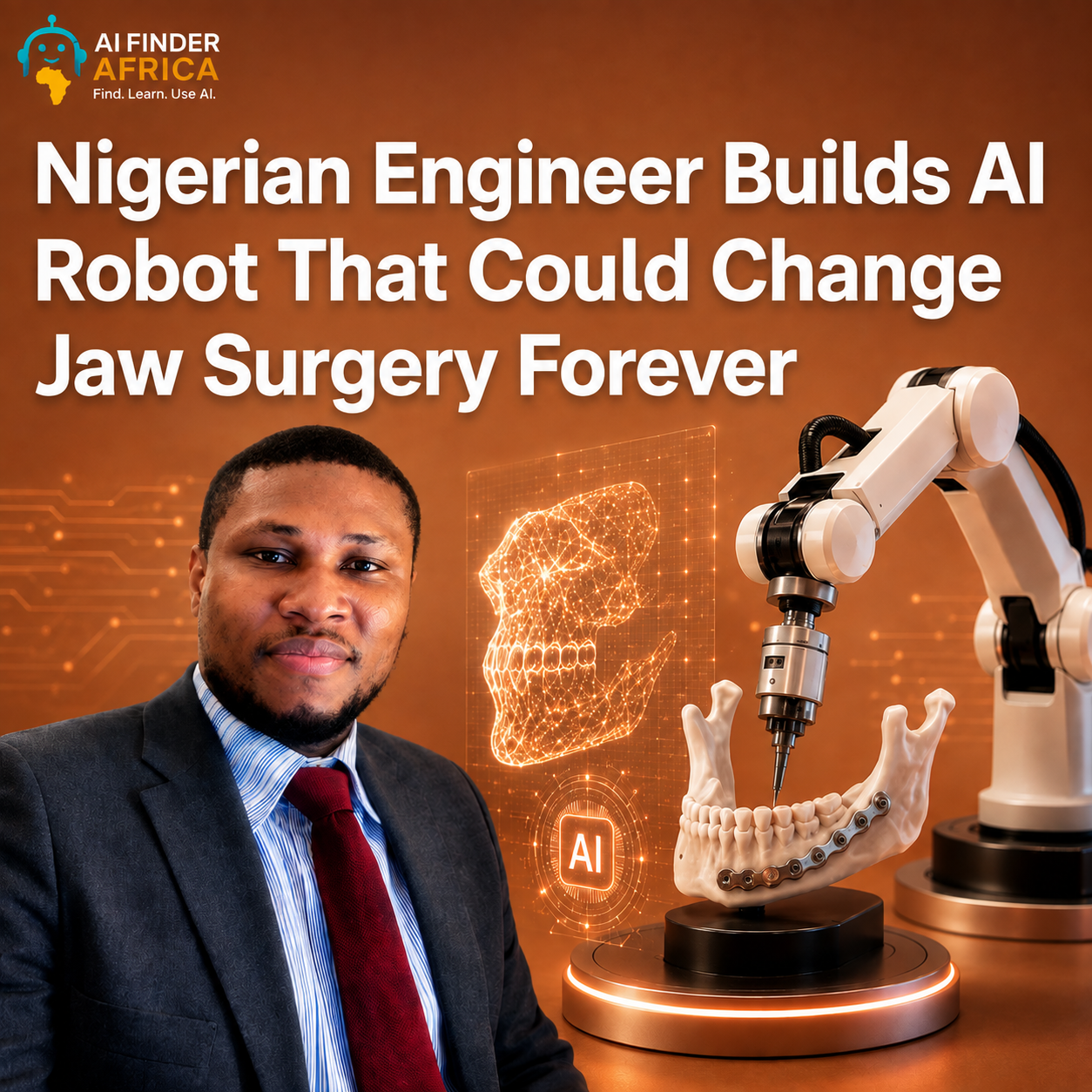
Nigerian Engineer Builds AI Robot That Could Change Jaw Surgery Forever
Nigerian Engineer Builds AI Robot That Could Change Jaw Surgery Forever
Imagine breaking your jaw in an accident.
Or undergoing surgery to remove cancer from your face.
Now imagine the surgeon spending precious time bending a tiny metal plate by hand, trying to make it fit your bone perfectly. One wrong bend could mean starting all over again. That slow, painstaking process may soon become history.
A Nigerian-born engineer based in the United States has helped develop an AI-powered robotic system that could reshape reconstructive surgery by doing one thing remarkably well: bending surgical plates with machine-level precision. And if the technology lives up to its promise, it could make surgeries faster and more accurate, and even improve patient recovery.
Meet the Nigerian Behind the Breakthrough
The engineer behind the innovation is Kenechukwu Nwajiaku, a Nigerian control systems researcher working in the United States.
Together with researchers from Case Western Reserve University and The Ohio State University, Nwajiaku developed an intelligent robotic control system capable of automatically shaping craniomaxillofacial fixation plates the small metal plates surgeons use to rebuild damaged jaw and facial bones.
It is a project that combines three of today's most exciting technologies:
Artificial Intelligence, Robotics, Machine Learning
The goal? To help surgeons achieve a near-perfect fit every single time.
Why This Matters More Than You Think
Every year, thousands of patients undergo reconstructive surgery after:
Road accidents, Facial injuries, Cancer surgery, Birth defects, Severe bone fractures
During these operations, surgeons rely on titanium fixation plates to hold broken bones together while they heal. But here is the problem. Every patient's face is different. That means surgeons usually have to manually bend each metal plate to match the patient's anatomy. It is a skill that takes years to master. Even then, it is not always perfect.
The Hidden Challenge: "Springback"
Metal has a frustrating habit. When you bend it, it often tries to bend back. Engineers call this springback. That tiny movement can make the plate fit less accurately, forcing surgeons to reshape it repeatedly while the patient remains under anesthesia. Nwajiaku's team decided to solve that problem with AI.
Instead of simply bending the plate, their robotic system predicts exactly how much the metal will spring back before it even happens. The robot then compensates for that movement automatically, producing a plate that much more closely matches the desired shape.
How the AI Robot Works
The technology uses an advanced control framework called Gaussian Process-Enhanced Model Predictive Control (GP-MPC). That sounds technical.
In simple terms, here is what happens.
The robot combines two different kinds of intelligence:
First, it uses physics to understand how metal should behave.
Then, it uses machine learning to learn from real-world data and correct anything the physics model does not predict accurately.
It is like having an experienced engineer constantly teaching the robot how to become more precise after every bend. According to Nwajiaku, that is what makes the system far smarter than traditional industrial robots.
The Results Are Impressive
The research team tested the robotic system using computer simulations and physical robotic experiments.
Compared with conventional robotic control systems, the AI-powered approach delivered:
About 22% better accuracy when bending the plate.
Around 34% better accuracy when twisting the plate.
More consistent performance, even when conditions changed unexpectedly.
For surgeons, that could mean:
Better-fitting implants, Shorter procedures, Fewer adjustments during surgery, More predictable surgical outcomes
AI Is Not Replacing Surgeons
One important point stands out. The robot is not designed to replace doctors. Instead, it acts like a highly skilled assistant. Surgeons still decide where the plate goes and perform the operation.
The robot simply handles one of the most repetitive and technically demanding parts of the preparation process. It is another example of AI augmenting human expertise rather than replacing it.
Still Not Ready for Hospitals Yet
As exciting as the breakthrough is, patients should not expect to see these robots in operating rooms tomorrow. The technology still needs additional engineering work, regulatory approval, and clinical validation before it can become part of routine medical practice.
That is standard for medical innovations, especially those involving surgery. But the early results suggest the concept is both practical and highly promising.
A Proud Moment for Nigerian Innovation
Nwajiaku says his inspiration comes from applying industrial automation to problems that directly improve people's lives.
Instead of making factory machines smarter, he is helping make healthcare smarter. His work also highlights a growing trend: Nigerian engineers, scientists, and researchers are increasingly contributing to cutting-edge AI breakthroughs on the global stage. From robotics to healthcare, their innovations are reaching far beyond the laboratory.
The Bigger Picture
Artificial intelligence is often associated with chatbots, image generators, and coding assistants. But breakthroughs like this remind us that AI's biggest impact may happen somewhere much quieter in hospitals, operating rooms, and medical laboratories.
If technologies like Nwajiaku's continue to evolve, future surgeons may spend less time bending metal by hand and more time focusing on what matters most: saving lives. And that may be one of AI's most meaningful contributions yet.




 Explore