


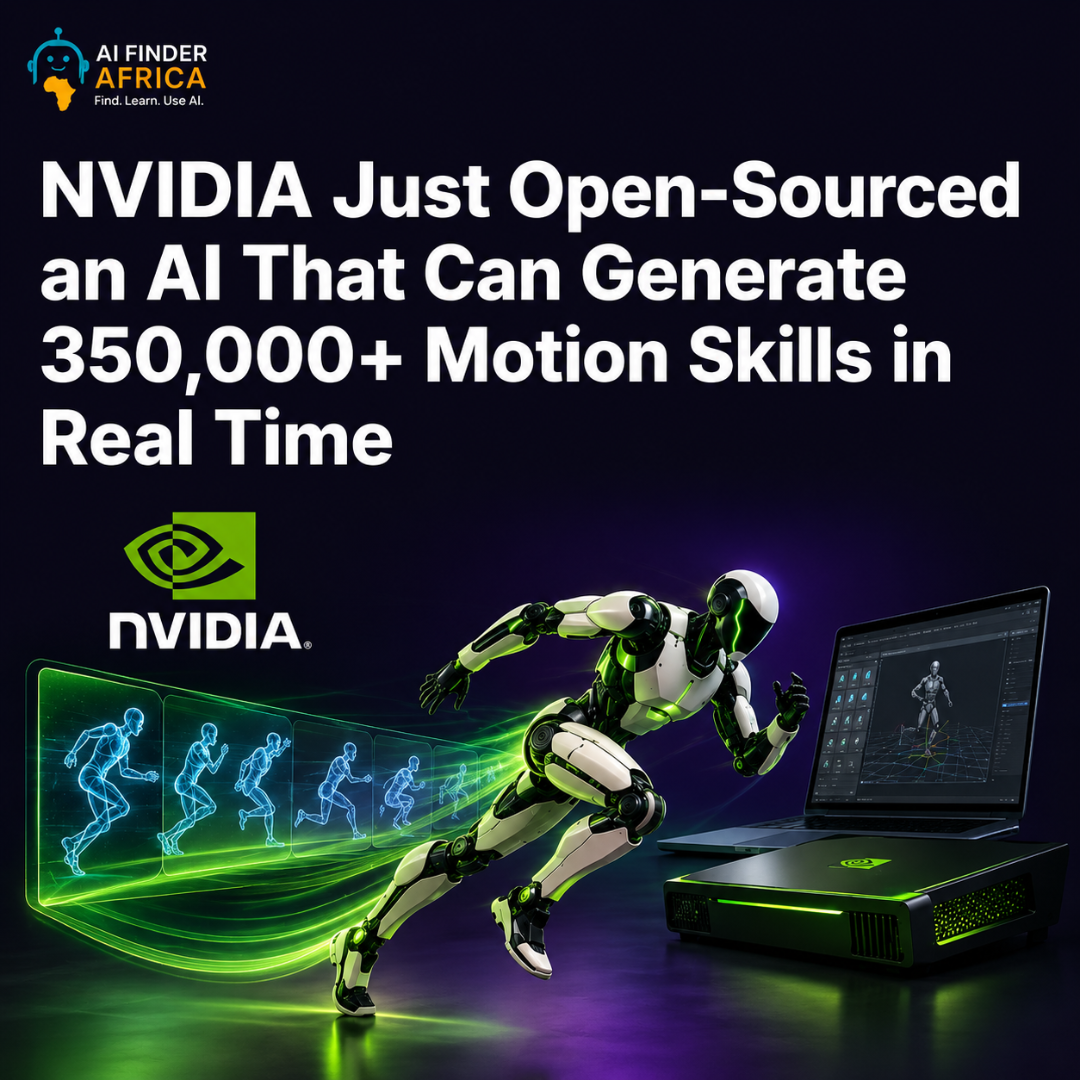
NVIDIA Just Open-Sourced an AI That Can Generate 350,000+ Motion Skills in Real Time
NVIDIA Just Open-Sourced an AI That Can Generate 350,000+ Motion Skills in Real Time
What if a game character did not need thousands of pre-made animations to know how to walk, run, jump, crouch, or pick something up?
What if an AI could simply generate the movement on the spot?
That is the idea behind MotionBricks, a new research system from NVIDIA that is making serious waves in AI-powered animation and robotics.
And the numbers are wild.
NVIDIA says MotionBricks can generate motion at up to 15,000 frames per second with about 2 milliseconds of latency, while one neural backbone can model more than 350,000 motion clips.
But there is an important correction to the viral graphic making the rounds: the 350,000 figure refers to motion clips in the dataset, not literally 350,000 distinct "skills." NVIDIA's research page describes the system as modeling a dataset of more than 350,000 motion clips.
So, What Exactly Is MotionBricks?
Traditionally, making a video-game character move realistically requires a huge amount of animation work.
Developers create movements for walking, running, jumping, turning, fighting, and interacting with objects. Then they build complicated systems to decide which animation should play and how one movement should transition into another.
MotionBricks takes a different approach.
Instead of simply selecting a pre-made animation, the AI can generate movement between constraints in real time.
NVIDIA describes its system as using "smart primitives" that allow developers to control things such as movement direction, speed, style, and interactions with objects.
That means a character could be told to walk in a particular direction, change its style or interact with something in the environment, while the model generates the motion needed to make it happen.
And it is not limited to normal walking.
NVIDIA's demonstrations include movements such as zombie-style walking, injured movement, skipping, strafing, jumping over a bench, sitting, and picking up a sword.
The Really Interesting Part: Robots
This is where MotionBricks becomes more than a gaming experiment.
NVIDIA has also demonstrated the technology controlling a Unitree G1 humanoid robot.
In other words, the same general approach that can make a virtual character move inside a game can also be applied to physical robots.
That creates an interesting bridge between two worlds that have traditionally been developed separately:
virtual characters and physical machines.
A system that understands movement could potentially help robots learn and perform more complex behaviours without engineers having to manually program every possible movement.
And Yes, Developers Can Experiment With It
NVIDIA has released MotionBricks as part of its GR00T Whole-Body Control project.
The initial public release includes an interactive G1 demo, pretrained checkpoints, and synthetic training code, giving researchers and developers a way to experiment with the technology. The project's source code is available under Apache 2.0, while the pretrained model weights use NVIDIA's Open Model License.
That makes this more than a flashy NVIDIA research demonstration.
Developers can actually get their hands on the technology.
Why This Could Matter
For game developers, MotionBricks could eventually mean more responsive characters, fewer manually authored transitions, and more dynamic worlds.
For robotics researchers, it could mean another way to generate natural full-body movement.
And for AI, it represents something even bigger.
AI is not just learning to write, see, and speak.
It is increasingly learning how things move.
Imagine future games where NPCs do not simply replay the same handful of animations. Imagine robots that can adapt their movements to new situations instead of relying entirely on pre-programmed instructions.
That is the direction MotionBricks is pointing toward.
The future of AI may not just be about generating what we see or hear. It may also be about generating how machines and digital characters move.




 Explore