


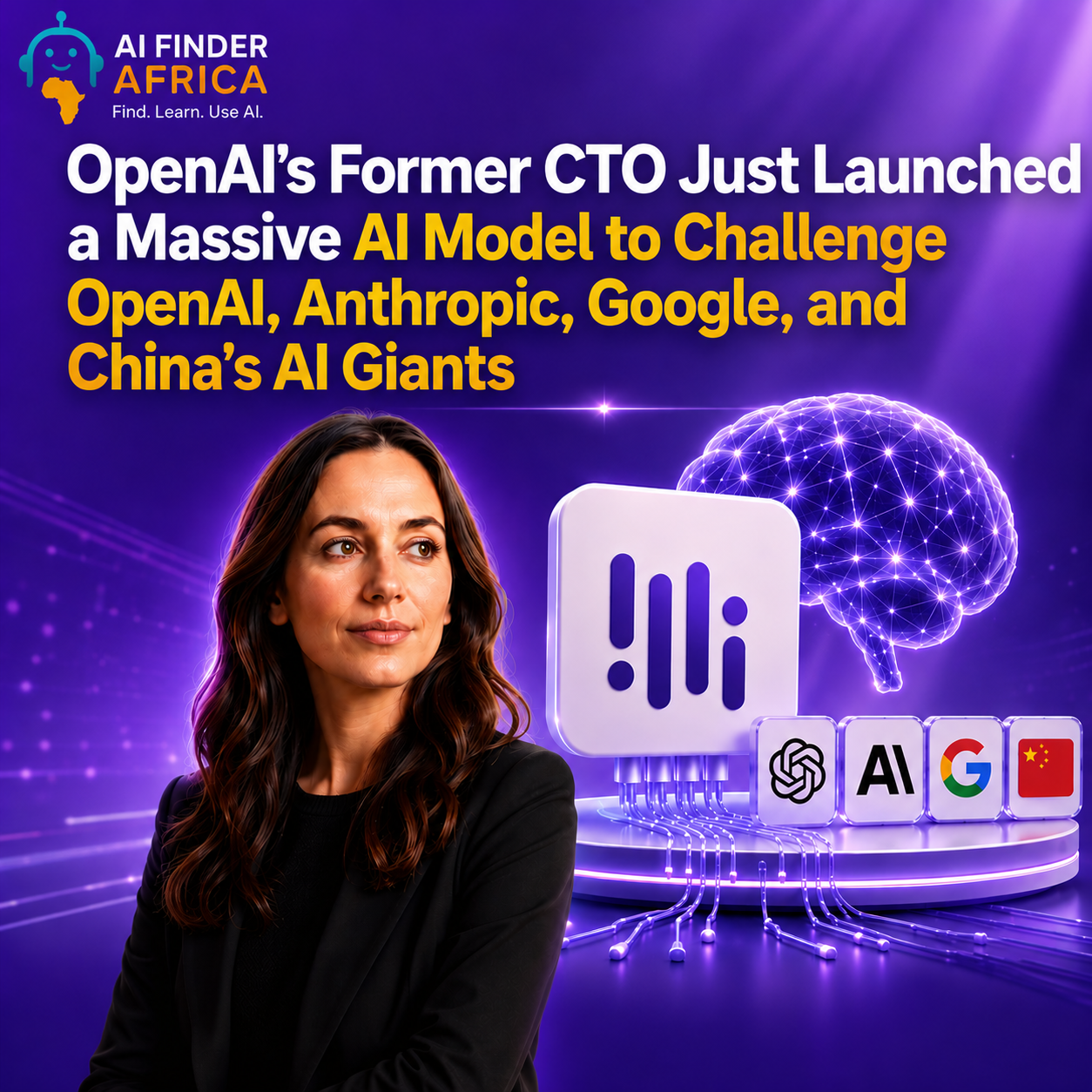
OpenAI's Former CTO Just Launched a Massive AI Model to Challenge OpenAI, Anthropic, Google, and China's AI Giants
OpenAI's Former CTO Just Launched a Massive AI Model to Challenge OpenAI, Anthropic, Google, and China's AI Giants
For the past two years, the AI race has been dominated by familiar names: OpenAI, Google, Anthropic, Meta, and a growing wave of Chinese AI companies. Now, another major contender has entered the arena.
Thinking Machines, the AI startup founded by former OpenAI Chief Technology Officer Mira Murati, has officially unveiled Inkling, its first general-purpose open-weight AI model. The launch marks the company's biggest move yet and positions it as one of the few Western firms offering a serious open alternative to the increasingly popular AI models coming out of China. Unlike proprietary AI systems that are primarily accessed through cloud APIs, Inkling is an open-weight model that developers can download, customize, and deploy on their own infrastructure. This gives organizations greater flexibility, control, and the ability to tailor the model to their specific needs.
Why Everyone Is Talking About Inkling
Think of most leading AI models as luxury sports cars. They are incredibly powerful, but you can only drive them the way the manufacturer allows. Inkling takes a different approach.
It is an open-weight model, meaning developers can access its trained weights, run it on their own infrastructure, fine-tune it with their own data, and build specialized AI applications without depending entirely on a company's cloud service.
For businesses worried about privacy, compliance, or customization, that is a big deal. As enterprises increasingly look for AI systems they can control, open-weight models are becoming one of the hottest trends in artificial intelligence.
Backed by One of AI's Most Recognized Leaders
Thinking Machines may be a young company, but its founder is anything but new to AI.
Mira Murati spent years at OpenAI, where she helped oversee products including ChatGPT, GPT-4, DALL·E, and Codex before leaving to launch Thinking Machines. Her new company aims to build AI that is not only powerful but also practical for businesses and developers.
Inkling is its first flagship model and follows the earlier release of Tinker, a platform that helps organizations customize AI systems for enterprise use.
One of the Largest Open-Weight Models Ever Released
Inkling is not a small experiment.
According to Thinking Machines, the model contains 975 billion total parameters and uses a Mixture-of-Experts (MoE) architecture that activates only about 41 billion parameters during inference. This allows the model to deliver frontier-level capabilities while keeping computational costs more manageable.
The company also says Inkling supports:
A 1 million-token context window
Text, image, audio, and video understanding
Advanced reasoning
Coding assistance
Scientific research
AI agent workflows and Enterprise automation
Rather than competing solely as a chatbot, Inkling is designed to be a flexible foundation model that developers can build upon.
Can It Really Compete With OpenAI and Anthropic?
That is the question everyone is asking.
Thinking Machines published benchmark results comparing Inkling against models from OpenAI, Anthropic, Google, and several leading Chinese AI labs.
The company does not claim to outperform the best frontier models across every benchmark. Instead, Inkling delivers particularly strong performance in coding, software engineering, and AI agent-related tasks, while remaining competitive in reasoning and enterprise applications.
In other words, the company is positioning Inkling as a practical alternative, not necessarily the overall benchmark leader.
Why China Is Part of This Story
Inkling's launch also highlights a growing reality in AI.
Over the past year, Chinese companies such as Alibaba (Qwen), DeepSeek, Moonshot AI, and Zhipu AI have become major players in open-weight AI, releasing powerful models at an impressive pace.
Meanwhile, many Western companies have shifted toward closed, subscription-based products. Thinking Machines believes developers still want high-quality open-weight AI built outside China, and Inkling is its answer to that demand.
The company even noted that customers have already used its Tinker platform to customize models such as Alibaba's Qwen, demonstrating how businesses are increasingly blending different AI ecosystems instead of relying on a single provider.
Why This Launch Matters
The AI industry is entering a new phase.
For years, success was measured by who built the biggest model. Now the conversation is changing.
Developers want flexibility. Businesses want customization. Governments want greater control over where AI runs and how data is handled. Open-weight models like Inkling offer all three.
That is why launches like this matter, not because they immediately replace ChatGPT or Claude, but because they give organizations another serious option.
The Bigger Picture
Thinking Machines may still be one of the newest companies in AI, but Inkling signals that it is aiming much higher than simply becoming another startup.
With one of the largest open-weight AI models ever released, backing from one of OpenAI's most influential former executives, and a strategy focused on developer freedom rather than locked-down services, the company has officially entered the global AI race.
Whether Inkling becomes the next major AI platform remains to be seen. But one thing is already clear:
The battle for the future of artificial intelligence is no longer just between OpenAI, Google, and Anthropic.
A new generation of challengers has arrived, and Thinking Machines wants to be one of them.

 Explore