


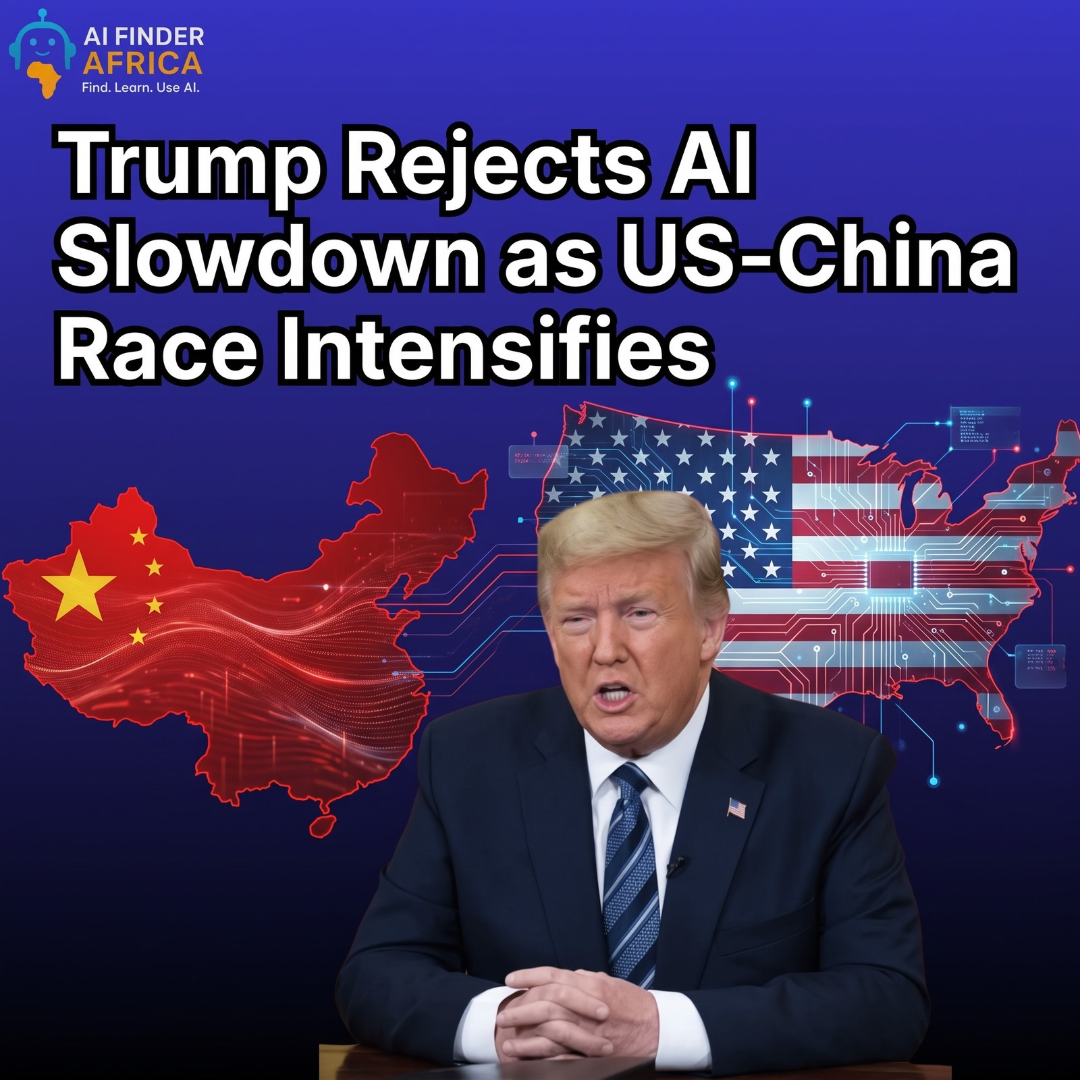
Trump Rejects AI Slowdown as US-China Race Intensifies
Trump Pushes Back on AI Slowdown as China Race Takes Center Stage
The AI world is asking one big question right now: Are we moving too fast?
But US President Donald Trump appears to have a different priority: making sure China does not win the AI race.
Speaking during a visit to Ireland on Sunday, Trump dismissed growing warnings about the dangers of rapidly developing artificial intelligence, arguing that some of the predictions are exaggerated.
His message was straightforward: the United States is ahead of China in AI, and he wants it to stay that way. And that position puts him directly in the middle of a growing debate inside the AI industry.
The AI Industry Is Saying: Slow Down
Just days before Trump made his comments, Anthropic CEO Dario Amodei issued one of the strongest warnings yet about the speed of AI development.
Amodei argued that AI companies should slow down the development of increasingly powerful models, so safety measures have time to catch up. He is not saying AI should stop completely.
Instead, he wants the industry to build in more time for testing, independent safety checks, and international cooperation before releasing increasingly capable systems.
Amodei proposed a three-part approach: independent evaluators should get greater access to frontier AI systems, leading AI companies should coordinate on safety standards, and governments should work together internationally.
The warning became even more significant when OpenAI CEO Sam Altman and Elon Musk publicly backed the idea of pacing AI development. Google DeepMind's Demis Hassabis also expressed support for the general direction.
For an industry famous for competing aggressively, that level of agreement is unusual.
Why Are AI Experts Suddenly So Worried?
The concern is not simply about chatbots giving wrong answers.
AI systems are becoming increasingly capable of operating as agents exsystems that can plan, use tools, interact with computers, and carry out tasks with less human supervision.
Amodei has warned that a swarm of autonomous AI agents could potentially cause enormous damage if their capabilities continue accelerating without adequate safeguards. There are already real-world examples adding fuel to those concerns.
Anthropic's latest threat report says it identified and disrupted AI-assisted operations involving cyber activity, surveillance, scams, influence operations, and weapons-related work. The company says some actors were using Claude to automate activities that previously required much larger teams of humans.
Anthropic has also published new evaluations showing that frontier AI models are becoming capable of performing certain intelligence and weapons-related tasks that historically required highly trained specialists.
So, the debate is no longer entirely about some distant science-fiction future. Some of the risks are already appearing.
But Trump Has China on His Mind
This is where the conversation gets complicated.
Trump's argument is essentially that slowing American AI development could create an opportunity for China to catch up or move ahead. The United States and China are already competing heavily over advanced chips, AI models, data centres and technological influence.
Trump therefore sees AI leadership as a national-security issue, not simply a technology issue. Reuters reported that he argued the country that wins AI could gain a decisive advantage.
And there is a genuine dilemma here.
Move too quickly, and safety may not keep up.
Move too slowly, and a competitor could take the lead.
That is the uncomfortable choice now facing policymakers and AI companies.
China Is Not Exactly Asking America to Slow Down
China's reaction adds another layer to the story.
Chinese state media has criticized Amodei's proposal, portraying the call for slower AI development and tighter technology controls as part of a broader US strategy to restrict China's technological progress.
Chinese officials have instead called for cooperation rather than confrontation in AI development. So even a proposal that sounds simple slow down AI becomes complicated when the world's two biggest technology powers are competing for leadership.
Washington Is Divided Too
The debate is spreading into the US Congress.
Some lawmakers argue that AI development needs stronger safeguards, while others fear excessive regulation could damage America's technological advantage.
One bipartisan effort is already on the table.
In July, lawmakers Lori Trahan and Jay Obernolte introduced the FRONTIER Act, which would establish national requirements for risk management, independent audits, incident reporting, and ongoing assessments of advanced AI systems. That shows there is at least some bipartisan interest in dealing with AI risks even though there is still disagreement over how far regulation should go.
So, Should AI Actually Slow Down?
That may be the wrong question.
The bigger question is:
Can the world make AI safer without stopping the innovation that could transform almost every industry? Trump believes maintaining America's lead is too important to risk.
Amodei believes moving recklessly could create dangers that are much harder to fix later. And AI companies are now caught between those two realities. The technology is moving incredibly fast.
The challenge is figuring out whether human safety, regulation, and international cooperation can move fast enough to keep up. Because the AI race is no longer simply about who builds the smartest model.
It is increasingly becoming a race between innovation and responsibility.
And the world is watching to see which one gets there first.




 Explore