


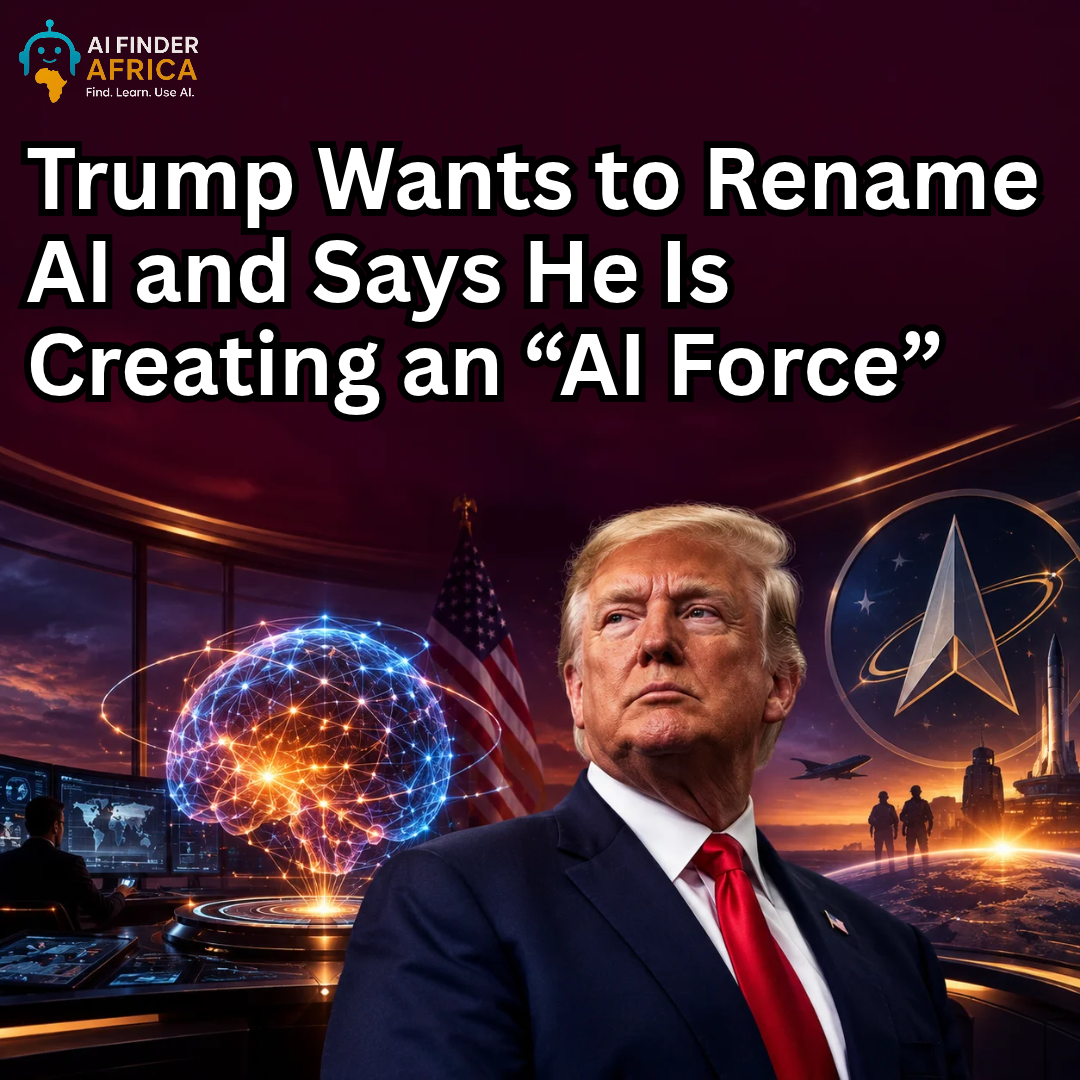
Trump Wants to Rename AI and Says He Is Creating an “AI Force”
Trump Wants to Rename AI and Says He Is Creating an “AI Force”
What if Artificial Intelligence got a new name?
President Donald Trump has an idea. Actually, he has three.
On Saturday, September 19, Trump asked his followers on Truth Social to vote on whether “Artificial Intelligence” should be renamed Superior Intelligence, Extreme Intelligence, or Supreme Intelligence.
But that was only the beginning.
A few hours later, Trump announced something much bigger: plans to create an “AI Force” and appoint a new AI “czar” to oversee the technology. The announcement comes at a fascinating moment for AI, as governments, researchers, and major technology companies debate how quickly the technology should advance and how much oversight it needs.
Trump Thinks “Artificial Intelligence” Needs a New Name
Trump's first AI announcement was surprisingly simple. He argued that the phrase “Artificial Intelligence” is inaccurate and “very ineloquent” and asked people to choose a replacement.
The three options were: Superior Intelligence, Extreme Intelligence, Supreme Intelligence
The proposal is more than a naming exercise because Trump has been using the moment to make his broader position on AI clear. He has repeatedly argued that the United States should not slow down its AI development while China is competing for technological leadership.
In his latest posts, Trump said his administration would support the industry rather than “hinder or stifle” its growth.
So, for now, AI is not being renamed by law. It is simply the subject of Trump's public poll.
Then Came the “AI Force”
The more significant announcement came in Trump's second post. He said he was forming an AI Force, comparing the idea to the Space Force, which Congress established during his first term.
But there is a major question:
What exactly is the AI Force? Trump has not said.
There is currently no detailed public explanation of its structure, funding, membership, legal authority, or whether it would be a military organization, a government task force, or something else entirely.
The White House also had not provided detailed answers about the proposed organization in the latest reporting. That leaves the announcement as a proposal rather than an operational government body.
And There Will Be an AI Czar
Trump also said he would soon announce an AI czar. The role would apparently be connected to the administration's broader AI strategy, but Trump has not yet explained the position's exact responsibilities.
This would effectively revive a role previously held by venture capitalist David Sacks, who served as Trump's AI and crypto czar before stepping away from the formal position earlier this year. Sacks later became a co-chair of the President's Council of Advisors on Science and Technology.
Trump offered one unusual description of the future appointment:
“Only High I.Q. individuals need apply!”
Who gets the job and what authority that person will actually have remains to be seen.
Why Is Trump Talking About AI This Much?
The timing is important.
The announcement arrives during one of the most intense AI safety debates in the United States. Some AI researchers and technology executives have been warning that increasingly powerful AI systems could create serious risks if development moves faster than safety measures.
Anthropic CEO Dario Amodei, for example, recently proposed a plan to “pace the frontier” of AI development.
OpenAI CEO Sam Altman, SpaceX CEO Elon Musk and Google DeepMind's Demis Hassabis have also recently discussed concerns around increasingly powerful AI systems.
Trump has taken a different position. He has questioned the need for additional restrictions and has described some of the warnings about AI's potential dangers as a “hoax.”
That puts his latest announcement in a bigger debate:
Should America slow AI down to manage potential risks, or move faster to maintain its technological advantage?
Trump is clearly emphasizing the second approach.
The Data Center Fight Is Part of the Same Story
Trump's comments also come as America's AI infrastructure is facing growing opposition. AI models need enormous computing infrastructure, which means more data centers, more electricity and, in many locations, more pressure on local resources.
Communities across the U.S. have raised concerns about energy use, water consumption, infrastructure, and the local impact of large data centers.
Trump has pushed back against those criticisms, arguing that data centers can bring economic benefits to communities. However, his claims about specific benefits have not been accompanied by evidence in the posts announcing the AI Force. And interestingly, opposition to data centers is not confined neatly to one political party. That makes the AI debate much bigger than Silicon Valley.
It is becoming a question about jobs, electricity, national security, local communities, regulation, and America's position in the global technology race.
America vs. China Is Still in the Background
There is another reason the AI debate matters so much to the Trump administration: China.
The United States and China are competing aggressively for leadership in artificial intelligence, advanced chips, computing infrastructure, and other strategic technologies.
Trump has repeatedly framed maintaining America's AI lead as a national priority.
That competition is also expected to feature prominently in his upcoming meeting with Chinese President Xi Jinping. U.S. and Chinese officials have separately been discussing possible mechanisms for communicating about serious AI incidents, showing that competition and AI safety discussions are happening at the same time.
In other words, Washington is trying to answer two questions simultaneously:
How do we build AI faster?
And: How do we make sure we do not lose control of what we are building?
So, Is AI Really Getting a New Name?
Not yet.
Trump has proposed alternatives and asked the public to vote, but there is no indication that the U.S. government is officially renaming artificial intelligence.
The bigger story is arguably the proposed AI Force and AI czar. Those announcements could become significant if the administration eventually gives them formal responsibilities and authority.
For now, however, there are more questions than answers.
What will the AI Force actually do?
Who will lead it?
Will it focus on national security, AI development, regulation, infrastructure, or all of them?
And will the new AI czar become one of the most influential technology officials in Washington?
We do not know yet.
But one thing is becoming increasingly obvious:
AI is no longer just a technology story.
It is becoming a government story, an economic story, a national-security story, and increasingly, a geopolitical one. And if Trump gets his way, America is not planning to step on the brakes. It is preparing to press the accelerator.




 Explore