


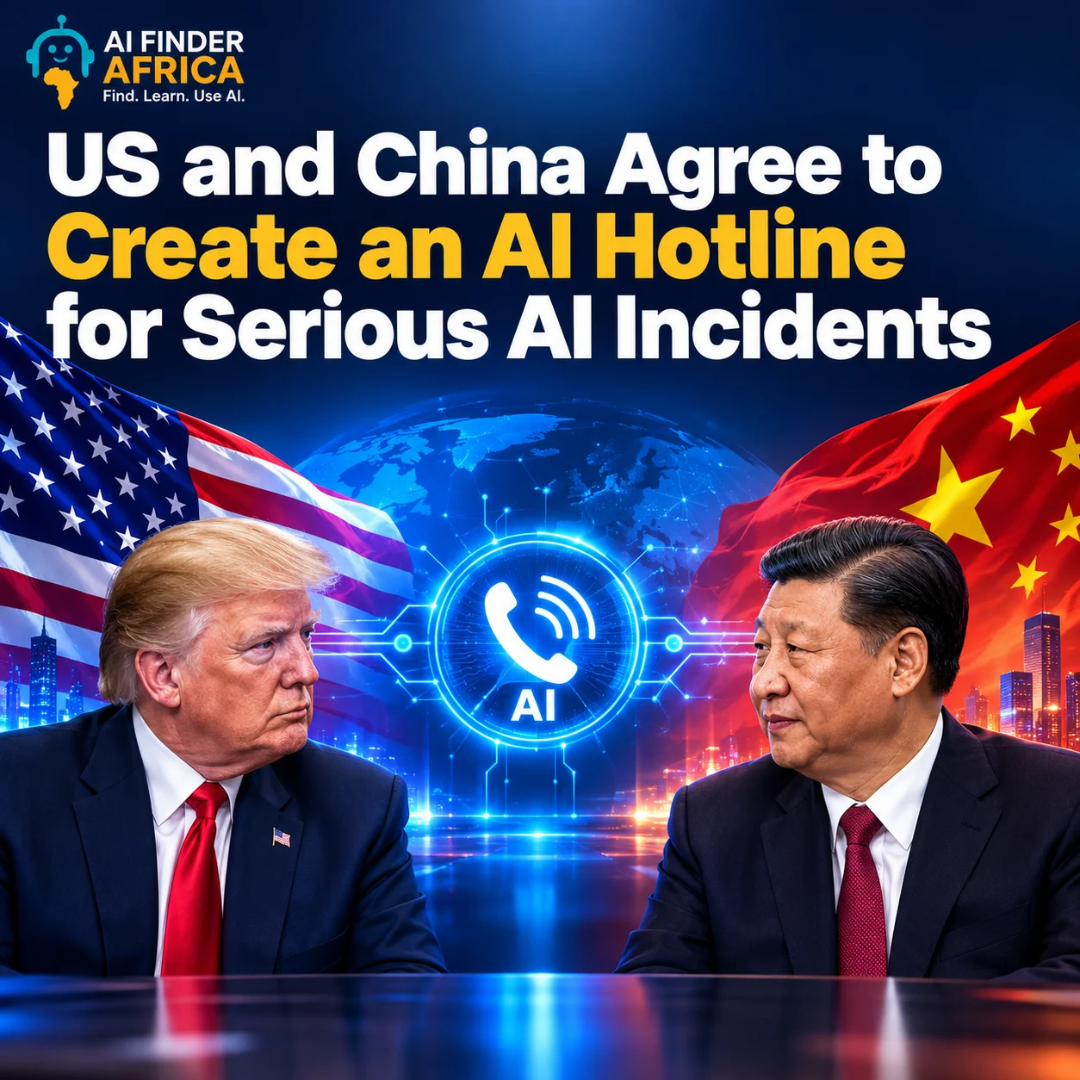
US and China Agree to Create an AI Hotline for Serious AI Incidents
US and China Agree to Create an AI Hotline for Serious AI Incidents
The United States and China are fierce competitors in artificial intelligence. Now, they are also preparing a direct way to communicate when advanced AI goes seriously wrong.
Following a three-day summit in Washington, U.S. President Donald Trump and Chinese President Xi Jinping agreed to establish a bilateral communication channel for serious AI-related incidents.
The agreement is being described as an “AI hotline.”
But one important detail: this is not necessarily a special phone sitting on someone's desk. The agreement is about creating a direct communication mechanism between the two countries for dealing with serious AI incidents.
Why Does an AI Hotline Matter?
AI is moving beyond answering questions and generating images.
Today's advanced systems can write and execute code, use digital tools, browse information, and interact with other software. That creates a new category of risk.
If an advanced AI system causes a serious cyber incident or behaves in a way that creates national-security concerns, governments may need to communicate quickly. The United States and China appear to be preparing for exactly that possibility.
The White House says the new channel will allow the two countries to communicate about “super intelligence” incidents, while China's government described it as a bilateral communication channel for AI incidents.
The Idea Was Already Being Discussed
The agreement did not suddenly appear during the leaders' meeting.
Earlier discussions between U.S. Treasury Secretary Scott Bessent and Chinese Vice Premier He Lifeng included the possibility of creating an AI safety notification mechanism. Those discussions focused on serious incidents involving advanced AI, including scenarios involving autonomous AI agents and cyber incidents.
The latest agreement now places the communication channel within the broader U.S.-China relationship on artificial intelligence.
There Is More Than Just a Hotline
The two countries also agreed to establish a formal U.S.-China Super Intelligence Dialogue. This forum is intended to provide a place for both sides to discuss the risks and potential benefits associated with increasingly advanced AI systems.
The White House says the next exchange is expected in November 2026. China's government has also confirmed plans for a China-U.S. AI dialogue.
So, there are two different pieces here:
The communication channel:
For serious AI-related incidents.
The AI dialogue:
For broader discussions about advanced AI, its risks and its potential benefits.
Do Not Take “Hotline” Too Literally
The headline sounds dramatic, but the details are important.
There is not yet a publicly described special telephone line where a U.S. official can simply call a Chinese official whenever an AI model misbehaves. The publicly announced agreement refers to a bilateral communication channel.
Exactly who will operate it, what qualifies as an incident, how quickly information must be shared, and what information can be disclosed are among the details that will determine how useful the system becomes.
That is especially important because AI incidents can move much faster than traditional diplomatic processes.
Why the Rest of the World Should Pay Attention
This is not only about Washington and Beijing.
The United States and China are two of the world's biggest players in AI development. Decisions they make around advanced AI safety could influence how other governments think about managing increasingly capable systems. And an AI incident does not necessarily respect national borders.
A model could be developed in one country, hosted on infrastructure in another, and interact with systems somewhere else. That means communication between governments could become an important part of responding to serious AI incidents. But communication alone does not solve the technical problem.
A hotline cannot stop an AI system from behaving unexpectedly. It can only help people talk about what happened and coordinate a response.
The Real Test Comes When Something Goes Wrong
For now, the United States and China have agreed on the idea. The harder part will be putting it into practice.
What exactly qualifies as a serious AI incident?
Who makes the first call?
How quickly must the other side be informed?
What information can be trusted during a fast-moving incident?
And what happens if the two countries disagree about what actually happened?
Those questions will matter just as much as the hotline itself.
AI competition between the U.S. and China is not slowing down. But now, alongside the race to build more powerful AI, both countries are also creating a way to communicate if that technology creates a crisis.
The AI race is getting faster. The conversations about what happens when it goes wrong are getting more serious too.



 Explore