

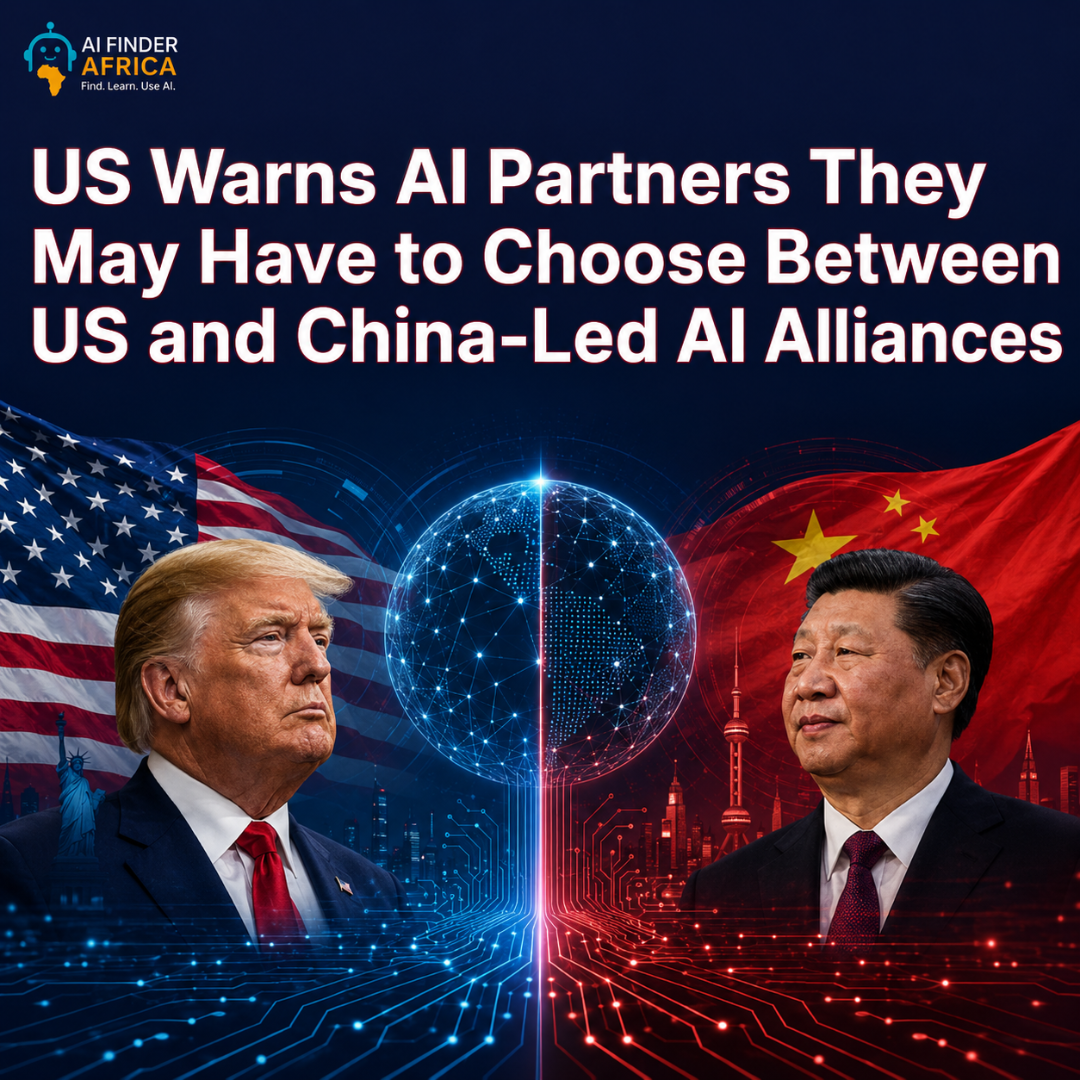
US Warns AI Partners They May Have to Choose Between US and China-Led AI Alliances
US Warns AI Partners They May Have to Choose Between US and China-Led AI Alliances
The global AI race just got a lot more political.
The United States is preparing to warn dozens of countries that they may have to choose between Washington and Beijing when it comes to certain international AI partnerships.
According to a report, the U.S. is preparing a message for countries involved in its AI cooperation efforts, warning that joining competing China-led initiatives could put their participation in a U.S.-led coalition at risk.
And this is not simply about which country's AI chatbot is better.
At the center of the dispute is Pax Silica, a U.S.-led initiative designed to strengthen cooperation around AI, semiconductors, critical minerals, energy, advanced manufacturing and other parts of the technology supply chain.
The initiative is becoming one of Washington's biggest tools for building what it considers a trusted technology ecosystem.
Now, Washington appears ready to make membership more exclusive.
The message: you may not be able to play both sides
Report stated that a draft U.S. State Department letter is being prepared for the 35 countries and territories that signed the AI Opportunity Statement.
The draft reportedly warns that participation in Pax Silica represents a commitment that could be incompatible with joining competing initiatives whose expectations conflict with the U.S. framework.
In other words, countries may soon face a difficult choice:
Washington or Beijing?
The immediate issue is China's newly established World Artificial Intelligence Cooperation Organization, which Beijing is positioning as a platform for international AI cooperation.
One country has already highlighted the problem for Washington: Kazakhstan.
Kazakhstan is involved with the U.S.-backed Pax Silica initiative while also joining China's AI cooperation organization. That kind of dual alignment is precisely what U.S. officials are reportedly trying to discourage.
Why is America doing this?
Because the AI race is no longer just about software.
Behind every powerful AI model are chips, data centers, electricity, minerals, telecommunications infrastructure, and enormous amounts of computing power.
Pax Silica is designed around that entire ecosystem, with the U.S. seeking stronger cooperation with trusted partners and less dependence on strategic competitors for critical technology and resources.
China, meanwhile, is building its own international technology relationships.
And that creates a new battlefield: who gets to shape the global AI ecosystem?
The United States wants countries aligned with its technology and supply-chain strategy. China is working to expand its own influence.
For countries caught between the two, staying neutral could become increasingly difficult.
What happens next?
For now, it is important to understand that the reported U.S. letter is a draft, not a new global law forcing every country to choose American or Chinese AI.
The reported consequence is also primarily about participation in the U.S.-led coalition, not a blanket ban on countries using Chinese AI products or technologies.
But the direction is clear.
The era when countries could comfortably cooperate with both Washington and Beijing on strategic AI projects may be getting harder.
And as AI becomes more important to national security, economies, and global influence, the biggest question may no longer be: who builds the best AI?
It may be:
Who gets to decide which AI future the world builds together?
That is the real race now.



 Explore