


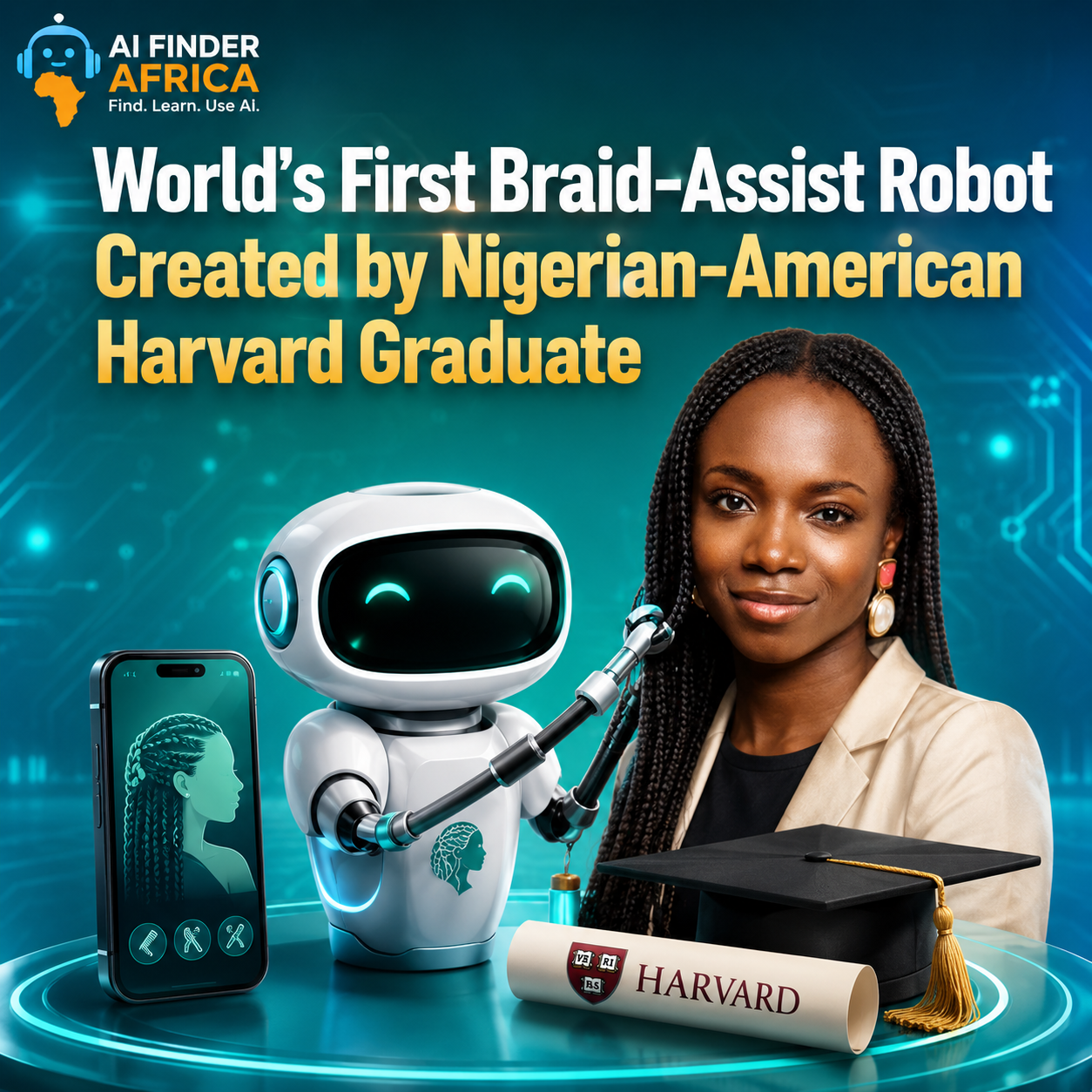
World's First Braid-Assist Robot Created by Nigerian-American Harvard Graduate
World's First Braid-Assist Robot Created by Nigerian-American Harvard Graduate
What if getting your hair braided no longer meant spending an entire day at the salon?
For millions of people around the world, especially Black women, that idea has seemed almost impossible.
Hair braiding is more than just a hairstyle. It is culture. It is creativity. It is tradition. But it is also incredibly time-consuming. A single appointment can last anywhere from six to twelve hours, leaving clients exhausted and hairstylists with sore hands, wrists, shoulders, and backs.
Now, one Nigerian-American engineer believes technology can change that.
Meet Yinka Ogunbiyi, a Harvard-trained engineer whose startup, HaloBraid, has developed what is being described as the world's first braid-assist robot a device designed to help professional hairstylists braid hair faster without replacing the human artistry behind the craft.
It All Started With One Painful Experience
Ironically, the idea for HaloBraid did not come from a robotics lab. It came during the COVID-19 lockdown.
Like many people, Ogunbiyi could not visit a salon. So she decided to braid her own hair. It took four days.
That experience made her ask a simple question:
"If cars can drive themselves and robots can perform surgery, why does braiding hair still take an entire day?"
Instead of accepting it as "just the way things are," she treated braiding as an engineering problem waiting to be solved.
Meet HaloBraid
HaloBraid is not a robot hairstylist.
It is a robotic assistant. Here is how it works:
A professional stylist still performs all the creative parts of the hairstyle:
Parting the hair, Creating the sections, Starting each braid, Finishing and sealing the ends
The HaloBraid device simply takes over the long, repetitive middle section of the braid before handing control back to the stylist.
Think of it like power steering for hairstylists. The stylist stays in control. The machine handles the repetitive work.
Built to Help Stylists, Not Replace Them
Whenever robots enter an industry, one question always comes up:
"Will this replace jobs?"
Ogunbiyi says that is not the goal. Instead, HaloBraid was designed to protect hairstylists.
Professional braiders often spend years performing thousands of repetitive hand movements every day. Over time, many develop wrist injuries, back pain, arthritis, or carpal tunnel syndrome.
HaloBraid reduces the physical strain while allowing stylists to serve more clients without sacrificing quality. In other words, the robot does not replace the stylist. It helps them work longer, healthier, and more efficiently.
Investors Are Paying Attention
The beauty industry has seen countless innovations from hair dryers to straighteners, but textured hair technology has largely been overlooked. That changed when HaloBraid entered the scene.
The startup recently secured $7 million in seed funding, led by Seven Seven Six, the venture capital firm founded by Reddit co-founder Alexis Ohanian. Other investors include AlleyCorp and Bling Capital.
Ohanian, whose wife Serena Williams and daughters frequently wear braided hairstyles, said he immediately understood the problem HaloBraid is trying to solve.
Thousands of Salons Are Already Waiting
Perhaps the biggest surprise? HaloBraid has not even launched commercially yet.
Yet more than 7,000 professional salons have already joined its waiting list. That kind of demand shows just how eager the beauty industry is for tools that can save time without compromising quality.
Why This Matters Beyond Beauty
This story is not really about hair. It is about how artificial intelligence and robotics are quietly entering industries many people never expected.
For years, AI has dominated conversations around coding, writing, and customer service. Now it is beginning to transform hands-on professions too.
HaloBraid demonstrates that automation does not always mean replacing people. Sometimes, it simply removes the hardest, most repetitive part of the job so humans can focus on creativity, skill, and personal connection.
What is Next?
HaloBraid plans to use its new funding to expand manufacturing, refine the product, and prepare for its commercial rollout later this year. Ogunbiyi has also hinted that this is only the beginning.
Future products could help with other labor-intensive parts of textured hair care, including removing braids, another process that can take hours. Her long-term vision is not just to build one robot. It is to modernize an entire industry that has remained largely unchanged for generations.
Final Thoughts
Some of the world's biggest technology breakthroughs do not happen in billion-dollar data centers.
Sometimes, they begin in everyday moments like spending four days trying to braid your own hair.
By combining engineering with cultural understanding, Yinka Ogunbiyi has created a technology that respects tradition while solving a real-world problem.
If HaloBraid delivers on its promise, it could transform salon experiences, improve the lives of professional stylists, and prove that AI and robotics can preserve craftsmanship instead of replacing it.
The future of beauty may not be fully automated. But it might just be a little faster, a lot healthier, and far more innovative.




 Explore