


Africa Could Unlock $1 Trillion With AI by 2035 — Here’s the Roadmap
Artificial Intelligence is no longer limited to a single global tech hub.
A new report by the African Development Bank is now placing Africa at the centre of the global AI growth conversation, not as a consumer of technology, but as a future builder of it.
And the numbers? They’re massive.
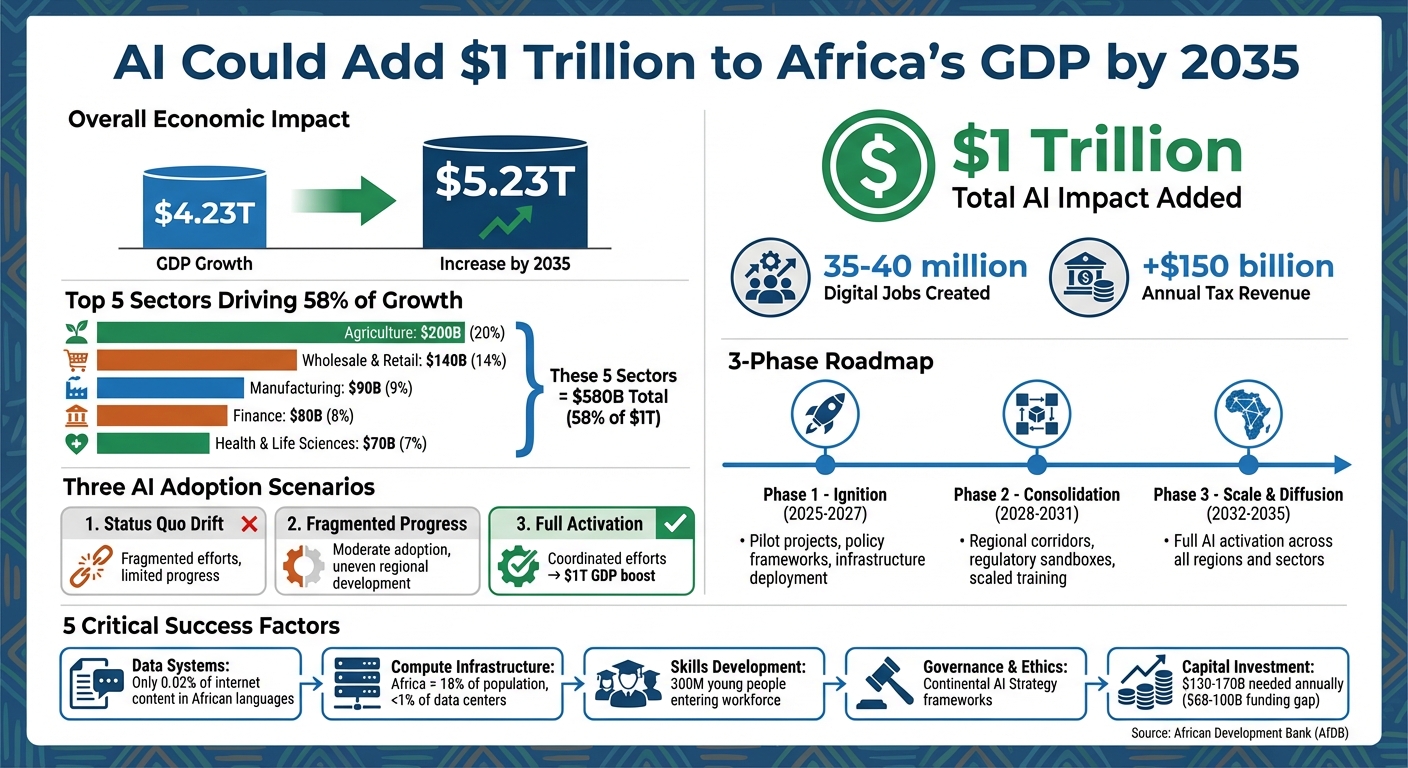
According to the Bank’s latest study developed under the G20 Digital Transformation Working Group, Africa could unlock up to $1 trillion in additional GDP by 2035 through inclusive AI adoption.
That’s nearly one-third of the continent’s current economic output.
So… Where Will This $1 Trillion Come From?
Contrary to popular belief, AI’s economic impact in Africa won’t be evenly spread across every industry.
Instead, the report highlights five priority sectors expected to capture the biggest share of the continent’s AI-driven productivity gains:
- Agriculture — 20%
- Wholesale & Retail — 14%
- Manufacturing (Industry 4.0) — 9%
- Finance & Financial Inclusion — 8%
- Health & Life Sciences — 7%
Together, these sectors could generate approximately $580 billion in AI-related economic value by 2035.
Why these sectors?
Because they combine three critical things: Large economic contribution, Readiness to adopt digital tools and Strong potential for inclusive development
In simple terms, they’re big, they’re growing, and AI can realistically improve how they work from smarter farming systems to AI-assisted diagnostics and automated financial services.
Africa’s AI Moment Is Closer Than It Looks
The report titled Africa’s AI Productivity Gain: Pathways to Labour Efficiency, Economic Growth and Inclusive Transformation notes that Africa’s opportunity isn’t based on theory alone.
It’s driven by real, measurable advantages:
- A rapidly growing digital ecosystem
- A young, tech-adaptive population
- Expanding mobile and internet penetration
- Ongoing policy and sectoral reforms
This combination is turning Africa into one of the most promising regions globally for AI-driven economic growth.
But there’s a catch.
AI Growth Won’t Happen Automatically
The Bank makes it clear that unlocking Africa’s AI potential depends on building five key enablers:
- Data: Reliable and interoperable datasets are essential for training AI systems relevant to African realities.
- Compute Infrastructure: Without scalable computing power, even the best AI models cannot function effectively.
- Skills: A workforce that can develop, deploy, and maintain AI tools is non-negotiable.
- Trust: Governance frameworks and ethical regulations are needed to drive adoption and ensure safety.
- Capital: Investment is required to de-risk innovation and accelerate real-world deployment.
When these factors align, the report says they can trigger a cycle of AI-driven productivity growth across industries.
The Three-Phase Plan to Get There
To turn projections into reality, the African Development Bank outlines a structured timeline for Africa’s AI readiness:
- Ignition Phase (2025–2027): Focus on foundational infrastructure, skills development, and early adoption pilots.
- Consolidation Phase (2028–2031): Strengthening regulatory frameworks and scaling successful implementations.
- Scale Phase (2032–2035): Widespread AI integration across industries and national economies.
According to the Bank, hitting early milestones by 2026 could set Africa’s long-term AI growth flywheel in motion.
In other words, the roadmap already exists.
The real challenge now isn’t deciding what to do; it’s executing quickly enough to keep up with the pace of global AI transformation.
As governments, startups, and private investors look toward Africa’s digital future, this report signals something important:
AI in Africa is no longer a distant ambition.
It’s becoming an economic strategy.




 Explore