


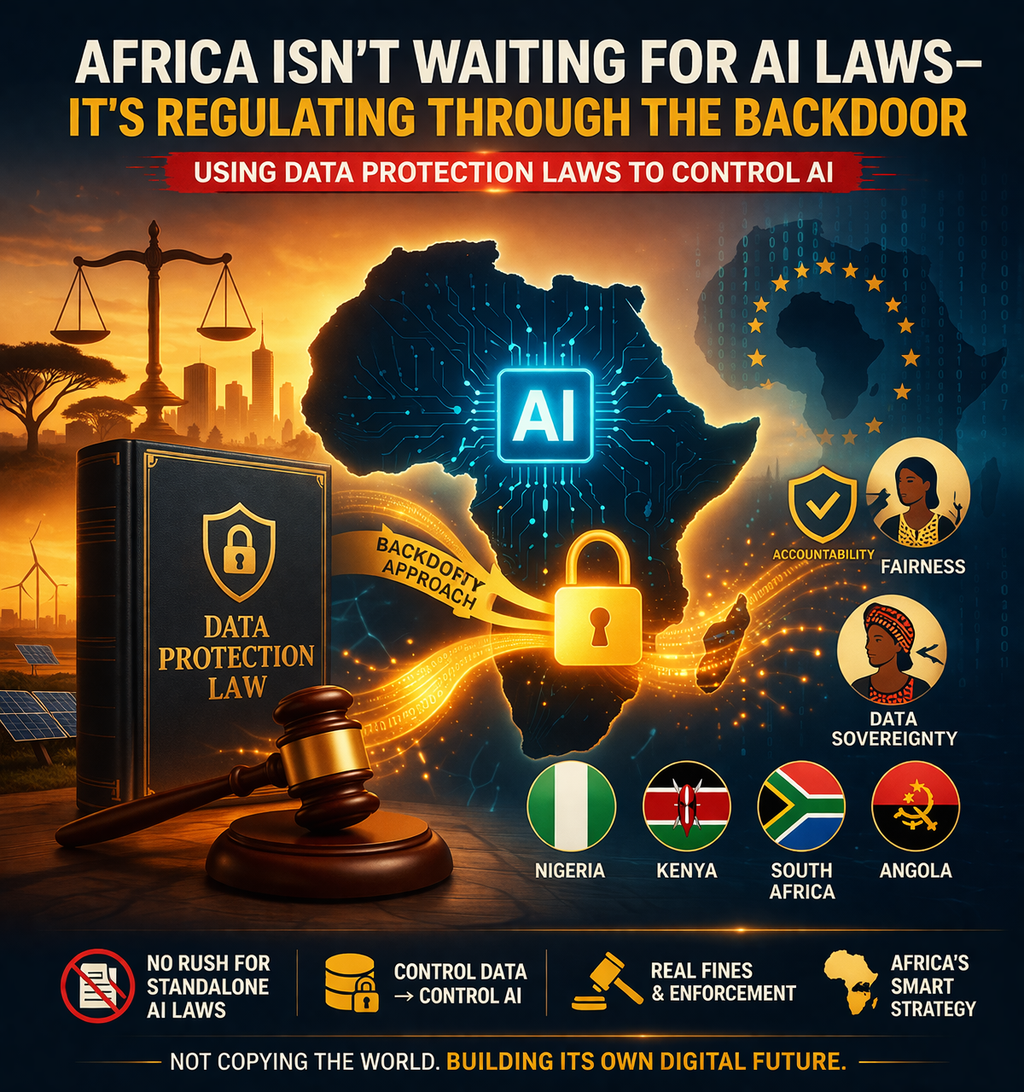
Africa Isn’t Waiting for AI Laws—It’s Regulating Through the Backdoor
AI is moving fast. Governments? Not always.
But across Africa, something interesting is happening.
Instead of rushing to create complex, standalone AI laws, many countries are taking a smarter and faster route. They’re regulating AI through something they already have: data protection laws.
It’s subtle. Almost invisible.
And according to the Future of Privacy Forum, it might just define Africa’s next wave of digital policy.
The “Backdoor” Strategy Explained
Think about it this way.
AI runs on data your data, my data, everyone’s data.
So instead of trying to regulate AI directly, governments are tightening the rules around how data is collected, used, and shared. Control the data, and you indirectly control the AI.
Countries like Nigeria, Kenya, South Africa, and Angola are already moving in this direction, updating their data protection laws to address things like automated decision-making, algorithmic accountability, and cross-border data flows.
No big AI law headlines.
Just quiet, strategic changes.
When AI Decisions Go Wrong
This shift isn’t happening in a vacuum.
Real-world problems are forcing governments to act.
A 2025 study examining credit-scoring systems across African markets found something troubling: bias against women-led businesses. In some cases, women had lower approval rates despite better repayment records.
That’s not just a tech issue, it is an economic one.
And suddenly, data protection becomes more than privacy. It becomes a tool for fairness and accountability in AI systems.
From Weak Laws to Real Consequences
Africa’s first wave of data protection laws was often criticised as too vague, hard to enforce, and easy to ignore.
That’s changing.
Governments are now tightening definitions, strengthening regulators, and actually enforcing penalties.
In Nigeria, the National Data Protection Commission fined a major company hundreds of millions of naira for unlawful data practices in 2025. In Kenya, regulators have also issued significant fines for misuse of personal data.
For the first time, these laws are starting to bite.
The Bigger Question: Who Owns the Data?
Behind all of this is a deeper issue of data sovereignty.
As global tech companies build powerful AI systems, African countries are asking a critical question: Who controls the data that fuels them?
The answer isn’t simple.
Some countries are exploring ways to keep certain types of data within their borders, while still allowing others to flow across markets. It’s a balancing act between national control and global participation.
And it’s becoming a defining theme of Africa’s AI future.
What Happens Next?
This “backdoor” approach won’t last forever.
Standalone AI laws are already emerging. Kenya, for example, introduced an AI bill in early 2026, and more countries are expected to follow.
But for now, data protection remains the main tool and not by accident.
Across the continent, governments are experimenting, adapting, and building frameworks that reflect local realities instead of copying global templates.
The Real Story
This isn’t just about regulation.
It’s about strategy.
Africa isn’t sitting back and waiting for the perfect AI law. It’s using what it has, learning in real time, and shaping its own path.
And in a world where technology often moves faster than policy, that might be the smartest move of all.




 Explore