


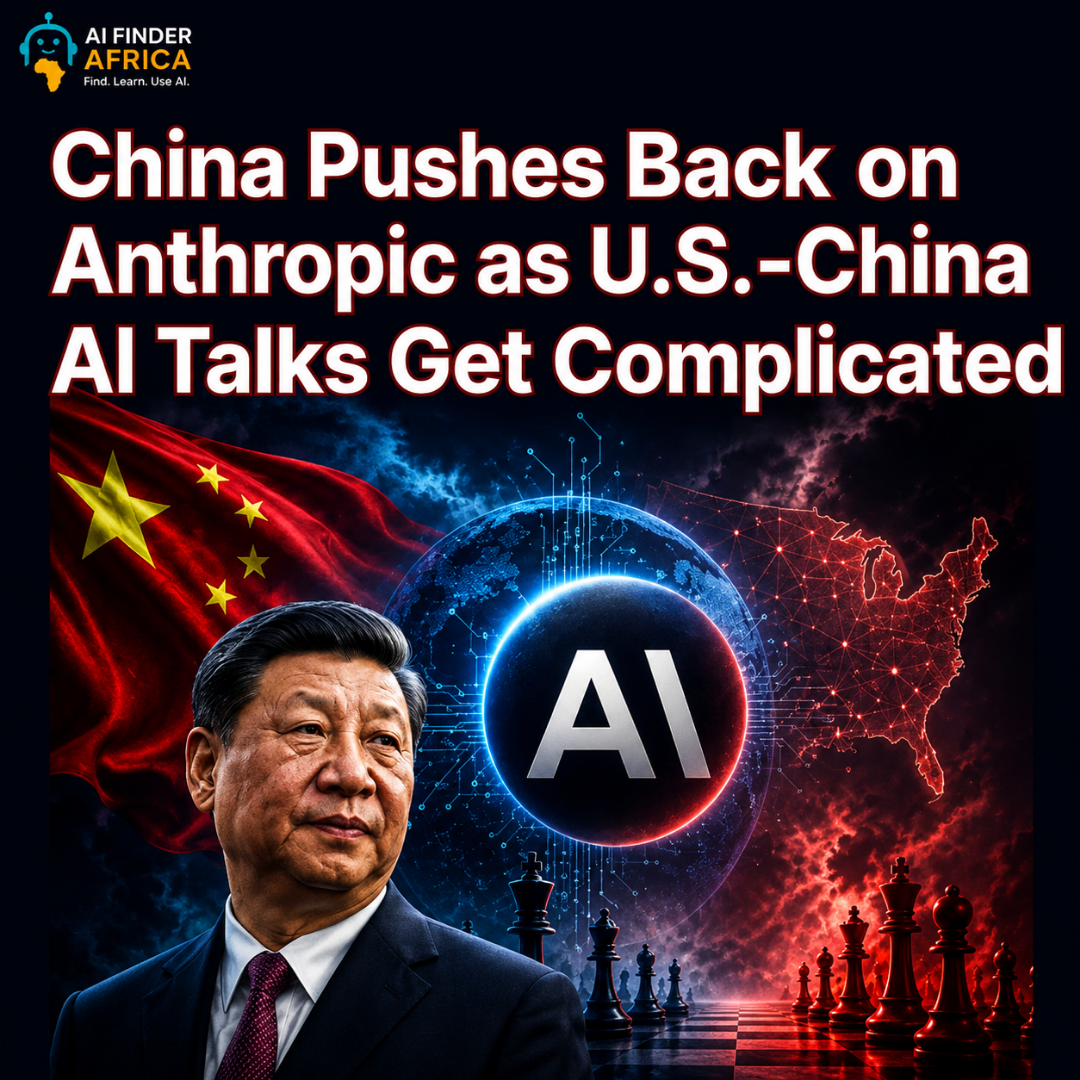
China Pushes Back on Anthropic as U.S.-China AI Talks Get Complicated
China Pushes Back on Anthropic as U.S.-China AI Talks Get Complicated
The global AI race is no longer just about who can build the smartest chatbot.
It is increasingly becoming a battle over who gets access to powerful AI, who controls it, and who gets to decide what is safe.
And now, Anthropic has found itself right in the middle of that growing U.S.-China tension.
In July, Chinese authorities publicly warned users about Anthropic’s Claude Code, an AI coding tool capable of writing, reviewing, and debugging software. China’s National Vulnerability Database, which is affiliated with the Ministry of Industry and Information Technology, described certain versions of Claude Code as carrying a serious security risk and warned that the software could transmit sensitive information, including location and identity-related data, to remote servers.
That sounds serious.
But there is another side to the story.
Anthropic said Claude Code is not officially available in China and argued that the feature in question was an experimental anti-abuse mechanism designed partly to prevent unauthorized use and attempts to extract knowledge from its models through a process known as distillation.
So, what began as a dispute over a coding tool quickly became part of something much bigger.
The U.S. and China Are About to Talk AI
Washington and Beijing are preparing for dedicated AI discussions in September, following an agreement reached during the Trump-Xi summit in May.
Reports say that the talks are expected to examine how the two countries can manage risks from increasingly powerful AI systems. The exact date, location, and participants were still being worked out when the talks were first reported.
And Anthropic is very much part of the conversation.
According to the report, Beijing's priorities include Anthropic's advanced Mythos system, how Washington plans to control the release of future frontier AI models, and whether the U.S. could place restrictions on Chinese open-weight models. Chinese officials are reportedly pushing for technical engagement rather than political arguments.
In other words, this is not simply a meeting about chatbots.
It is about the rules of the next generation of AI.
Why Anthropic Matters
Anthropic has been increasingly vocal about Chinese AI companies allegedly using model distillation to reproduce capabilities from American AI systems.
At the same time, China is rapidly developing its own frontier models, while companies such as Alibaba, DeepSeek, and others are pushing cheaper and increasingly capable alternatives.
That creates an uncomfortable situation.
The U.S. wants to maintain its lead in advanced AI. China wants greater technological independence and access to powerful AI capabilities. And both countries are becoming increasingly concerned that the other's AI systems could create cybersecurity, military, and national-security risks.
Even Alibaba reportedly moved to restrict employees from using Claude Code and directed them toward its own Qoder coding platform, further highlighting how quickly AI tools are becoming caught up in the technology rivalry.
This Is Bigger Than Claude
The interesting part is that AI is becoming geopolitical infrastructure.
The argument is no longer simply:
“Which AI model is better?”
It is becoming:
Who can use it?
Where can it be used?
Who controls the models?
How powerful should they be?
And what happens when an AI system becomes capable of cyberattacks or other dangerous tasks?
The U.S. and China are now trying to answer some of those questions while simultaneously racing to build more powerful systems.
That is why these upcoming talks matter.
They may not produce a major agreement immediately. In fact, analysts expect the first meeting to focus on relatively basic issues, including agreeing on what actually qualifies as a frontier AI model.
But that could be the beginning of something much larger.
The AI race has officially moved beyond Silicon Valley.
Now, Washington and Beijing are trying to figure out the rules of the game while the game is still being invented.




 Explore