


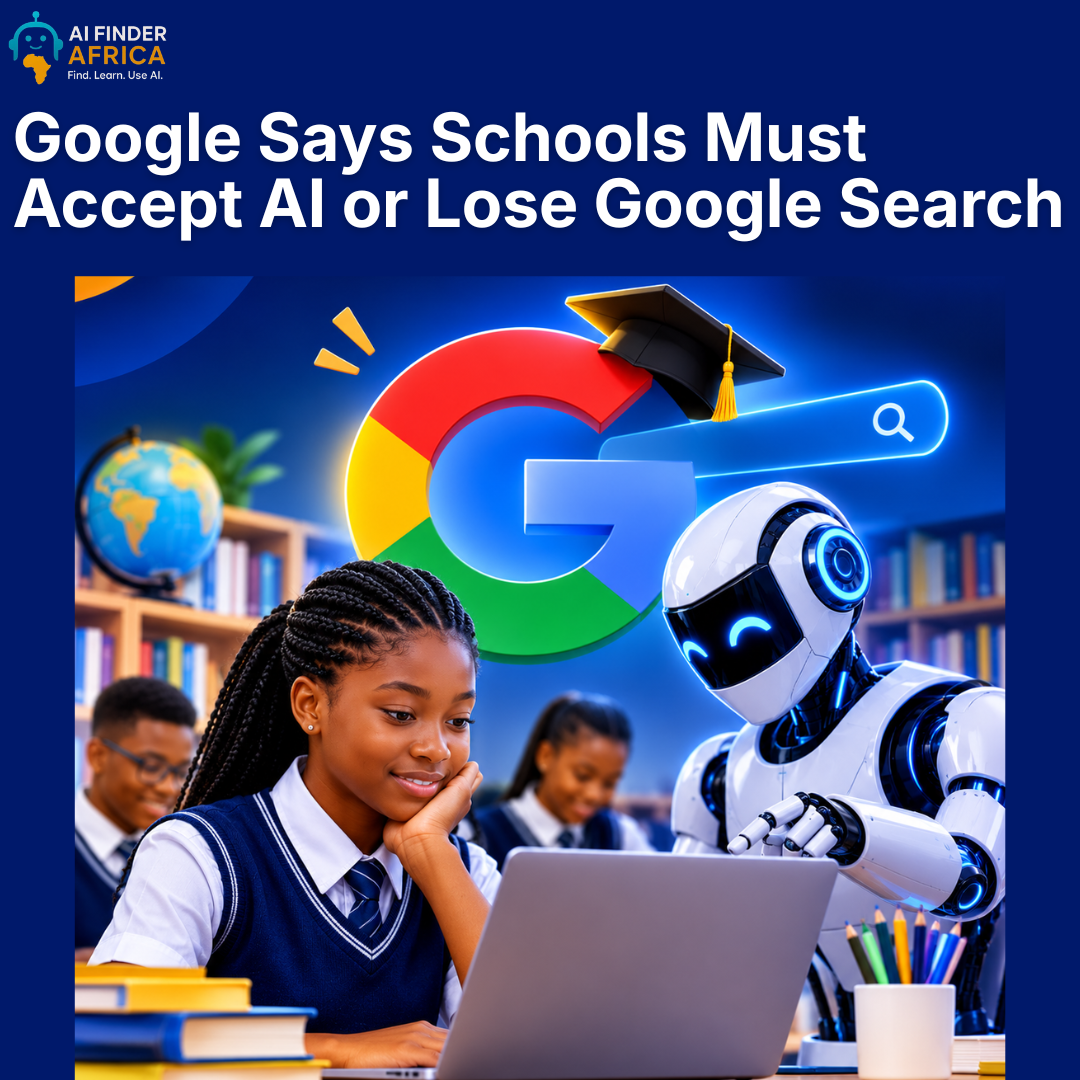
Google Says Schools Must Accept AI or Lose Google Search
Google Says Schools Must Accept AI or Lose Google Search
On November 3, 2026, Google announced changes to how schools manage access to its AI-powered education products.
The changes affect K–12 student accounts in the United States, covering tools such as:
Gemini: Google's AI assistant.
Gemini Notebook: An AI-powered learning and research tool.
Gemini in Classroom: AI features integrated into Google's classroom platform.
Google Search: The search engine millions of students use for research and homework.
Here is the part that has everyone talking.
Google says these services will be switched off by default for K–12 student accounts until school administrators explicitly enable them.
Schools can decide which products to activate. However, Google has also explained that Search and AI are now deeply connected. That means a school that decides to disable AI completely will also lose access to Google Search for its students.
In simple terms, schools can choose whether to use Google's AI features, but they cannot have the traditional AI-free Google Search experience they might prefer.
Why Is Google Making This Move?
Google says it wants to give schools more control over how AI is used in education.
According to Chris Phillips, Google's Vice President and General Manager of Education, the company has listened to teachers, school administrators, researchers, and policymakers. Its goal is to make AI more useful for learning rather than simply giving students another shortcut to completing assignments.
Google is also introducing a feature called Guided Learning. Instead of immediately giving students answers, Guided Learning is designed to walk them through problems step by step.
For example, imagine a student struggling with a difficult mathematics question.
Rather than simply displaying the final answer, the AI can break the problem into smaller steps, ask questions, explain concepts, and help the student understand how to solve it.
The idea is to make AI behave more like a personal tutor than a machine that does students' homework.
Google says Guided Learning is rolling out globally in Google Classroom for schools that have enabled its Gemini features. It is also beginning a pilot of Guided Learning capabilities in Search at selected US schools.
Teachers and Parents Have a Reason to Be Concerned
Not everyone is excited about Google's announcement.
For years, teachers have encouraged students to research information, compare sources, develop their own opinions, and solve problems independently. But with AI becoming increasingly powerful, there is a growing concern that some students may become too dependent on technology.
Instead of reading an entire article, they might ask AI for a summary.
Instead of struggling with a mathematics problem, they might request the answer.
And instead of writing an assignment themselves, they might allow a chatbot to do most of the work.
These concerns are not necessarily arguments against AI. They are questions about how much independence students should retain while using it.
Some schools have already taken action.
New York City and Los Angeles have introduced restrictions on student-facing generative AI use in parts of their school systems, reflecting concerns about academic integrity, student development, and responsible technology use.
Google's latest announcement makes that decision more complicated for schools that rely heavily on its products.
Why Critics Are Calling It an AI Ultimatum
The strongest criticism is not simply that Google is introducing AI into education. It is that schools may have to accept AI-powered Search if they want their students to continue using Google Search.
Former Federal Trade Commission Chair Lina Khan criticized the approach, arguing that Google was using its dominant position in online search to pressure schools into adopting AI.
New York City Mayor Zohran Mamdani also pushed back, arguing that technology companies should not have the power to dictate how public schools teach children. Other education advocates have raised concerns about students losing opportunities to practice independent research and evaluate information themselves.
Think about it.
A school might be comfortable using Google Classroom, Chromebooks, and Gmail but still want to restrict generative AI for younger students.
Under Google's proposed arrangement, that school could face a difficult decision: enable AI features within Search or stop offering Google Search to those student accounts. For institutions that have built much of their digital learning around Google's ecosystem, switching to alternatives may not be easy.
What Happens Next?
Google says the updated controls will give school administrators more flexibility, including the ability to manage access by grade level.
This means a school could decide to restrict AI access for younger students while allowing older students to use selected features. The company also plans to make changes to its school Search experience in early 2027.
However, the central concern remains: schools will not be offered a straightforward traditional Google Search experience completely separated from AI under the announced arrangement.
That leaves administrators with important decisions to make about student access, classroom policies, and alternative research tools.




 Explore