


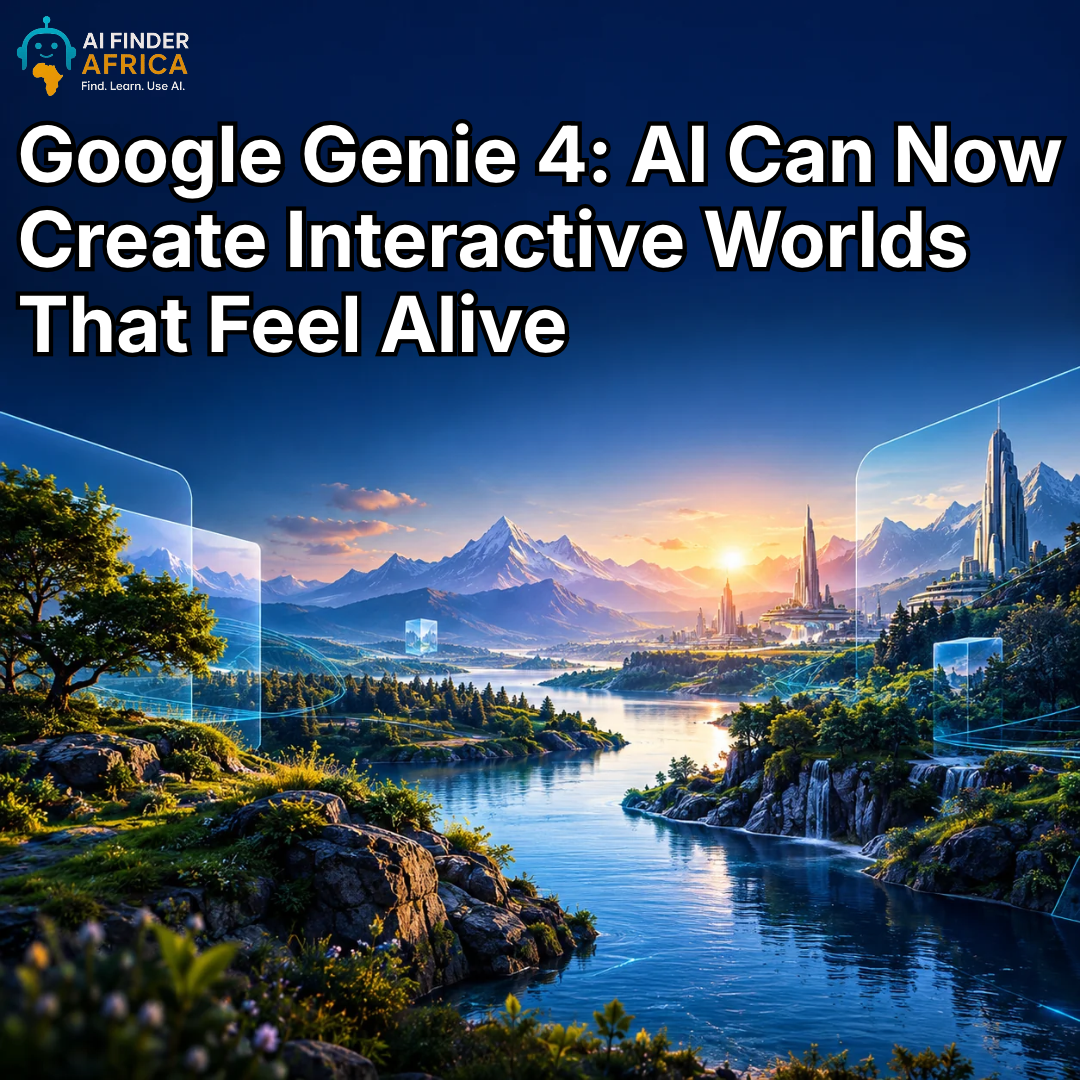
Google Genie 4: AI Can Now Create Interactive Worlds That Feel Alive
Google Genie 4: AI Can Now Create Interactive Worlds That Feel Alive
AI is moving beyond generating pictures, videos, and text. Google is now exploring something much bigger: technology that can create entire virtual worlds people can enter, explore, and control.
Google DeepMind introduced Genie 4, its latest AI world model. The technology can generate realistic, interactive environments that respond to instructions while users explore them.
Think of a virtual environment where the weather can change because you asked it to, characters can respond to what you say, and the surroundings continue evolving as you move around. That is the kind of experience Google is working towards.
And unlike a traditional AI video generator, Genie 4 is not simply creating a finished clip for you to watch. It is generating an environment that you can actively interact with.
You Can Change the World Without Starting Again
One of Genie 4's most interesting features is its ability to understand instructions while a simulation is already running.
For example, imagine exploring a virtual city. You could type a prompt asking for rain to begin, change the camera angle, introduce another character, or add a new object. Genie 4 can adjust the environment without requiring you to restart the entire experience.
This makes the technology particularly interesting for people who create digital experiences. Instead of spending hours rebuilding a scene every time an idea changes, creators can experiment with different possibilities through simple text instructions.
Google is also combining Genie 4 with models from its Gemini family. Gemini Omni helps ground the environments in realistic appearances and behavior, while other Gemini models provide reasoning that helps the simulation remain coherent as events unfold.
The idea is to make these virtual worlds feel less like disconnected computer-generated scenes and more like environments where actions have consequences.
These AI Worlds Can Now Make Their Own Sounds
Genie 4 also introduces something that makes the experience more immersive: native audio generation.
This means the model can create sounds that match what is happening inside its virtual environments.
A forest can have the sound of wind moving through trees. A beach can have waves crashing against the shore. Characters can also speak and respond through interactive dialogue.
This is an important development because realistic visuals alone do not always make a virtual environment feel convincing. Sound plays a major role in how people experience their surroundings.
By generating visuals, movement, and audio together, Genie 4 is moving towards a more complete form of interactive simulation.
What Could This Mean for Gaming, Film and Robotics?
The technology could have applications across several industries.
Gaming: Developers could use Genie 4 to turn early ideas into explorable prototypes. They could test environments, character designs, and gameplay mechanics before investing heavily in building a complete game. Smaller studios may also find it useful for experimenting with ideas without needing to create every asset from scratch.
Filmmaking: Directors and creative teams could explore scenes before production begins. They could test camera angles, lighting, dialogue, and character movements by changing instructions while the simulation is running.
Education and journalism: Interactive environments could help people explore historical settings, understand complex events, or experience how certain situations might unfold. Google says trusted testers are already exploring ways to turn archival photographs into interactive environments.
Robotics: This may be one of the most important applications. Robots and AI agents need to learn how to respond to different situations. Genie 4 could help researchers create virtual environments where these systems practice tasks and encounter different scenarios before operating in the physical world.
These applications are still being explored, but they show why world models are attracting so much attention in AI research.
Is Google Genie 4 Available to Everyone?
Not yet.
Google has started releasing Genie 4 as a research preview to a limited group of trusted testers across creative industries, journalism, education, gaming, and engineering.
The company plans to expand access to Google AI Ultra subscribers through Project Genie, alongside early-access opportunities for selected partners using the Gemini API and Google AI Studio.
However, there are still challenges to address.
Google acknowledges that details inside a generated environment can change or drift as a simulation continues. Complex interactions, accurate audio, readable text, and maintaining consistency over longer sessions are also areas that need improvement.
For transparency, videos and audio generated with Genie 4 will include SynthID, Google's digital watermarking technology for identifying AI-generated content.
AI Is Moving From Creating Content to Creating Experiences
Genie 4 offers a glimpse into a different way of interacting with artificial intelligence.
Until now, much of the excitement around generative AI has focused on asking a tool to produce something: an image, a video, a song, or a piece of text.
World models introduce another possibility. Instead of simply generating content, AI can create an environment, simulate what happens inside it, and allow people to influence the experience.
Genie 4 is still experimental, and it has a long way to go before these possibilities become everyday tools. But its direction is worth watching.
The future of AI may not be limited to what we can generate on a screen. It could also include entire worlds we can step into, explore, and shape ourselves.




 Explore