


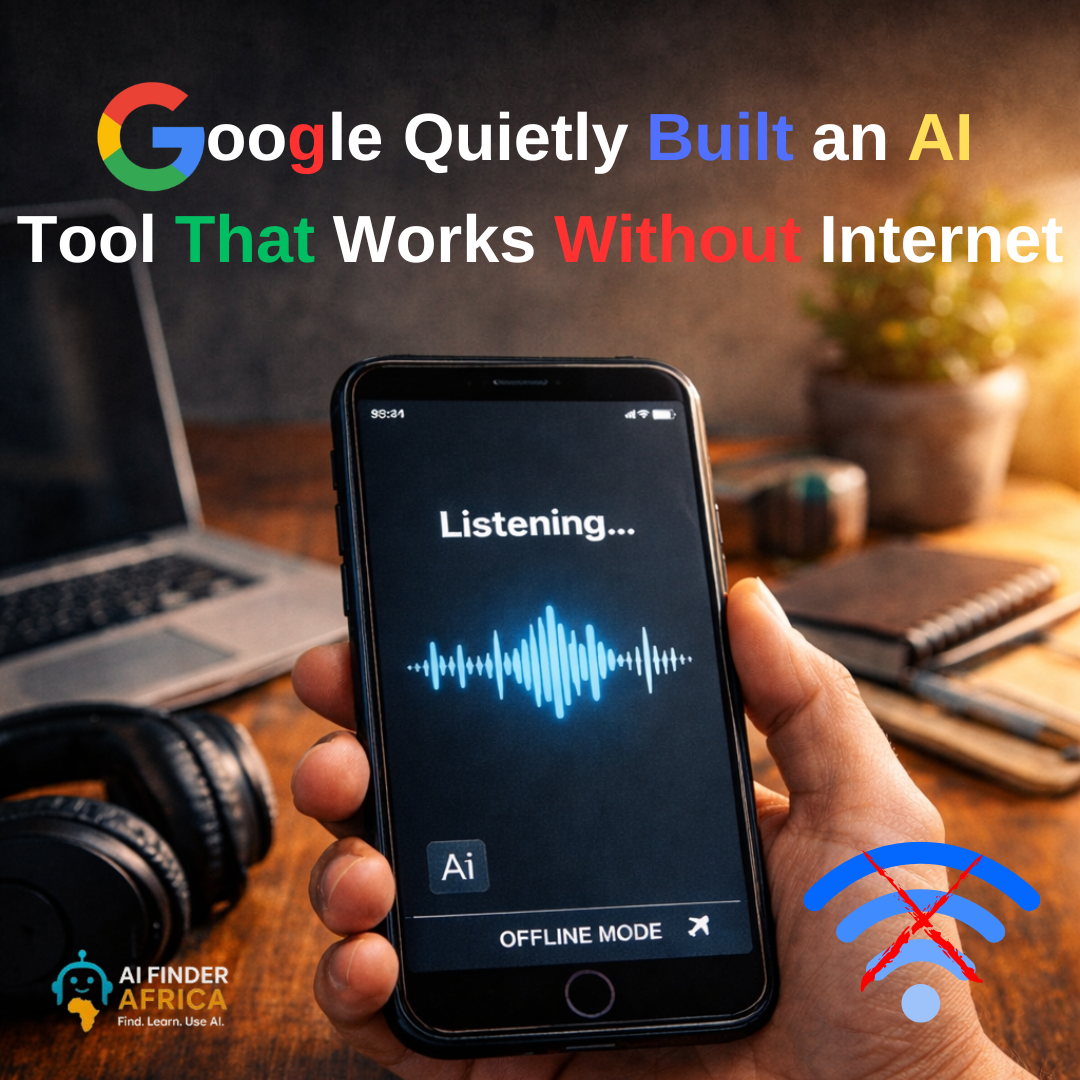
Google Quietly Built an AI Tool That Works Without Internet
No countdown. No Sundar Pichai on a stage with a laser pointer. Just an app.
Google did something completely out of character: it launched a product in silence. No fanfare, no keynote, no carefully worded press release timed to a Monday morning news cycle. Just a quiet little drop into the iOS App Store while the rest of the world wasn't looking.
The app is called Google AI Edge Eloquent. And if you haven't heard of it yet, well, that's kind of the point.
Your Voice, But Make It Professional
Here's something we've all experienced. You try to dictate a message, an email, maybe a note to yourself and what comes back is a disaster. A word-for-word transcript of every "uh," every false start, every time you said "so anyway" three times in a row before getting to the actual point.
Eloquent was built specifically to solve that problem and it goes about it differently from anything Google has shipped before.
This isn't a transcription tool. It is an editor. The moment you pause speaking, the app gets to work stripping out filler words, smoothing over mid-sentence restarts, and handing you back something that actually reads like you meant to write it.
As you speak, you see a real-time transcription alongside a waveform. Hit stop, and the app cleans everything up and automatically copies the result to your clipboard ready to paste wherever you need it.
And once the text is cleaned up, you're not stuck with just one version. Below the transcript are options like "Key points," "Formal," "Short," and "Long" to transform the text depending on what you actually need. Turning a rambling voice memo into a tight bullet-point summary? Done.
Making a casual rant sound boardroom-ready? Easy.
The Part That Should Make Every Privacy-Conscious Person Pay Attention
Most AI tools, even the ones you love, are sending your data somewhere. A server. A data centre. Someone's cloud. Eloquent flips that model on its head. All machine learning processing runs entirely locally on your iOS device. Your audio, confidential conversations, and personal data never leave your device.
"AI Edge" is Google's branding for on-device AI experiences, and Eloquent is perhaps the most consumer-ready expression of that vision yet. The app runs on Gemma-based speech recognition models downloaded directly onto your phone, meaning it works even when you're completely offline. No Wi-Fi, no data, no problem.
There is an optional cloud mode that brings in Gemini for heavier text cleanup, but you control that toggle. Want to keep everything strictly on-device? One switch, and your words never leave your hands.
Oh, and Did We Mention It's Completely Free?
No subscription. No usage limits. No freemium wall hiding the good features.
Google says the app offers "voice dictation without subscriptions" with "no cap" on usage. That positions Eloquent as a direct shot at competitors like Wispr Flow and SuperWhisper, both of which charge monthly fees for similar functionality.
The app also undercuts Apple's own built-in dictation, which is free but offers no filler-word removal, no text transformation, and no vocabulary learning. Eloquent does all three, for nothing.
It Actually Learns You
Here's the feature that quietly separates Eloquent from the pack. Users who sign in with a Google account can allow Eloquent to import frequently used words from their recently sent Gmail messages, building a vocabulary profile without requiring any deliberate configuration. Your industry jargon. Your colleagues' names. The niche terminology that makes standard dictation apps stumble. Eloquent picks all of that up automatically, privately, on your device.
You can also manually add custom words to the dictionary yourself, which is genuinely useful for anyone in medicine, law, finance, tech, or any field where the vocabulary is specific and unforgiving.
The Android Twist Nobody Saw Coming
Here's where the story gets a little spicy.
Google, the company that makes Android, launched this app on iOS first. That alone raised eyebrows across the tech press. Android is Google's own platform; it is where Google typically demonstrates new capabilities first. So, launching on iPhone before their own operating system is, to put it mildly, an unusual move.
But there's more. There was a prominent "Download for Android" button sitting right at the top of Eloquent's page. It was inactive, but it was a clear sign that a Google Play Store launch was imminent. That button has since completely vanished from the site. Whoever manages that page clearly jumped the gun and just as quickly tried to cover their tracks.
Google has since updated the App Store listing, removed references to the Android app, but added that an iOS keyboard is coming soon.
And the bigger picture? Google says it is "evaluating other platforms, including desktop, for tasks like dictating docs and code and prompting AI agents." This thing could grow well beyond a mobile app.
Why Does This Matter Beyond Just Another App Launch?
Because of what it signals.
The AI dictation space has been quietly exploding. Wispr Flow has built a loyal fanbase.
SuperWhisper dominates among Mac power users. These are paid tools that have carved out real markets. And now Google has walked into that space with something free, offline, and backed by one of the most powerful AI ecosystems on the planet.
If Eloquent proves itself, if users adopt it, if the accuracy holds up across accents and use cases, the implications stretch far beyond this single app. We could be looking at the foundation for the next generation of Google's keyboard, voice typing in Google Docs, and maybe even how you interact with Gemini itself.
The app exists. It's free. It works offline. That's more than most of its paying competitors can say simultaneously.
Google didn't make a big deal out of this. Maybe they're still testing. Maybe they wanted to see how it landed without the weight of expectation. Either way, it landed, and the quiet launch of a potentially category-defining tool is somehow the most Google thing they've done in a while.


 Explore