


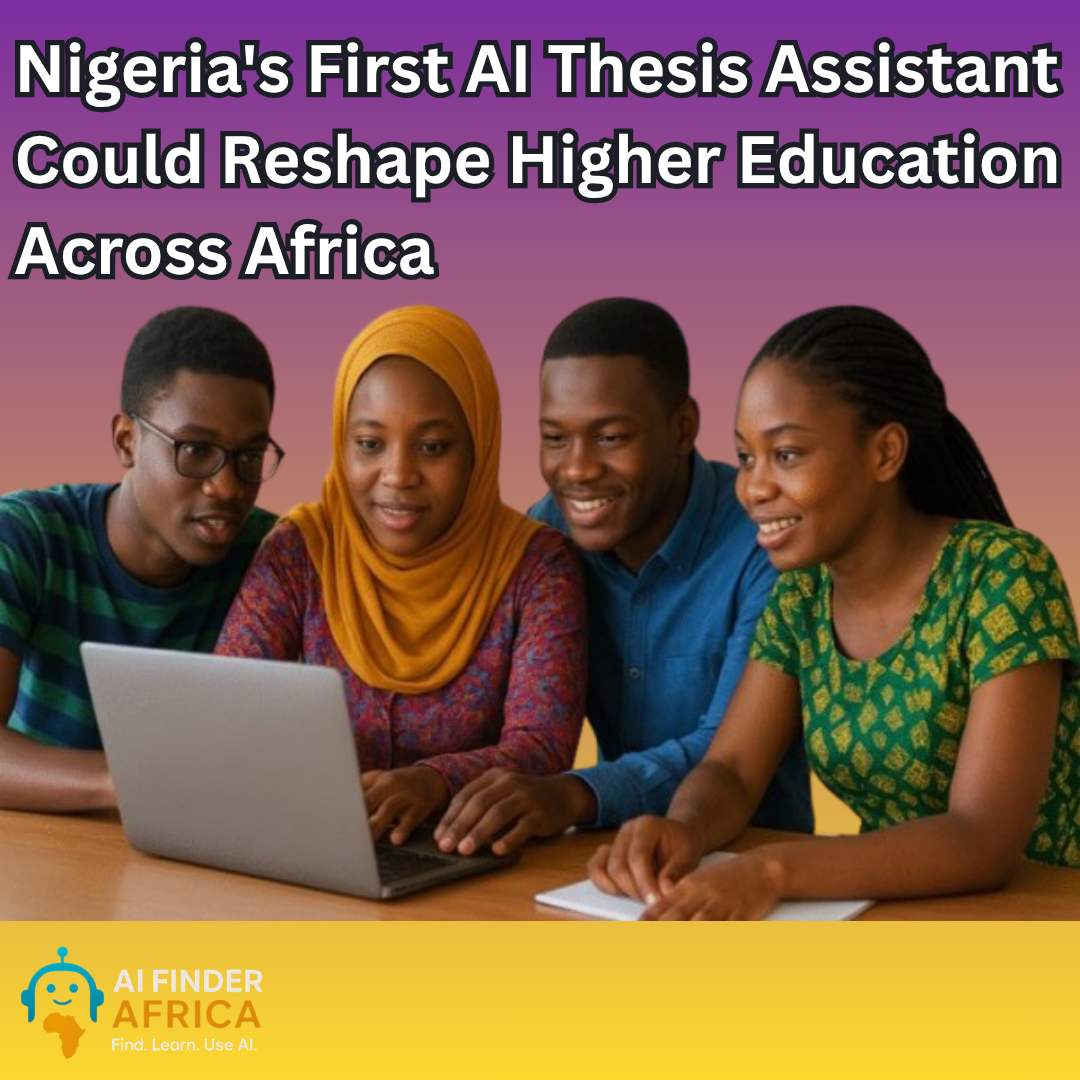
Nigeria's First AI Thesis Assistant Could Reshape Higher Education Across Africa
Nigeria's First AI Thesis Assistant Could Reshape Higher Education Across Africa
If you have ever written a final-year project, thesis, or dissertation, you know the feeling.
The endless literature reviews. The supervisor's corrections. The confusion over citations.
The frustration of staring at a blank page, wondering where to start.
For many students, writing a thesis is not just difficult; it is overwhelming.
Now imagine having an AI-powered research companion that doesn't simply write for you but actually guides you through the entire academic journey, from choosing a topic to preparing for your final defense. That future may have just arrived in Nigeria.
The University of Abuja (UniAbuja) has unveiled what is being described as Nigeria's first AI-powered academic research ecosystem dedicated to structured thesis, dissertation, and scholarly writing. Known as Thesis-SpeedWrite, the platform aims to help students and researchers navigate the complexities of academic writing while maintaining academic integrity and critical thinking.
And unlike many AI tools making headlines today, this one isn't trying to replace the researcher. It is trying to make researchers better.
The Problem Every Student Knows Too Well
Research writing has always been one of the biggest hurdles in higher education. Students often struggle with:
- Selecting a researchable topic
- Organizing literature reviews
- Managing references
- Structuring chapters
- Aligning methodology with objectives
- Responding to supervisor feedback
The challenge isn't always intelligence. Sometimes it's simply a lack of structure.
According to Professor Isaiah Ilo of UniAbuja's Department of Theatre Arts, years of interacting with students revealed recurring problems of confusion, inconsistency, weak methodological alignment, and poor literature management. Those observations eventually led to the creation of Thesis-SpeedWrite.
This Is Not Another "Write My Thesis" AI
That is what makes this story interesting. Most AI writing tools focus on generating text.
Type a prompt. Get an answer. Copy and paste. Done.
But Thesis-SpeedWrite takes a different approach.
Instead of functioning as a content generator, the platform is designed around a structured academic workflow. It guides users through research planning, topic refinement, literature organization, guided reading, chapter development, revision, and defense preparation.
Think of it less as an AI ghostwriter and more as an intelligent research coach. The platform includes tools such as:
- Project planning systems
- Table of contents builders
- Reference management libraries
- Literature mapping tools
- Guided reading frameworks
- Revision support systems
The goal is to help researchers stay organized while maintaining scholarly discipline.
Why This Launch Matters Right Now
The timing could not be more relevant. Universities around the world are still trying to figure out how AI fits into education. Some institutions worry that AI will encourage plagiarism and weaken critical thinking. Others see it as an opportunity to improve learning and productivity.
Meanwhile, AI adoption among students is skyrocketing.
Professor Ilo referenced findings from the UK's Higher Education Policy Institute showing student use of AI tools rose from 66% in 2024 to 92% in 2025.
The reality is simple:
AI is already in the classroom.
The debate is no longer whether students will use AI.
The debate is how they should use it.
Thesis-SpeedWrite appears to be one attempt at answering that question.
UniAbuja Wants AI to Support, Not Replace, Learning
One of the biggest concerns surrounding academic AI tools is whether they undermine genuine learning. UniAbuja says that is not the goal.
Vice-Chancellor Professor Hakeem Fawehinmi described the platform as a tool that complements critical thinking rather than replacing it. The system is designed to guide students through the research process while preserving academic standards and supervisory oversight.
That distinction is important. Because the future of education may not be about banning AI. It may be about teaching students how to use AI responsibly.
Africa's AI Opportunity
The launch also touches on a bigger conversation happening across the continent.
During the unveiling, representatives from the Nigerian Communications Commission highlighted how Africa largely missed the opportunities of previous industrial revolutions but now has a chance to play a more active role in the AI-driven Fourth Industrial Revolution. That message is becoming increasingly common.
Instead of simply importing technology, African institutions are beginning to build solutions tailored to local realities. Thesis-SpeedWrite is a good example. It was not developed in Silicon Valley. It was not imported from Europe.
It was built by Nigerian academics to solve Nigerian academic challenges. And that may be one of its most important achievements.
Could This Change Research Across Africa?
It is still early. No single platform will solve every challenge in higher education. But the idea behind Thesis-SpeedWrite reflects a growing shift in academia.
The future may belong to AI systems that don't just generate content but help users think more clearly, work more efficiently, and produce better research. If that vision succeeds, the platform could become more than a university project. It could become a blueprint for how AI is integrated into higher education across Africa.
And for the thousands of students currently battling deadlines, supervisor comments, and unfinished literature reviews, that future probably can't come soon enough. Because sometimes the biggest obstacle to great research is not knowledge. It is knowing where to begin.



 Explore