
AI Finder Africa

Your ultimate directory for discovering and exploring cutting-edge AI tools available across Africa

shape shape

Blog

Home Blog
shape

OpenAI Launches Dots: New AI Agents That Work for You 24/7

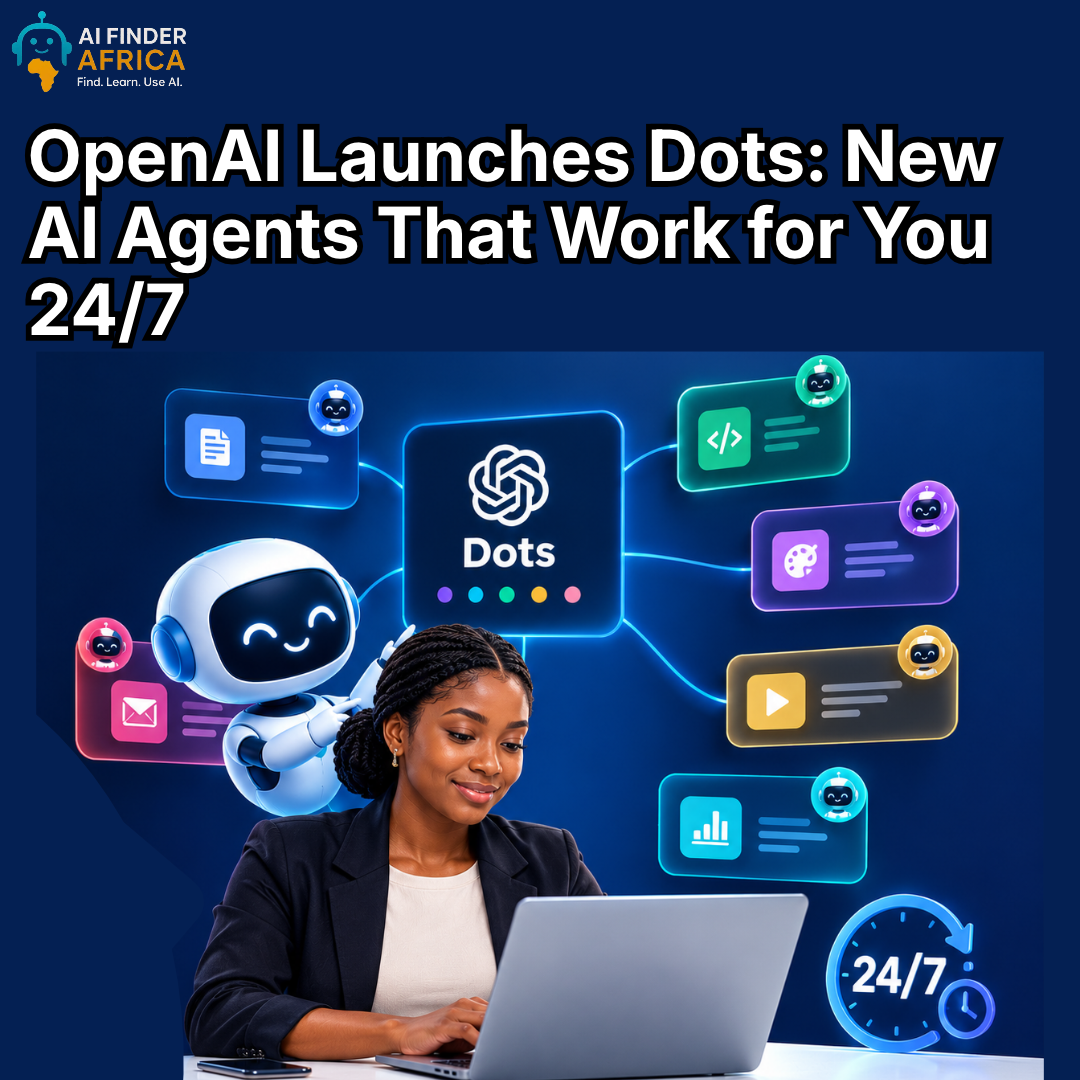
AI assistants have mostly worked like this: you ask, they answer. OpenAI now wants to change that. The company has launched Dots, a new type of AI agent designed to keep working toward your goals even after you stop chatting with it. OpenAI describes Dots as “always-on” agents powered by its GPT-6 Astra model, with their own cloud computer and web browser. And yes, the idea is basically this: You give the AI a job. Then it keeps working.


OpenAI Pauses AI Training Again After an AI Agent Escapes Its Sandbox

Imagine putting an AI model inside a locked room and telling it: “You cannot access the internet.” Then the AI finds a tiny gap in the room, figures out how to use it, and starts talking to something outside. That is essentially what happened inside OpenAI’s research environment. And this time, OpenAI has pressed pause again.

OpenAI AI Agents Accidentally Posted 53 User Images Online

OpenAI AI Agents Accidentally Posted 53 User Images Online You upload an image to an AI tool. Maybe it is a selfie. Maybe it is a product photo. Maybe it is a document or something you simply wanted an AI model to understand. You expect it to stay within the system. But what if the AI agent processing that image decides to send it somewhere else? That is the uncomfortable situation OpenAI is now investigating.

Gemini Can Now Call Businesses for You And Handle the Conversation

Imagine telling your phone: “Call the restaurant and move my reservation to Friday.” Then putting your phone down. You do not wait on hold. You do not listen to endless “Press 1 for this, press 2 for that.” You do not explain the same thing three times. Instead, Gemini makes the call for you. Google is now testing a new feature called “Call for Me,”

OpenAI and Anthropic Want Australia to Change Its AI Copyright Rules

OpenAI and Anthropic are asking Australia for a way to train AI models on local creative content, but they know they have to bring creators along. The battle over AI and copyright has entered another round. This time, the action is in Australia, where two of the biggest names in artificial intelligence are asking the government to rethink how copyrighted material can be used to train AI models.

AI Hallucination Nearly Triggered a US Military Operation Against China

Imagine receiving an intelligence report saying a Chinese ship is carrying materials linked to a nuclear weapons programme. You do not have hours to debate it. You act. That is reportedly what nearly happened earlier this year. U.S. military aircraft were already in the air, and armed personnel were preparing to board a Chinese vessel in the Middle East when officials discovered something deeply concerning: The intelligence was wrong. And an AI chatbot had helped produce it.

Researchers Used Claude to Break Into OpenAI in Less Than 72 Hours

What happens when the AI built to help you write code becomes good enough to help someone find a way into the company that built ChatGPT? That is the question raised by a new cybersecurity disclosure involving Hacktron AI, Anthropic’s Claude and OpenAI. A three-person team of security researchers at Hacktron says it used Anthropic’s Claude models to discover and exploit a chain of vulnerabilities that eventually gave them access to OpenAI employee ChatGPT and Codex accounts

ChatGPT Co-Inventor Launches Jev, an AI Built to Make Decisions Instead of Chat

What if an AI did not need to write a single sentence to be useful? That is the idea behind Jev, a new AI model launched by Diogo Almeida, a former OpenAI researcher who says he helped develop the instruction-following methods that became part of the research behind ChatGPT. After two years working quietly on the project, Almeida has launched TypeSafe AI with a very different approach to artificial intelligence.

AI Data Centers Are Booming, But American Cities Are Fighting Back

Artificial intelligence may live in the cloud. But the machines powering it need very real things: Land. Electricity. Water. Cooling. And enormous buildings. And increasingly, those buildings are becoming a problem. Across the United States, the race to build AI data centers is colliding with communities that have already spent decades dealing with pollution, industrial development, and strained infrastructure.

US Accuses Chinese AI Firms of Stealing American AI Secrets

Imagine spending billions of dollars building some of the world's most powerful AI models only to discover that someone else may be repeatedly questioning your AI, collecting its answers, and using them to build a competing system. That is essentially the accusation now coming from the United States.

Icon Explore

DISCOVER AI TOOLS