


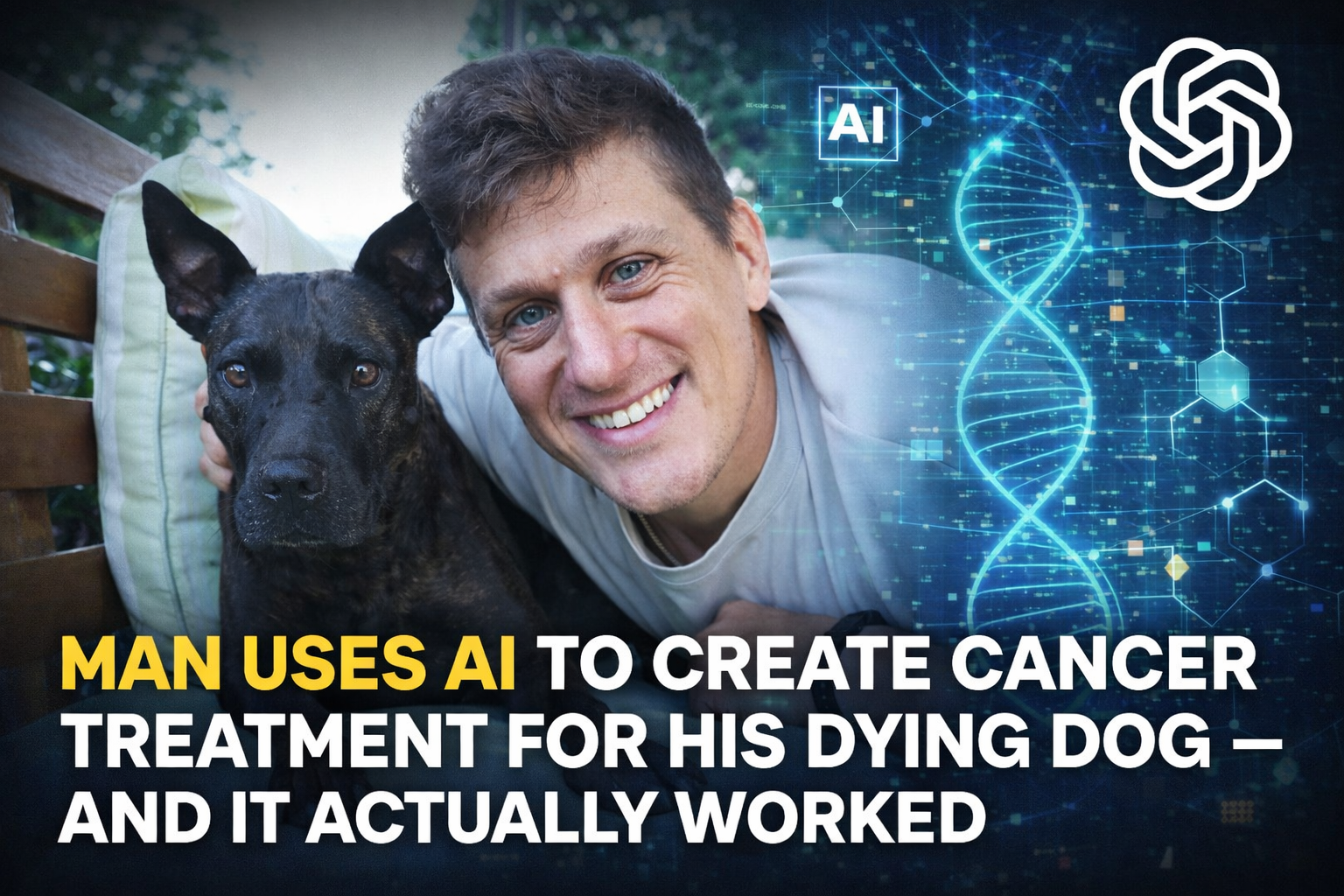
Man Uses AI to Create a Cancer Treatment for His Dying Dog — And It Actually Worked
It sounds like something straight out of a movie.
A man.
His dying dog.
And an unexpected partner: AI.
But this story is real, and it’s quietly becoming one of the most talked-about examples of what artificial intelligence can actually do in the real world.
It started with bad news no pet owner wants to hear
When Australian tech entrepreneur Paul Conyngham found out his rescue dog, Rosie, had aggressive cancer, the outlook was grim.
Surgery didn’t work.
Chemotherapy didn’t stop it.
Veterinarians told him there wasn’t much else to try.
Most people would have accepted it.
He didn’t.
So he turned to AI
Not a lab. Not a pharmaceutical company.
AI.
Conyngham began using tools like ChatGPT to explore possible treatment paths. That search led him into something far more complex: immunotherapy and genetic analysis.
He paid about $3,000 to sequence his dog’s DNA, trying to understand what was actually causing the cancer at a molecular level.
Then things got even more interesting.
Using AI tools, including systems that can analyse protein structures, he processed the genetic data to identify mutations and possible targets for treatment.
In simple terms?
He used AI to help answer a question scientists spend years trying to solve:
“What exactly is driving this cancer, and how do we stop it?”
From data… to a vaccine
With help from researchers at the University of New South Wales, that data turned into something groundbreaking:
A personalised mRNA cancer vaccine designed specifically for his dog.
Yes, really.
After regulatory hurdles and collaboration with scientists, Rosie received the treatment.
And then something unexpected happened.
The results shocked even researchers
The tumours began to shrink.
In some cases, significantly, with reports showing reductions of around 50%.
Her energy improved.
Her quality of life got better.
It wasn’t called a "cure", but it was something powerful:
More time.
The bigger picture
What started as one man refusing to give up on his dog has turned into a powerful signal:
We’re entering a world where AI doesn’t just assist humans
It collaborates with them to solve problems that once felt impossible.
And if AI can help design a cancer treatment for a dog…
You can’t help but wonder:
What’s next?



 Explore