


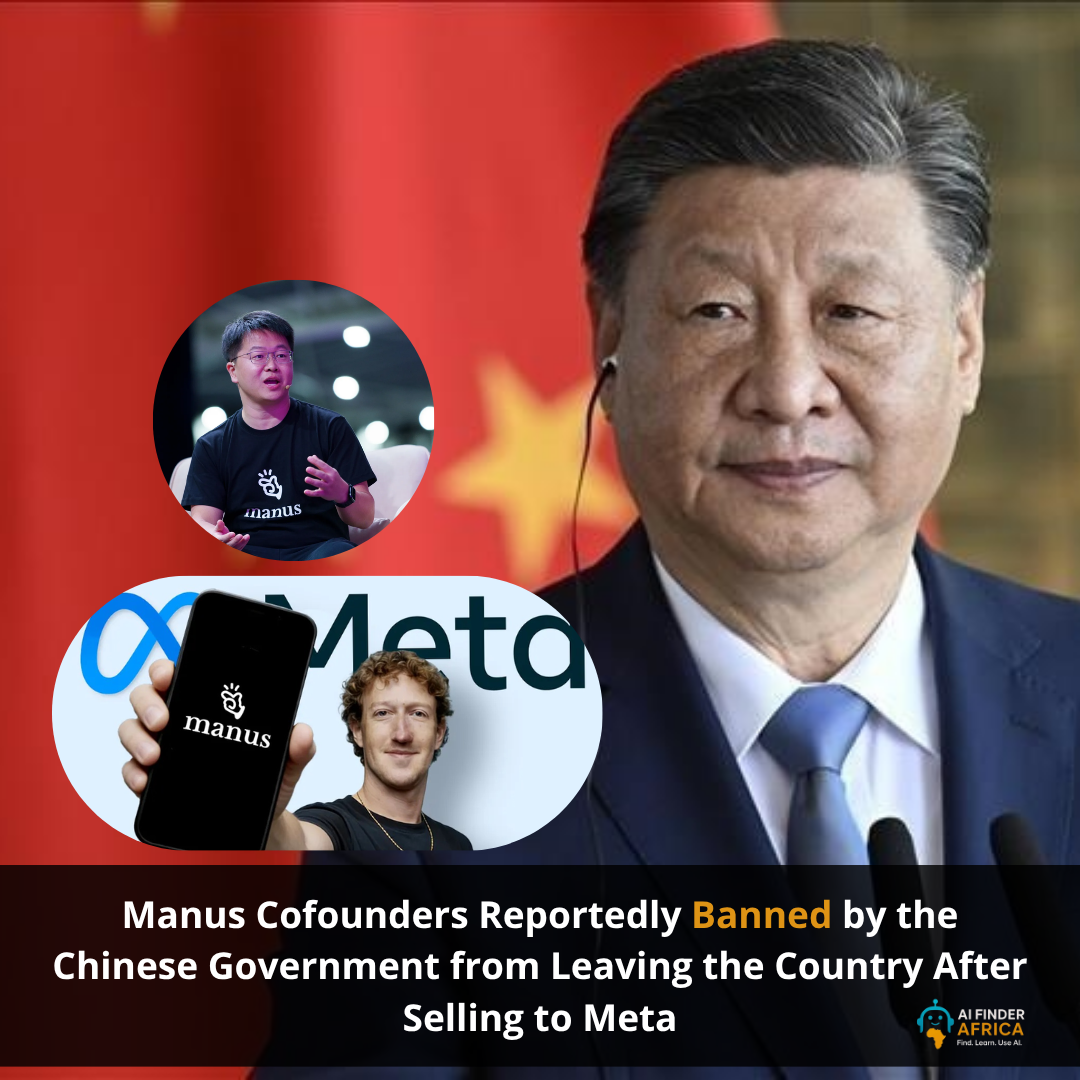
Manus Cofounders Reportedly Banned by the Chinese Government from Leaving the Country After Selling to Meta
It was supposed to be a big win.
A fast-rising AI startup. A multi-billion-dollar exit. And one of the biggest tech companies in the world, Meta writing the cheque.
But now? The story has taken a sharp, almost cinematic turn.
The Deal That Started It All
In late 2025, Meta acquired Manus, a fast-growing AI startup known for building autonomous AI agent systems that can actually do tasks like coding, research, and automation, not just chat.
The price tag? Around $2 billion.
For Meta, this wasn’t just another acquisition; it was a strategic move in the global AI race, where companies are scrambling to build smarter, more capable systems that go beyond chatbots.
Then Came the Plot Twist
Just months after the deal, things got complicated.
Chinese authorities reportedly blocked Manus’ co-founders from leaving the country, right in the middle of a regulatory review.
The founders, Xiao Hong and Ji Yichao, were called in for questioning in Beijing and later told they couldn’t leave.
They’re not under arrest.
They can move within China.
But they can’t leave.
So… What’s the Problem?
At the centre of this is something bigger than just a business deal:
Who gets to control powerful AI technology?
China is investigating whether the acquisition broke foreign investment and technology transfer rules, especially since Manus originally had roots in China before relocating to Singapore.
And here’s the key tension:
- AI is no longer just “tech”
- It’s now seen as national infrastructure
- And countries are treating it like a strategic asset
Bigger Than Just One Startup
This isn’t just about Manus.
It’s about a growing global reality:
AI companies are no longer just startups; they are becoming geopolitical assets.
China’s move signals a broader shift, tightening control over:
- Talent
- Intellectual property
- Advanced AI systems
Especially when foreign companies are involved.
What This Means for Tech (and Everyone Watching)
This situation raises some uncomfortable questions:
- Can founders truly “exit” if their tech is considered strategic?
- Will cross-border tech deals become harder or riskier?
- Are we entering an era where AI innovation is tied to national control?
Even Meta, which insists the deal followed the rules, is now caught in the middle of a high-stakes regulatory and political situation.
The Real Story Beneath the Headlines
At first glance, this looks like a business story.
But zoom out, and it’s something else entirely:
A glimpse into the future of tech
where billion-dollar deals don’t just involve companies… they involve countries, power, and control.
And in that world?
Even a $2 billion exit might not mean freedom.



 Explore