


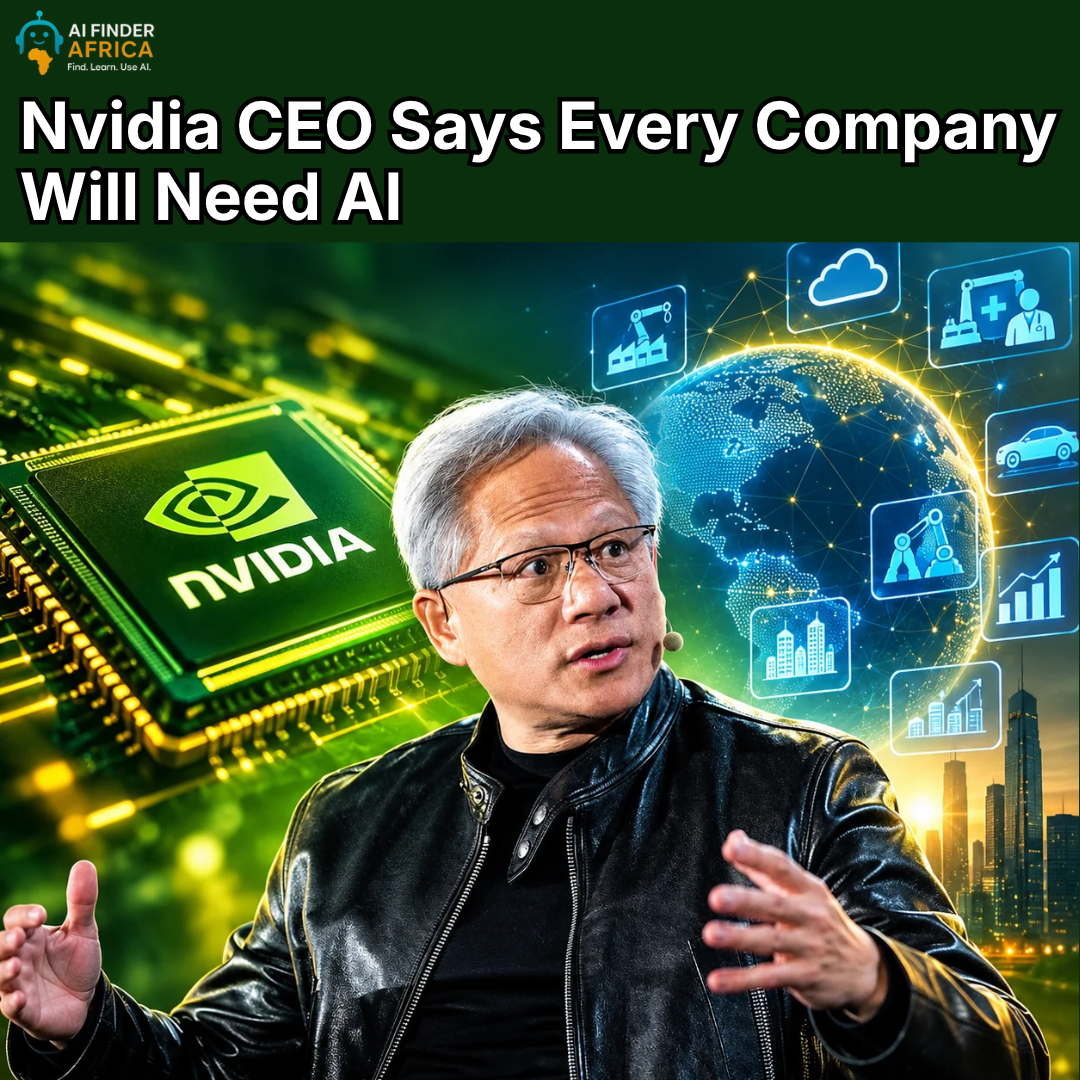
Nvidia CEO Says Every Company Will Need AI
Nvidia CEO Says Every Company Will Need AI
Imagine a future where AI helps a doctor discover new treatments, a car detect danger on the road, a bank analyse financial risks, and a fashion business understand what customers want. That future is already taking shape.
And according to Jensen Huang, the CEO of Nvidia, artificial intelligence will eventually become a major part of every company and industry.
Speaking during a visit to Stockholm, Sweden, in October 2026, Huang delivered a clear message: businesses should not treat AI as a passing trend. They should start preparing for a world where it becomes part of how work gets done.
“Every single company will be an AI company eventually. Every single industry will be impacted by AI,” he said.
But Huang is not just talking about the future. His company is investing billions of dollars in the infrastructure, businesses, and technology needed to make that future possible. So, what exactly does this mean for businesses, workers, and anyone trying to understand where AI is heading?
Why Does Nvidia Believe Every Business Will Use AI?
To understand Huang's prediction, look at how businesses operate today. Companies spend time answering customer questions, analyzing information, managing inventory, developing products, detecting problems, and making decisions. AI can help with many of these tasks.
A retailer could use it to analyze buying patterns and improve stock planning. A marketing team could use AI to study campaign performance, generate ideas, and identify opportunities to reach potential customers. A manufacturer could use it to spot equipment problems before they cause expensive breakdowns.
The technology will not perform every task perfectly, and businesses still need people to check its work. But even when AI handles only part of a process, it can change how a company operates. That is the bigger idea behind Huang's prediction.
AI is moving beyond a tool people open occasionally to ask questions. It is becoming something businesses can build into their everyday operations, products, and services. In the same way companies adopted the internet, cloud computing and digital payments, many may eventually need AI to remain competitive.
The real question is no longer simply whether a business should experiment with AI. It is where the technology can deliver genuine value.
Nvidia Is Investing Billions to Build Europe's AI Future
Huang's comments came during a European tour focused on strengthening the region's AI industry.
In Stockholm, he said Nvidia had invested $8 billion in Europe over the previous year, with several billion dollars more in the pipeline at that time. By October 21, Report says that Nvidia's investments in the region had grown to nearly $10 billion. These investments support different parts of the AI ecosystem, including companies providing computing infrastructure and AI cloud services.
Why does that matter?
AI needs more than a chatbot and a good internet connection. Developing and running advanced AI systems requires powerful computing equipment, data centers, software and skilled people. Without enough infrastructure, businesses and researchers may struggle to build, train or run the AI systems they need.
Huang has therefore encouraged Europe to develop the full AI technology chain, from computing infrastructure to the applications people use. His message is that Europe should not simply consume AI products developed elsewhere. It should also build the technology, businesses and expertise needed to compete in the industry.
This is an important distinction. The countries and companies that develop AI infrastructure and products can have greater influence over how the technology evolves and where its economic benefits go.
Meet Sferical One: Sweden's New AI Supercomputer
One of the major developments during Huang's Stockholm visit was the launch of Sferical One, a shared AI supercomputer built in Sweden using Nvidia technology. The system is designed to give major Swedish companies access to advanced computing resources without each organization having to build an equivalent system independently.
Its founding partners include AstraZeneca, Ericsson, Saab, SEB and Wallenberg Investments, with SKF as a strategic partner.
The companies are exploring AI applications across different industries.
For example, pharmaceutical researchers can investigate how AI might support drug discovery. Telecommunications companies can develop advanced AI models, while manufacturers can explore predictive maintenance and quality control.
Financial institutions can also investigate AI applications for their operations.
Another important feature is local control. Sferical One is designed to let participating organizations develop and run AI workloads on infrastructure in Sweden, helping them retain greater control over sensitive data and their technology environments.
That matters in industries where information security, privacy and regulatory requirements are essential. The project illustrates how AI is becoming part of the underlying infrastructure of business, rather than remaining limited to individual applications.
Nvidia Is Also Helping Bring AI Into Cars
Nvidia's AI ambitions extend beyond computers and data centers.
During the same Stockholm visit, Volvo Cars announced an expanded partnership with Nvidia to advance safety technology for future automated-driving systems. The collaboration combines Volvo's long experience in vehicle safety with Nvidia's computing hardware and AI technology.
The goal is to help future vehicles understand complex driving environments, including busy city streets, highways, and parking situations. Think about how much information a car must process to navigate safely. It needs to interpret its surroundings, recognize potential hazards, and respond to changing conditions.
AI computing can help support these capabilities, but automated driving must also be tested carefully to ensure that systems behave safely in real-world situations.
The partnership is another example of how AI is moving into physical products. It is no longer just about writing text, generating images, or answering questions. AI is also being developed to help machines interpret the world and act within it.
From industrial equipment to vehicles, this is one of the areas expected to shape the next phase of AI development.


 Explore