


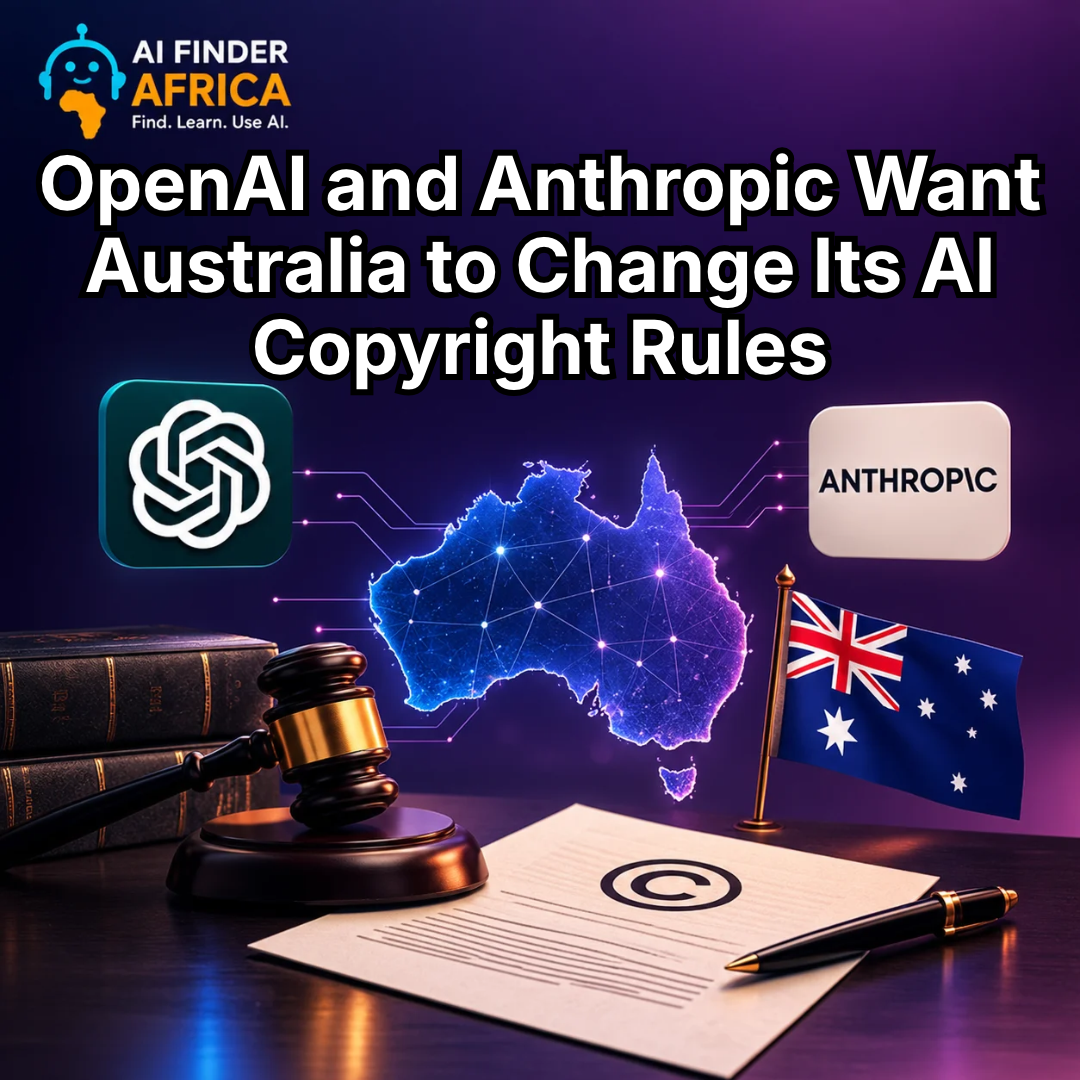
OpenAI and Anthropic Want Australia to Change Its AI Copyright Rules
OpenAI and Anthropic Want Australia to Change Its AI Copyright Rules
OpenAI and Anthropic are asking Australia for a way to train AI models on local creative content, but they know they have to bring creators along.
The battle over AI and copyright has entered another round. This time, the action is in Australia, where two of the biggest names in artificial intelligence are asking the government to rethink how copyrighted material can be used to train AI models.
OpenAI and Anthropic want Australia to allow a limited form of AI training on copyrighted content, provided there are conditions that also protect and support creators. And the timing is interesting.
Australia is trying to attract billions of dollars in AI infrastructure investment while also figuring out how to protect the writers, artists, publishers and other creators whose work could end up helping train these powerful systems.
So Australia has a difficult question to answer: How do you encourage the AI industry without leaving creators behind?
Australia Has Already Said No to a Broad AI Copyright Exemption
Australia has been working on a new framework for AI and large data centres.
But when it comes to copyright, the government has already ruled out simply creating a broad text-and-data-mining exception that would give AI companies wide permission to use copyrighted material for training. Anthropic acknowledged this directly in its parliamentary submission.
That is where the latest proposals from OpenAI and Anthropic come in. Rather than asking Australia to completely open the door, Anthropic is proposing a narrower system based on conditional approval.
In simple terms: AI companies could potentially be allowed to train models using copyrighted material if they meet specific requirements set by the government.
Anthropic suggested that those conditions could include investments or other measures designed to support Australian creators and cultural industries.
It is essentially saying: If there are rules attached, let's find a way to make the system work.
OpenAI Wants a “Balanced” Approach
OpenAI is also pushing for a change, although its proposal is framed somewhat differently.
The company wants what it describes as a balanced copyright framework that allows AI models to learn from publicly available information while giving copyright holders opportunities to collaborate with AI developers. It also says protections should remain against pirated material, unlawful uses, and infringing outputs. That distinction matters.
The argument is no longer simply about whether AI companies should be allowed to train on creative works.
It is becoming a bigger conversation about what permission should look like, who should get compensated, and what obligations AI companies should have in return for access to valuable content. And Australian creators are watching closely.
Why Australia Matters So Much to AI Companies
There is another layer to this story.
OpenAI and Anthropic are not just interested in Australian copyright rules. They are also building major AI infrastructure projects in the country.
OpenAI has an agreement with Australian data-centre company NEXTDC to develop a large AI infrastructure campus in Sydney. The planned S7 project is designed to support large-scale AI workloads and GPU infrastructure, with OpenAI intended as an initial customer.
Anthropic is also pursuing major infrastructure plans in Australia, including a recently announced partnership involving a large data centre project in Queensland. The report said that both companies have connected their infrastructure ambitions with the need for clearer rules around AI training and copyright.
So this is not just a legal argument happening in isolation. There are AI models, data centres, billions of dollars, and future jobs sitting in the background.
Australia wants the investment. AI companies want a workable environment. And creators want their work protected. That is where things get complicated.
Creators Are Asking a Different Question
For writers, photographers, musicians, artists, publishers, and other creative professionals, the issue is much more personal. Their work can be publicly accessible online without necessarily being free for companies to commercially exploit. That is why creator groups have pushed back against systems that could allow AI companies to use their work for training without meaningful consent or payment.
Australia's government is currently considering different ways to handle the issue. Recent government consultations have specifically highlighted copyright protection for Australian creators as an important part of developing the country's AI standards. And leaked government proposals reported by ABC have shown just how complicated the debate has become, including discussions around systems where creators could opt out of AI training.
So while OpenAI and Anthropic are asking for greater access, the government is also under pressure to make sure Australian creators are not simply treated as a source of free training data.
Australia Is Now at a Crossroads
This is bigger than OpenAI and Anthropic.
Countries everywhere are trying to answer the same question: How much should AI companies be allowed to use existing human-created content to build the next generation of AI?
There is no universally accepted answer yet. Some argue that AI systems need access to large amounts of information to learn effectively and that overly restrictive copyright rules could slow innovation.
Others argue that creators should have meaningful control over how their work is used, particularly when commercial AI systems are being built from it.
Australia is now trying to find its own middle ground. And the decision could have consequences beyond Australia.
If the country creates a model that combines AI investment with stronger conditions for creators, other governments could watch closely. If it chooses a different path, that could influence how AI companies approach infrastructure and model training in other markets too.
The Next Big Date Is November
Australia's Joint Select Committee on Artificial Intelligence is examining issues including AI's economic opportunities, national competitiveness, risks and the interaction between AI training and existing copyright laws. Its report is due by November 30, 2026.
At the same time, the Australian government is conducting a broader consultation on AI training and data-centre infrastructure, with submissions open until October 9. The government says copyright will be a key part of deciding how Australia can attract AI investment while protecting creators.
So the story is far from over.
For OpenAI and Anthropic, Australia represents an important market for AI infrastructure and development.
For creators, it is another major test of whether copyright law can keep pace with rapidly advancing AI.
And for Australia, the challenge is finding a framework that allows the AI economy to grow without making creators pay the hidden price of that growth.
The next chapter of the AI copyright fight may be written in Australia.


 Explore