

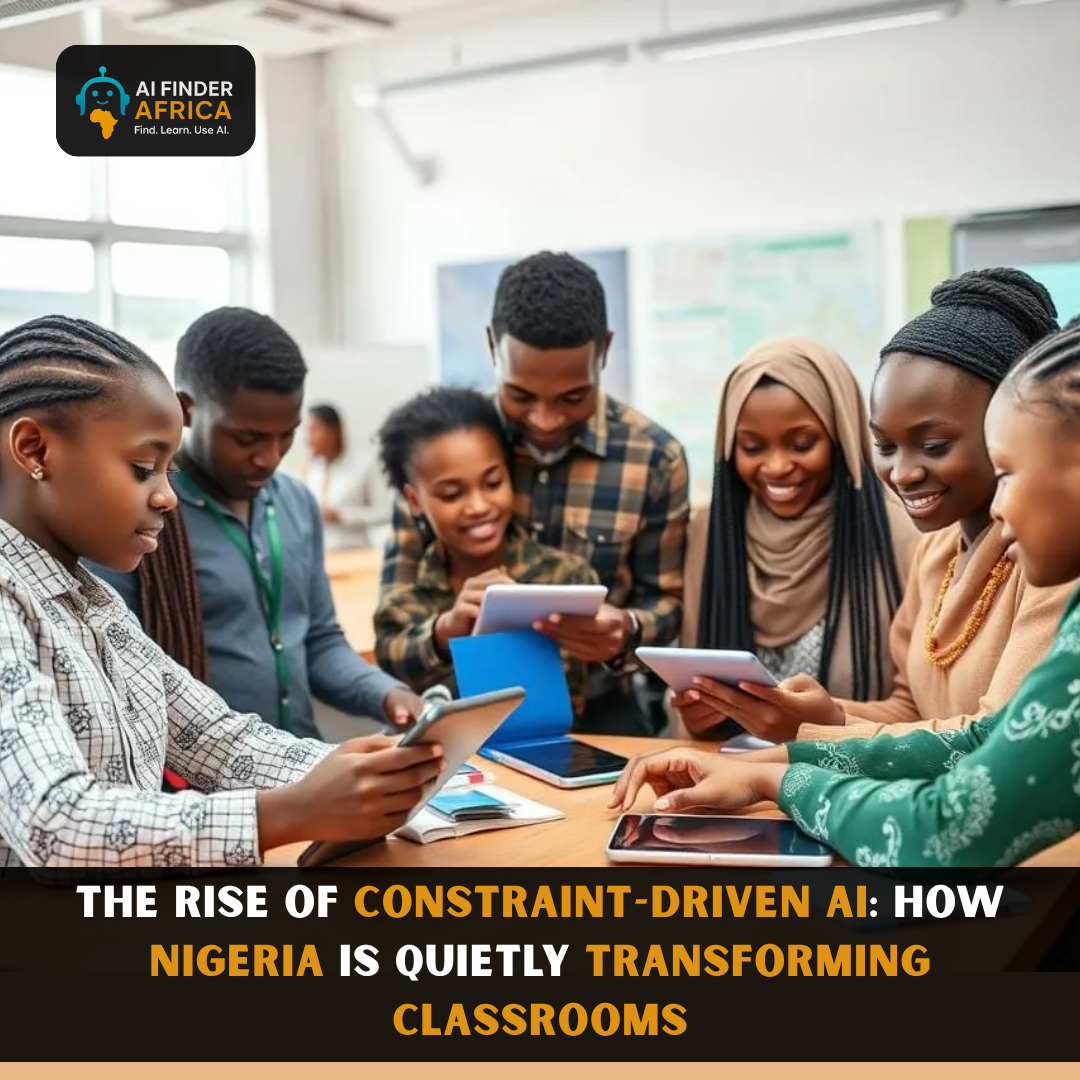
The Rise of Constraint-Driven AI: How Nigeria Is Quietly Transforming Classrooms
What happens when you build AI for people who don’t have perfect internet, expensive laptops, or unlimited data?
In Nigeria, that question is no longer theoretical; it is shaping an entirely new kind of innovation.
And at the centre of it is something powerful: constraint-driven AI.
A different kind of AI story
While much of the world builds AI for speed, scale, and cutting-edge hardware, Nigerian innovators are doing something different.
They’re building for reality.
Think basic Android phones, unstable internet connections, and limited access to expensive tools.
Instead of seeing these as barriers, designers like Cindy Shontan are turning them into an advantage.
Because when you design under constraints, you’re forced to focus on what actually matters: people.
Inside Nigeria’s AI-powered classrooms
Over the past five years in Lagos, Cindy has been working on AI tools for teachers, and what she discovered is surprising.
AI isn’t replacing teachers. It is making them better.
One tool, for example, helps teachers generate weeks of lesson plans in minutes. What used to take hours (or even weeks) now becomes a quick starting point.
But here’s the twist: teachers don’t just copy and paste.
They edit. They adapt. They personalise.
AI becomes a first draft, not the final answer. And that changes everything.
Instead of being overwhelmed with administrative work, teachers can:
- Focus more on students
- Give individual attention
- Spend time actually teaching
That’s not automation taking jobs; it is amplification.
The moment everything clicks
At first, many teachers were skeptical.
Some saw AI as "cheating". Others didn’t trust its accuracy.
But then something interesting happened.
The moment a teacher saw a full week’s lesson notes generated in minutes and realised they could tweak everything, that skepticism faded.
Fast.
What no amount of persuasion could do, experience did instantly.
Even more interesting? Teachers developed their own hybrid workflow:
- Use AI to generate content
- Refine it based on their classroom reality
- Deliver something more tailored than ever before
This wasn’t designed; it emerged naturally. And it might be the most sustainable way humans and AI will work together.
Designing AI people can actually trust
In a system dealing with students, parents, and education, trust isn’t optional.
So these tools were built differently.
Instead of overwhelming users with complex AI insights, they follow a simple rule: say just enough.
For example: Not: “Your child demonstrates weakness in fractional arithmetic." But: “Here are 3 ways to help your child understand fractions this week."
See the difference?
It is not just data; it is actionable help.
Even more importantly, AI suggestions are never presented as final truths; everything is editable, and users stay in control.
That transparency builds trust faster than any technical explanation ever could.
Why constraints might be Nigeria’s biggest advantage
Here’s the part most people miss.
The limitations in Nigerian devices, connectivity, and infrastructure are forcing builders to create leaner, smarter, more human-centred AI.
And over time, that could become a global advantage.
Because while others are building AI that assumes perfect conditions, Nigeria is building AI that works anywhere.
The real risk isn’t AI, it’s access
When people talk about AI, the biggest fear is job loss.
But from what’s happening in Nigerian classrooms, the bigger issue is something else: Who gets access and who doesn’t.
Because the teachers who do get access to these tools? They become faster, more effective, and more impactful.
Those who don’t risk being left behind.
Final thought
Nigeria’s AI story isn’t about flashy breakthroughs or billion-dollar models.
It’s about something quieter, but arguably more important.
Building AI that works for real people, in real conditions, solving real problems.
And in classrooms across the country, that approach is already transforming how education happens, one lesson plan at a time.



 Explore