


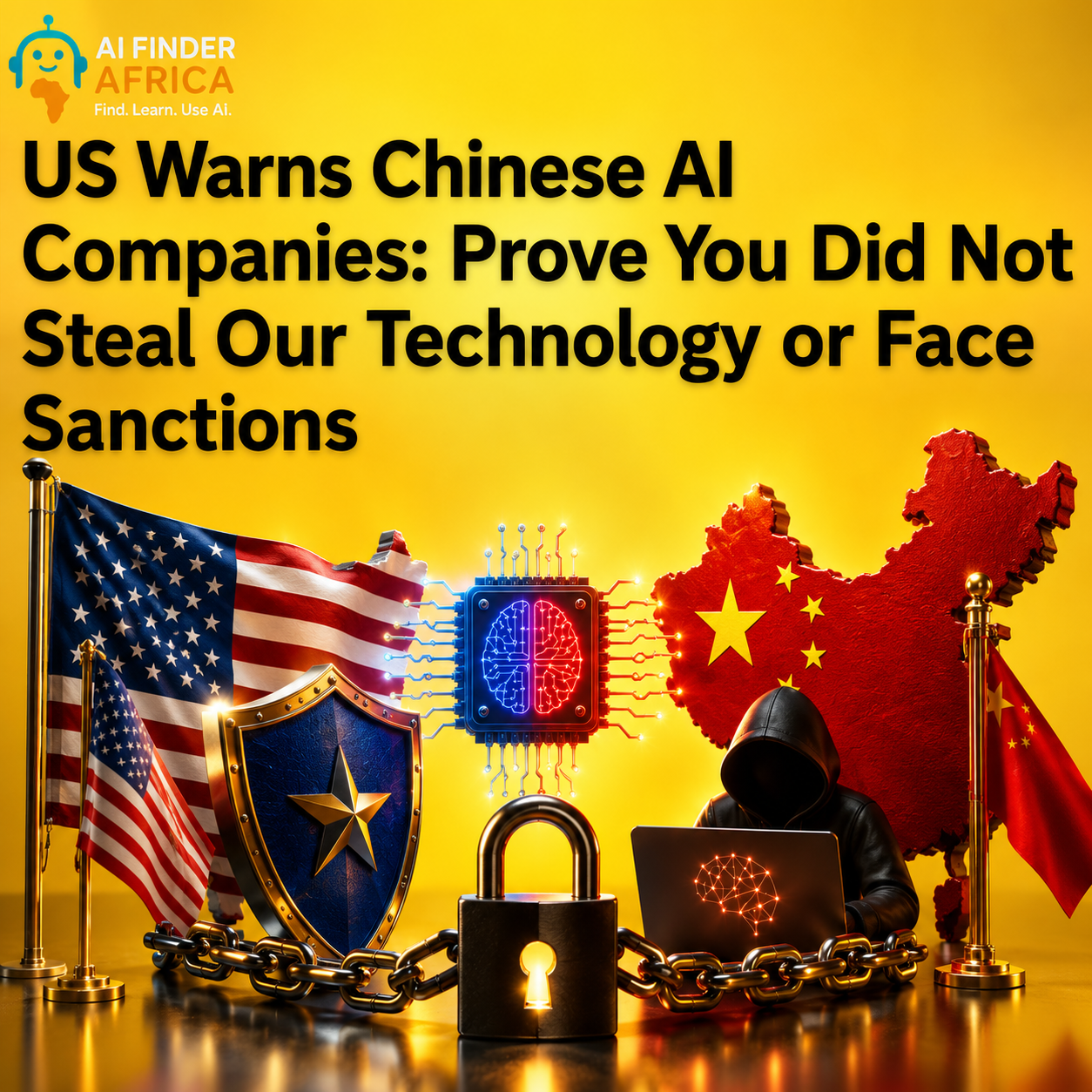
US Warns Chinese AI Companies: Prove You Did Not Steal Our Technology or Face Sanctions
US Warns Chinese AI Companies: Prove You Did Not Steal Our Technology or Face Sanctions
The AI race just took another dramatic turn.
For months, the biggest conversation in artificial intelligence has been about who can build the smartest models. Now, the focus is shifting to something even more controversial:
Who owns the technology behind them?
The United States has warned that Chinese AI companies could face sanctions if investigators determine their AI models were built using intellectual property stolen from American firms. The statement marks one of the strongest signals yet that Washington is prepared to treat AI models, not just computer chips, as a matter of national security.
If those warnings become action, the global AI industry could be heading into one of its biggest geopolitical battles yet.
The Warning That Grabbed Headlines
Speaking in an interview with Fox Business, U.S. Treasury Secretary Scott Bessent said the Trump administration supports open-source AI but not if it is built using stolen technology.
According to Bessent, the U.S. government will examine Chinese open-source AI models for evidence of intellectual property theft. If investigators conclude that American innovations were copied illegally, sanctions against the companies involved could follow.
His comments come as Chinese AI models have rapidly gained attention for delivering cutting-edge performance at significantly lower costs than many Western competitors.
Why Is the US So Concerned?
Chinese AI companies have made remarkable progress over the past year.
Models from companies such as Moonshot AI, DeepSeek, MiniMax, Alibaba, and Z.ai have demonstrated that China is no longer simply following the United States in AI development; it's becoming one of its biggest competitors.
One of the latest examples is Kimi K3, an open-weight model from Moonshot AI that has generated widespread attention after posting benchmark results competitive with leading American AI systems while remaining far less expensive to use.
That rapid progress has fueled concerns among U.S. AI companies, some of which argue that Chinese developers may have benefited from unauthorized use of their technology.
The Debate Over "Model Distillation"
At the center of the controversy is a technique called model distillation.
Imagine teaching a student by letting them observe how an expert solves problems.
That is essentially how AI distillation works.
A smaller model learns from the outputs of a larger, more capable model to reproduce some of its abilities more efficiently.
Supporters argue it is a legitimate machine learning technique that has existed for years.
Critics argue that using proprietary AI models without permission to build competing systems crosses the line into intellectual property theft.
There is currently no universal legal agreement that model distillation automatically constitutes IP theft, making the issue one of the most hotly debated topics in AI policy today.
Not Everyone Agrees With Washington
The proposed crackdown is not receiving unanimous support even inside the technology industry.
Microsoft CEO Satya Nadella recently questioned the idea that distillation should automatically be treated as theft, arguing that AI innovation has long relied on learning from existing research.
Similarly, Hugging Face CEO Clem Delangue has argued that distillation is only one small factor behind China's AI progress. In his view, China's rapid advances are largely the result of world-class research teams, significant investment, and an increasingly collaborative open-source ecosystem, not simply copying Western models.
The disagreement highlights just how complicated AI ownership has become.
Another Front in the US–China AI Rivalry
The latest warning is part of a much broader technology rivalry.
Over the past few years, Washington has already:
Restricted China's access to advanced AI chips, Tightened export controls on semiconductor technologies, Increased scrutiny of foreign investment in AI, expanded efforts to protect American AI research and intellectual property.
Now, AI models themselves could become targets of economic sanctions.
That would represent a significant escalation in the competition between the world's two largest economies.
Why This Matters Beyond Politics
This is not just a fight between governments.
It could affect:
Businesses choosing AI models for their products, Developers relying on open-source AI, Investors backing AI startups, Researchers collaborating across borders, Enterprise customers deploying Chinese AI systems.
If sanctions are imposed, companies using certain Chinese AI models could face legal, commercial, or compliance challenges, potentially reshaping the global AI market.
The Bigger Picture
Artificial intelligence is no longer just about writing code, generating images, or answering questions.
It is becoming a strategic technology on par with semiconductors, telecommunications, and energy.
The debate over intellectual property, open-source AI, and model distillation is likely to define the next chapter of the global AI race.
For now, the U.S. has issued a warning, not a final verdict. No sanctions have been announced, and no Chinese AI company has been formally found to have violated U.S. intellectual property laws.
But one thing is clear: the competition between American and Chinese AI companies is no longer just about who builds the smartest model.
It is increasingly about who owns the ideas behind it.


 Explore