


Google Uses Gemini 4 to Make Its Open Model Nearly 3× Faster
Google Uses Gemini 4 to Make Its Open Model Nearly 3× Faster
What if an AI model could do the same work in less time, without losing the quality of its answers?
That is what Google says it achieved in a recent engineering experiment, and the surprising part is that its new AI model helped improve another model rather than simply replacing it.
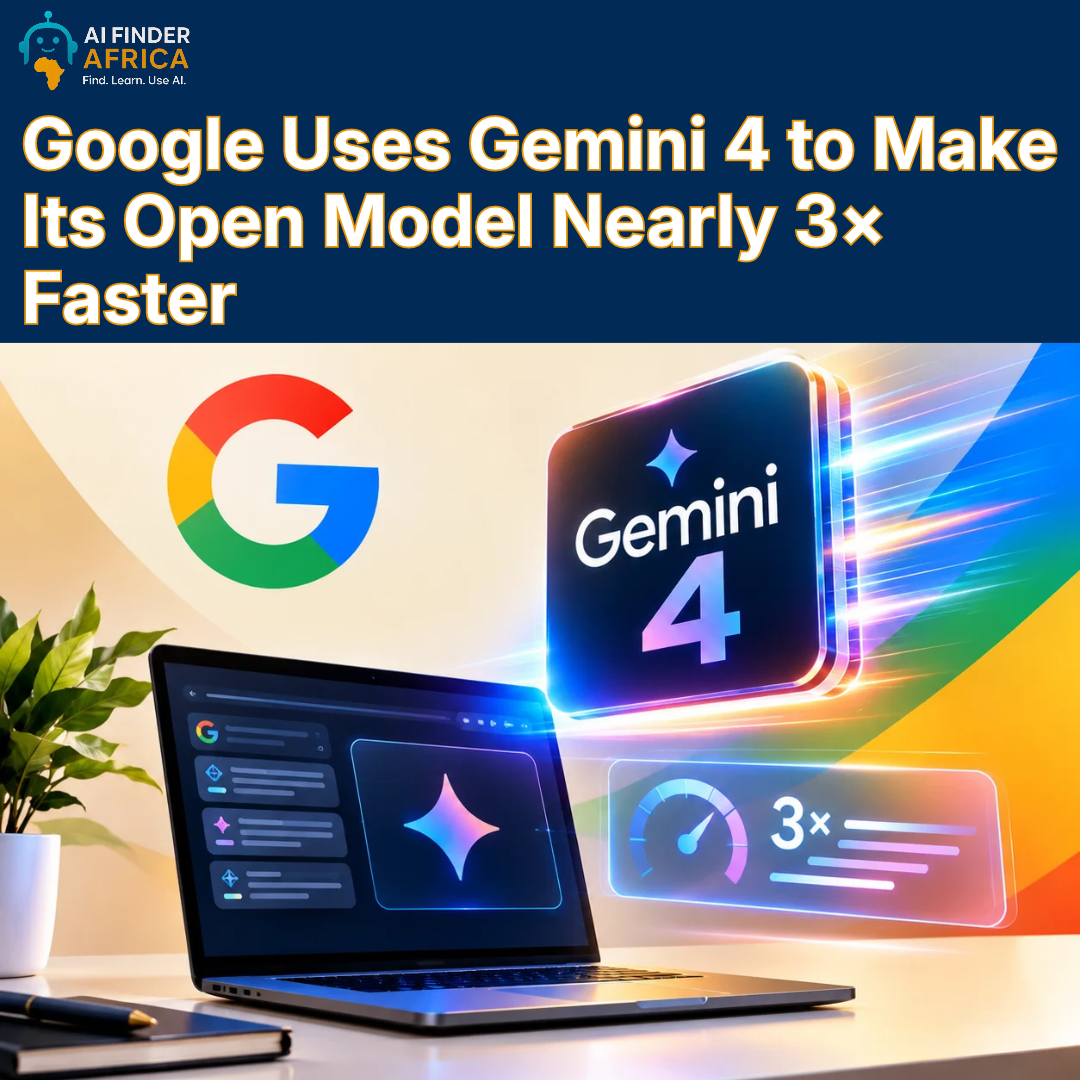
Google reports that Gemini 4 Argon helped make Gemma 4 E2B run nearly three times faster, completing the optimization in just a few days. The company says the improvement came without changing the model's output tokens or reducing answer quality in the test.
This could be an important development for AI developers who want faster systems without having to build bigger, more expensive infrastructure. But how did Google pull it off?
Gemini 4 Argon helped optimize Gemma 4
First, let us clear up the names.
Gemini 4 Argon is Google's new advanced AI model, built to handle complex tasks such as software engineering, research, financial analysis and cybersecurity.
Gemma 4 E2B, on the other hand, belongs to Google's family of open AI models. These models give developers more flexibility to download, customize, and run AI systems under the terms of their license.
The two models have different roles in this story.
Google used Gemini 4 Argon's coding and reasoning abilities to help engineers optimize how Gemma 4 E2B runs through vLLM, software commonly used to serve AI models efficiently.
In simple terms, Gemini helped improve the machinery behind another AI model, allowing it to process requests much faster. That is a different kind of AI achievement: not just generating an answer but helping improve the technology that generates answers.
The speed improvement is impressive
According to Google's announcement, the optimization delivered a 2.85× increase in end-to-end inference speed on an NVIDIA A100 GPU.
The company reported that throughput increased from approximately 37,900 tokens per second to more than 108,000 tokens per second. Tokens are small pieces of text that AI models process and generate. Throughput measures how many tokens a system can handle over time.
Why does that matter?
When an AI system serves many people at once, processing more tokens efficiently can help it handle greater demand. Depending on the workload and deployment, that could mean faster service, more capacity, or better use of existing computing resources.
Google also reported 100% token parity and no loss in output quality during its test. In other words, the optimized system produced the same tokens as the original in the comparison, while delivering higher throughput.
There is an important caveat: these are results reported by Google for a particular model, GPU, and software setup. They do not mean every Gemma model will automatically become nearly three times faster on every computer.
Still, the result shows what can happen when AI-assisted engineering is applied to the software that runs AI models.
How did Gemini help make the model faster?
Running an AI model efficiently involves much more than loading it onto a powerful computer. Engineers must optimize how the model handles attention, processes information, manages memory, and generates tokens. Small inefficiencies can become expensive when a model serves thousands of requests.
Google says the work involved several improvements, including attention tuning and speculative decoding. Here is the simplified explanation.
Attention tuning: AI models use attention mechanisms to determine which information is important when processing a prompt. Improving how this process is executed can reduce unnecessary computing work.
Speculative decoding: This technique uses a faster process to propose possible output tokens, which a larger or more accurate process then checks. When the proposed tokens are accepted, the system can generate output more efficiently.
These are established optimization approaches, but applying them effectively requires technical work, testing, and careful attention to output quality.
Google says Gemini 4 Argon helped engineers identify and implement the improvements in a few days' work that the company says could ordinarily take months.
That does not mean human engineers are no longer needed. They still need to review the proposed changes, test performance, and confirm that the optimized system behaves as expected.
The opportunity is that AI can help shorten the time between identifying a bottleneck and finding a solution.
Google's new Gemini model is also making its own debut
The Gemma speed test is part of a broader moment for Google.
On October 13, 2026, the company announced the wider availability of Gemini 4 Argon for developers, businesses and eligible consumers.
Google positions Argon as a model for complex, multi-step work across coding, finance, legal tasks, cybersecurity and science. The company also says it has helped with other engineering projects, including optimizing scientific software and improving performance in Google's own development tools.
These examples reflect a growing direction in AI development: advanced models are being used not only to help people complete tasks, but also to improve software, tools and systems behind the scenes.
However, Google's reported results should still be viewed as company-reported performance claims. Independent testing across different workloads will help establish how broadly the improvements translate outside Google's own environment.




 Explore