


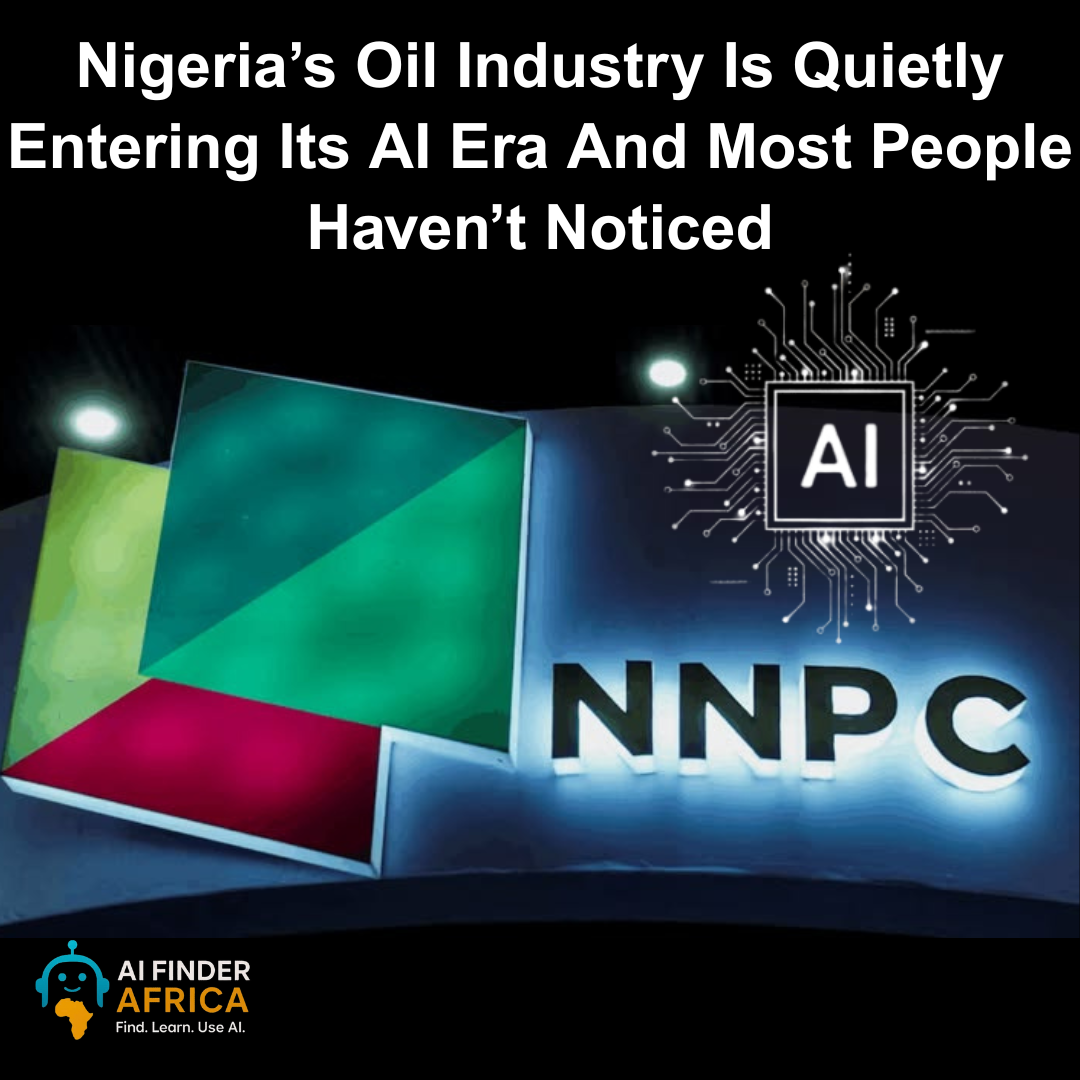
Nigeria’s Oil Industry Is Quietly Entering Its AI Era And Most People Haven’t Noticed
For decades, Nigeria’s oil and gas industry has operated like an old giant.
Powerful. Profitable. Critical to the economy. But also slow to change.
Now, something unusual is happening behind closed doors in Abuja. Artificial Intelligence is entering the conversation. And not just as another trendy tech buzzword.
The Nigerian National Petroleum Company Limited (NNPCL) and the Nigerian Institute of Petroleum and Gas Engineers (NIPetGE) are now openly pushing for the adoption of AI, robotics, IoT, and digital technologies across Nigeria’s energy sector. That may sound like a normal corporate meeting headline. It is not.
Because if this shift actually happens at scale, it could change how Nigeria discovers oil, monitors pipelines, predicts equipment failures, cuts operational costs, manages emissions, and even competes globally in the future energy economy. And perhaps for the first time in years, Nigeria’s oil sector is beginning to sound less like an old industry trying to survive and more like one trying to reinvent itself.
The Oil Industry’s Biggest Problem Isn’t Just Oil Anymore
The global energy industry is changing fast.
Countries are pushing cleaner energy. Investors are demanding sustainability. Technology is replacing traditional systems. And AI is becoming the new competitive advantage.
Around the world, energy companies are now using Artificial Intelligence for predictive maintenance, real-time monitoring, production optimization, safety systems, and data analysis. Nigeria does not want to be left behind.
That urgency became clear during a recent meeting between NNPCL executives and NIPetGE leaders in Abuja, where discussions focused heavily on digital transformation, sustainability, and the future of Nigeria’s hydrocarbon industry.
At the center of those discussions was one major idea: Building a smarter oil and gas sector powered by AI.
Imagine AI Watching Nigeria’s Pipelines in Real Time
Think about it for a second.
Nigeria loses billions yearly to pipeline vandalism, oil theft, equipment failures, operational inefficiencies, and shutdowns.
Now imagine an AI system capable of detecting pressure abnormalities before a leak happens.
Or drones monitoring remote pipelines automatically.
Or intelligent systems predicting equipment failure weeks before breakdowns occur.
Or decades of old geological data being digitally analyzed within minutes instead of months.
That is exactly the direction the industry appears to be moving toward.
According to reports, NIPetGE proposed the establishment of a National Centre for Intelligent Energy Systems to support the deployment of AI, robotics, and Internet of Things technologies throughout Nigeria’s petroleum value chain.
And honestly? That proposal alone could become one of the most important technology conversations in Nigeria’s energy sector over the next few years.
Nigeria Is Sitting on Decades of Untapped Data
One of the most interesting parts of this entire conversation is the data.
Nigeria has been drilling oil commercially since 1956.
That means the country is sitting on decades of geological records, seismic data, operational reports, drilling history, and production intelligence.
Much of it is still underused. Much of it is still trapped in outdated systems.
NNPCL recently revealed it is already exploring AI pilots and “digital mining” of historical industry data to improve efficiency and reduce production costs. And that is where things become interesting.
Because in today’s world, data is no longer just information. It is an asset.
The countries and companies that can properly analyze massive amounts of data will dominate future industries. Oil companies already understand this. Nigeria is now trying to catch up.
But There’s a Bigger Story Behind All This
This is not just about oil. It is about survival.
The global energy transition is accelerating.
Countries are reducing fossil fuel dependence. Carbon targets are becoming stricter. Investors increasingly care about sustainability. Energy companies are under pressure to modernize or risk becoming irrelevant.
That is why discussions during the Abuja meeting also included decarbonization, emissions trading systems, renewable energy partnerships, carbon capture projects, and hybrid energy initiatives.
In simple terms:
Nigeria’s oil industry is realizing that the future cannot run on old systems forever.
Technology is no longer optional. It is becoming necessary.
The Real Question Is Whether Nigeria Can Execute It
This is where Nigerians become skeptical. Because the country has heard ambitious plans before.
Digital transformation. Modernization. Innovation. Reforms.
The announcements are usually exciting. The execution is where problems begin. But AI may force a different outcome this time.
Why? Because the global industry itself is changing too fast for Nigeria to ignore.
Companies worldwide are increasing investment in AI infrastructure and intelligent operations across the energy sector. If Nigeria delays too long, competitors will simply move ahead. And in business, falling behind technologically eventually becomes expensive.
Nigeria’s Energy Future Might Depend on Technology More Than Oil
For years, Nigeria’s biggest energy discussions revolved around crude prices, fuel subsidies, refinery problems, and production targets. But the next chapter may look very different.The future conversation may revolve around:
Who owns the best data.
Who builds the smartest systems.
Who deploys AI fastest.
Who reduces waste most efficiently.
Who modernizes operations before everyone else.
And perhaps that is the real story here. Nigeria’s oil industry may finally be realizing that the future of energy is no longer just underground. It is digital.


 Explore