


A Japanese AI Startup Says It Can Rival Anthropic's Best Models Without Building a Bigger AI. Meet Fugu Ultra.
A Japanese AI Startup Says It Can Rival Anthropic's Best Models Without Building a Bigger AI. Meet Fugu Ultra.
For years, the AI industry has followed one rule:
Bigger is better. Bigger models. Bigger data centers. Bigger budgets.
And increasingly, bigger electricity bills.
Tech giants like OpenAI, Anthropic, Google, and xAI have spent billions building ever-larger AI systems in the race for artificial intelligence supremacy. But a Japanese startup believes there may be another way.
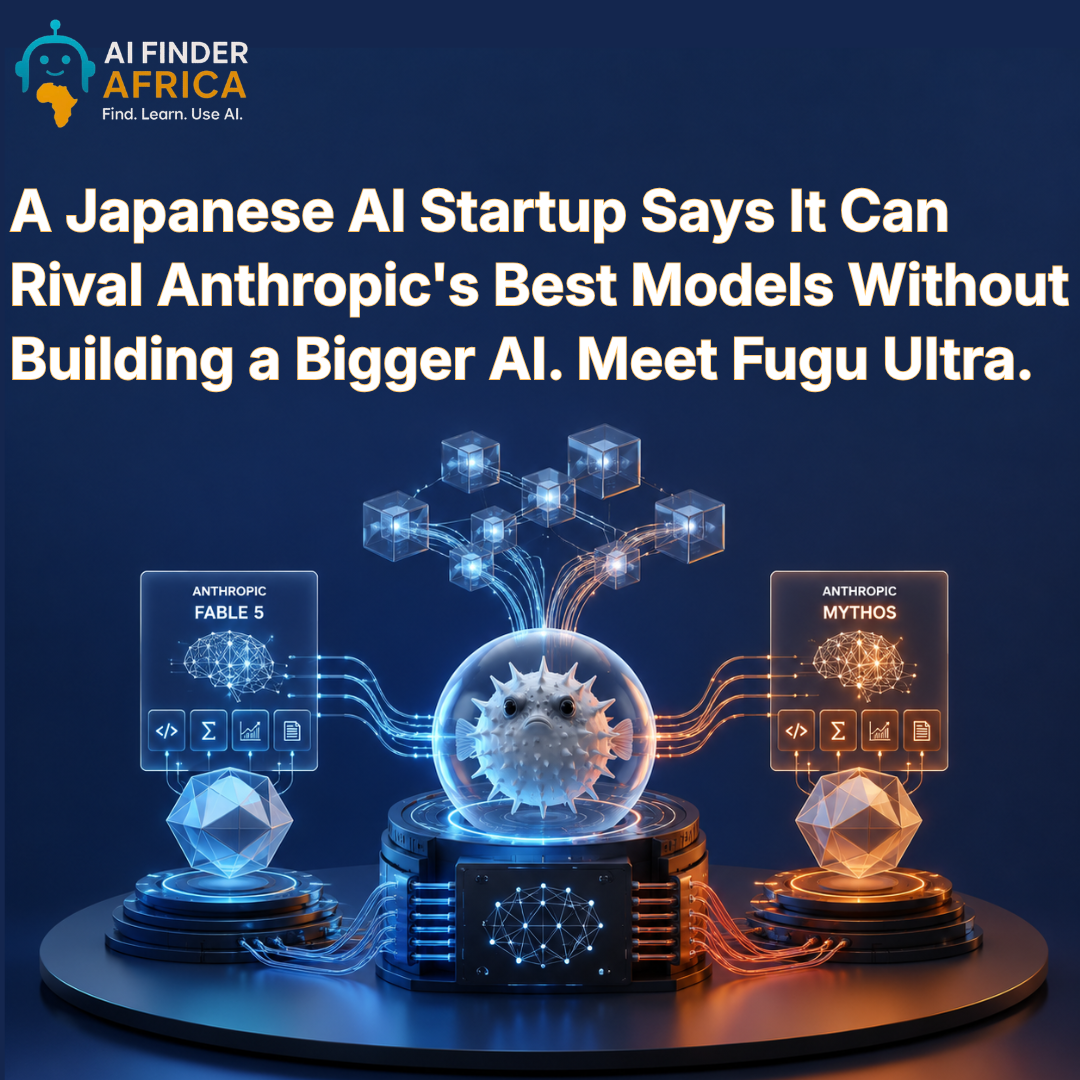
Instead of building a single gigantic AI brain, what if you could create a team of AI specialists that work together like experts solving a problem in the same room?
That is the idea behind Fugu Ultra, a newly launched AI system from Tokyo-based startup Sakana AI. And according to the company, the results are impressive enough to compete with some of the world's most advanced AI systems, including Anthropic's frontier models.
The AI Race May Be Changing
Most AI tools today rely on a single foundation model. When you ask ChatGPT a question, one model handles everything. The same principle applies to Claude, Gemini, and most leading AI systems.
Sakana AI thinks that is inefficient. Instead, Fugu Ultra operates more like an orchestra. Different AI agents handle different parts of a task, while a central "conductor" coordinates the entire process. The company calls this approach multi-agent orchestration.
Think of it this way:
If you were building a house, you would not ask one person to be the architect, engineer, electrician, plumber, and interior designer all at once. You'd assemble a team. Sakana believes AI should work the same way.
What Exactly Is Fugu Ultra?
Fugu Ultra is not a traditional AI model. That's an important distinction.
According to Sakana AI, Fugu Ultra uses a smaller language model that acts as a coordinator. It determines which specialized AI models should tackle different parts of a problem, combines their outputs, and delivers a final response.
In practical terms, it functions as an intelligent AI manager. Instead of relying on one model to do everything, it dynamically builds teams of AI agents and assigns work based on their strengths.
The system can adapt its workflow in real time depending on the complexity of the problem, making it particularly useful for coding, mathematics, scientific reasoning, and software engineering tasks.
The Big Claim Turning Heads
The reason Fugu Ultra is generating buzz across the AI industry is simple. Sakana AI claims the system can achieve performance levels comparable to frontier AI systems from leading labs.
In benchmark results published by the company, Fugu Ultra posted strong scores on GPQA-D, LiveCodeBench, and SWE-Pro, three respected evaluations that test advanced reasoning, coding ability, and software engineering performance.
According to the published benchmarks:
GPQA-D: 95.1
LiveCodeBench v6: 93.2
SWE-Pro: 54.2
These scores place it alongside or slightly ahead of several leading frontier AI systems on certain tests. That is a remarkable achievement for a company that is not trying to build the biggest AI model in the world.
But There is an Important Catch
Before anyone declares that Sakana AI has surpassed OpenAI or Anthropic, there is a crucial detail.
Fugu Ultra is not a standalone foundation model. It is an orchestration system.
In other words, it coordinates multiple AI models rather than replacing them.
Many AI researchers and developers have pointed out that Fugu's performance comes from intelligently combining the strengths of several models rather than creating a brand-new model that independently exceeds frontier systems. That's not necessarily a weakness.
In fact, it may be the point. The question Sakana AI is asking isn't:
"Can we build a bigger AI?"
Instead, it's asking:
"Can we make existing AI systems work together more effectively?"
Why This Matters for the Future of AI
The launch of Fugu Ultra highlights a growing trend in artificial intelligence. For years, progress was measured largely by scale.
More parameters. More compute. More data.
But many researchers now believe the next breakthrough could come from coordination rather than size. If a team of specialized AI agents can outperform a single giant model, it could dramatically change how future AI systems are built.
Instead of spending billions training ever-larger models, companies may focus on creating smarter ways for multiple systems to collaborate. That is exactly the future Sakana AI is betting on.
The Bigger Picture
Sakana AI has built its reputation around the concept of "collective intelligence," the idea that intelligent systems can become more capable by working together.
Fugu Ultra is perhaps the clearest demonstration of that philosophy yet. Whether multi-agent orchestration becomes the dominant AI architecture remains uncertain.
But one thing is clear: The industry is beginning to explore alternatives to the "bigger is always better" mindset. And if Sakana AI's results hold up in real-world applications, the future of artificial intelligence may not belong to a single super-intelligent model. It may belong to a team.
Final Thoughts
Fugu Ultra is not just another AI launch. It is a challenge to one of the biggest assumptions in modern AI. Instead of building a bigger brain, Sakana AI is building a better team.
And while the company's claims will continue to be scrutinized by researchers and competitors alike, the launch signals something important:
The next major leap in AI may come not from making models larger, but from teaching them how to work together.



 Explore