


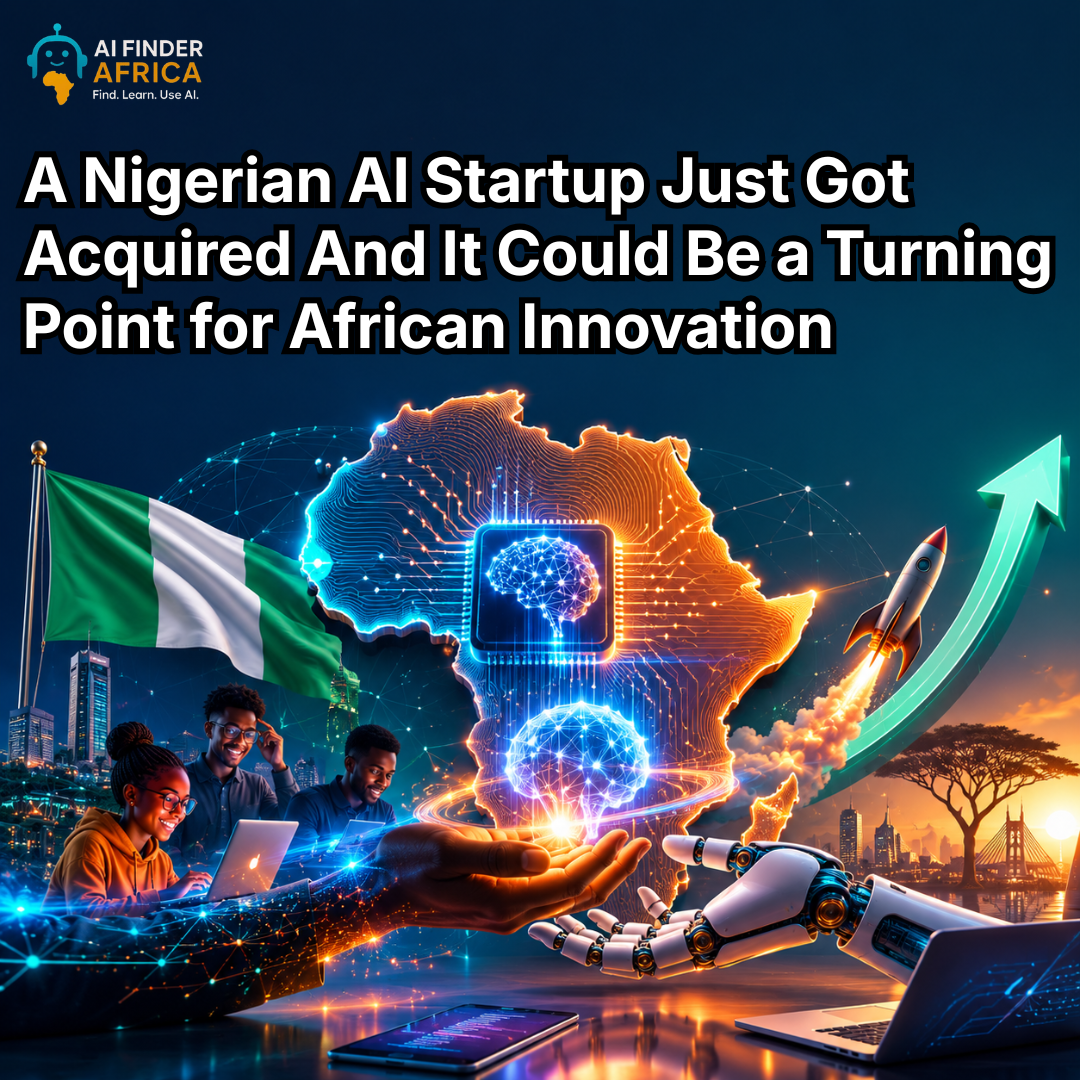
A Nigerian AI Startup Just Got Acquired And It Could Be a Turning Point for African Innovation
A Nigerian AI Startup Just Got Acquired, And It Could Be a Turning Point for African Innovation
For years, the global AI conversation has been dominated by Silicon Valley.
OpenAI. Google. Anthropic. Microsoft.
But something remarkable just happened in Nigeria that suggests Africa's AI story may be entering a new chapter.
A local AI startup that many people had never heard of a few years ago has just been acquired by one of Africa's leading technology companies. And it was not building another ChatGPT clone. It was teaching artificial intelligence how to sound Nigerian.
The Acquisition That Turned Heads
Bluechip Technologies, a pan-African technology company with operations across multiple African countries, has officially acquired Nigerian AI startup YarnGPT. The announcement was made during the 2026 Bluechip Data and AI Summit in Lagos by the company's co-founder and CEO, Kazeem Tewogbade.
At first glance, it may seem like just another startup acquisition. But many industry observers believe it represents something much bigger. It signals that African-built AI products are beginning to attract serious commercial attention.
And perhaps more importantly, it proves that solving local problems can become a powerful business opportunity.
Meet the Startup That Wanted AI to Sound More Nigerian
Most popular AI voice tools today were built using data primarily collected from Western users.
As a result, many struggle with African accents, local expressions, and indigenous languages. That's where YarnGPT saw an opportunity.
Founded by University of Lagos graduate Saheed Azeez, YarnGPT developed a text-to-speech platform capable of reading text in Nigerian-accented English as well as indigenous languages, including Yoruba, Igbo, and Hausa.
Instead of forcing Nigerians to adapt to foreign AI systems, YarnGPT adapted AI to Nigerians. That simple idea may have changed everything.
The Story Gets Even Better
What makes this acquisition especially inspiring is where it all started.
In 2023, Saheed Azeez participated in the Bluechip Data and AI Hackathon.
He did not even win first place. He finished as the first runner-up.
Most hackathon projects disappear after the event ends. But YarnGPT did not. The idea kept growing. The technology improved. The vision became clearer.
And now, just a few years later, the same company that hosted the competition has acquired the startup. It is the kind of founder story that many aspiring African innovators dream about.
Why This Matters Beyond One Startup
The acquisition is significant because it highlights a major shift happening in African technology.
For a long time, Africa's role in the tech ecosystem was often viewed as that of a consumer.
Technology was built elsewhere and imported into African markets. But artificial intelligence is creating an opportunity to change that narrative.
AI systems become more valuable when they understand local languages, cultures, accents, and behaviors. That is something global companies often struggle to achieve at scale.
Local founders, however, understand these realities naturally.
YarnGPT is a perfect example.
It was not trying to compete directly with OpenAI or Google. It was solving a uniquely African problem. And that approach appears to be paying off.
Bluechip's Bigger AI Ambition
The acquisition also reveals Bluechip Technologies' growing AI strategy.
According to the company, YarnGPT joins an expanding ecosystem that already includes products such as Bluechip Data Platform, Cribro, BluPrime, and CashComplete.
For Bluechip, the move represents a transition from simply offering AI-enabled services to owning AI products. That is an important distinction.
Owning intellectual property allows companies to create long-term value while building technology specifically designed for African markets.
Africa's Biggest AI Advantage Isn't Money
During discussions at the summit, several speakers pointed out a reality many people already know.
Africa may not yet have the trillion-dollar AI infrastructure budgets seen in the United States or China. But it has something equally valuable.
Talent. Young, ambitious, creative talent.
Bluechip co-founder Olumide Soyombo emphasized that Africa's greatest opportunity in the AI race lies in its people rather than massive data center investments. And YarnGPT may be evidence that this strategy works.
A young Nigerian founder identified a local problem, built a solution, gained recognition, and eventually attracted acquisition interest from a major technology company. That is exactly how innovation ecosystems are built.
A Glimpse Into Africa's AI Future
The real significance of this story is not the acquisition itself. It is what it represents. It shows that African founders do not need to copy Silicon Valley to succeed.
They do not need to build the next ChatGPT. They do not need to chase every global trend.
Instead, they can focus on creating AI solutions that understand African realities better than anyone else. Whether that is language technology, healthcare, education, agriculture, finance, or government services, the opportunity is enormous.
YarnGPT's journey suggests that the future of African AI may belong to startups that solve local problems exceptionally well.
The Bottom Line
The acquisition of YarnGPT by Bluechip Technologies is more than a business deal. It is a signal. A signal that African AI innovation is maturing.
A signal that investors and technology companies are beginning to recognize the value of locally developed AI products. And a signal to thousands of young African builders that world-class innovation can emerge from their own communities.
Just a few years ago, YarnGPT was a hackathon project. Today, it is an acquisition success story. Tomorrow, it could become one of many examples proving that Africa is not just participating in the AI revolution. It is helping shape it.


 Explore