


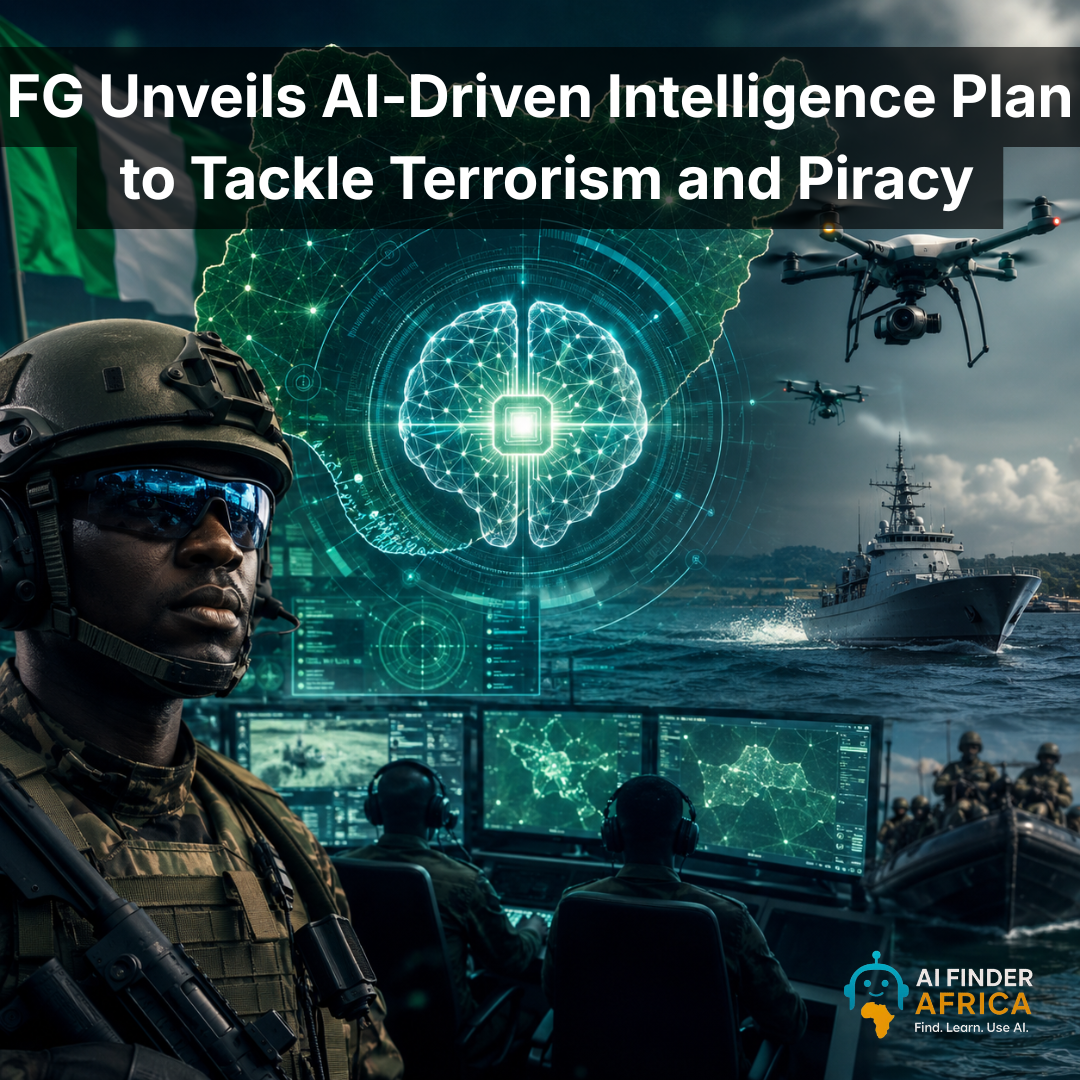
FG Unveils AI-Driven Intelligence Plan to Tackle Terrorism and Piracy
Picture this: A drone floats silently over the Sambisa Forest. No pilot. No crew. Just algorithms scanning the treeline in real time, flagging heat signatures, cross-referencing known threat patterns, and beaming actionable intelligence to a command centre hundreds of kilometres away, all before a soldier even picks up a radio.
This isn't a Hollywood script. It's what Nigeria is now actively building toward.
Monaco, of All Places
While most defence deals are quietly signed in anonymous conference rooms, Nigeria's Minister of Defence, Gen. Christopher Musa (Rtd), flew to Monaco last week to watch the future of Nigerian security play out in live demonstrations.
Standing beside officials from MARSS UK Ltd and their Nigerian partner MPS Mikopowers Ltd, he watched radar systems lock onto threats, AI algorithms identify them in milliseconds, and drone-interception technology neutralize unmanned aerial intruders in real time. The project has a name that sounds straight out of a military thriller: the Multi-domain Hybrid Intelligence Shield or HIS. And Nigeria wants it.
What Exactly Is the HIS?
Think of it as a nervous system for national security. The HIS isn't just one gadget, it's an entire ecosystem of interconnected technologies designed to give Nigeria's military something it has historically lacked: real-time situational awareness across multiple domains simultaneously.
Here's what's on the table:
- AI-powered threat identification algorithms that detect and classify threats faster than any human analyst
- Radar detection systems capable of tracking movement across borders, coastlines, and airspace
- Anti-drone technology, because the next wave of attacks won't always involve humans
- National and regional command-and-control centres nerve hubs that coordinate responses across agencies in real time
- Mobile response units rapid-reaction capability that doesn't wait for orders to trickle down the chain of command.
Why Now? Because Nigeria Is Running Out of Time
Here's the uncomfortable truth: Nigeria's security situation has been deteriorating fast.
Between January 1 and February 10 of this year alone, over 1,258 people were killed in violence across the country. That's a Vanguard-reported figure, and it covers barely six weeks.
In the North-East, Boko Haram and its splinter group, ISWAP, continue their insurgency a conflict that has raged since 2009 and has refused every declaration of victory. In December 2025, the United States launched over a dozen Tomahawk cruise missiles from a Navy ship in the Gulf of Guinea, striking terrorist enclaves in Sokoto State. The fact that American missiles had to fly to solve a Nigerian security problem tells you something.
In the North-West, a terrifying new group called Lakurawa has emerged, reportedly a hybrid of jihadists and criminal bandits who fund their operations through kidnapping. In November 2025, at least 402 people, mostly schoolchildren, were abducted across four northern states in a single month. That surpassed the 2014 Chibok kidnapping in scale.
The Niger Delta remains volatile. Crude oil theft, renewed militancy, and piracy in the Gulf of Guinea, which analysts describe as the world's most dangerous maritime zone, continue to bleed Nigeria's economy.
And in the South-East, armed groups enforcing what was once a crippling "sit-at-home" order have kept communities on edge, even as those orders have largely ended. Nigeria isn't fighting one war. It's fighting seven simultaneously, across six geopolitical zones, against enemies who don't wear uniforms.
The Real Problem Isn't Courage, It's Intelligence
Here's what military analysts have been saying for years: Nigeria's soldiers are brave. The problem is they often don't know the enemy is coming until it's too late.
A recent Premium Times investigation laid bare that Nigeria's early-warning systems are weak, information sharing between agencies is poor, and local communities, who often see suspicious activity days before an attack, have no reliable channel to report it. By the time intelligence reaches the right commander, the window has closed.
In Borno in 2025, Boko Haram overran more than 15 military outposts. The ambush that killed Brigadier General Musa Uba, a convoy commander on patrol, suggested that his movements had been tracked by the insurgents, possibly using informants. The military, meanwhile, had no warning. That's not a manpower problem. That's a data problem. And that's precisely what the HIS is designed to fix.
"The Strategic Brain of the Nation"
General Musa described the Ministry of Defence as "the strategic brain of the nation's defence architecture", and he's right. The problem is that for years, the brain has been operating without adequate sensory inputs.
The HIS would change that. Radar systems that never sleep. AI that processes threat data at machine speed. Drone interception that doesn't require a manned aircraft to scramble. Command centres where every agency sees the same picture at the same time.
The proposal also includes something rarely emphasized in Nigerian defence deals: technology transfer. Not just buying equipment that requires foreign technicians to maintain, but building local capacity to understand, operate, and eventually produce similar systems in Nigeria. That's the Centre of Excellence piece. Training Nigerian engineers, military officers, and doctrine writers so that HIS isn't a rental, it's a foundation.
The Questions Worth Asking
Is this the silver bullet? Probably not. Nigeria has signed defence agreements before. It has purchased equipment before. And insecurity has persisted.
The deeper structural issues, such as poverty, governance failures, porous borders, and marginalized communities with legitimate grievances, don't disappear when you install better radar. As security analysts have noted, terror groups have embedded themselves within communities so deeply that they've built their own intelligence networks that sometimes rival the state's. Technology amplifies capability. It doesn't replace political will.
There are also legitimate questions about civil liberties. Digital surveillance infrastructure, once built, rarely stays narrowly targeted. How it's governed, who oversees it, and what safeguards prevent misuse will matter enormously, especially in a country where past security operations have drawn allegations of abuse.
But Here's Why It Matters Anyway
Despite those caveats, the direction is right. Nigeria has been fighting asymmetric, multi-domain threats with largely conventional tools. Boots on the ground against enemies who use encrypted phones, drone reconnaissance, and sophisticated kidnapping logistics.
The HIS represents a fundamental rethink: that national security in the 21st century requires 21st-century infrastructure.
And for a country with over 230 million people, the world's largest Black population, and a coastline that borders the globe's most piracy-prone waters, getting this right doesn't just matter for Nigeria. It matters for the entire West African region. The question is no longer whether Nigeria needs a technological upgrade to its security architecture.
The question is whether the execution will match the ambition. Watch this space.




 Explore